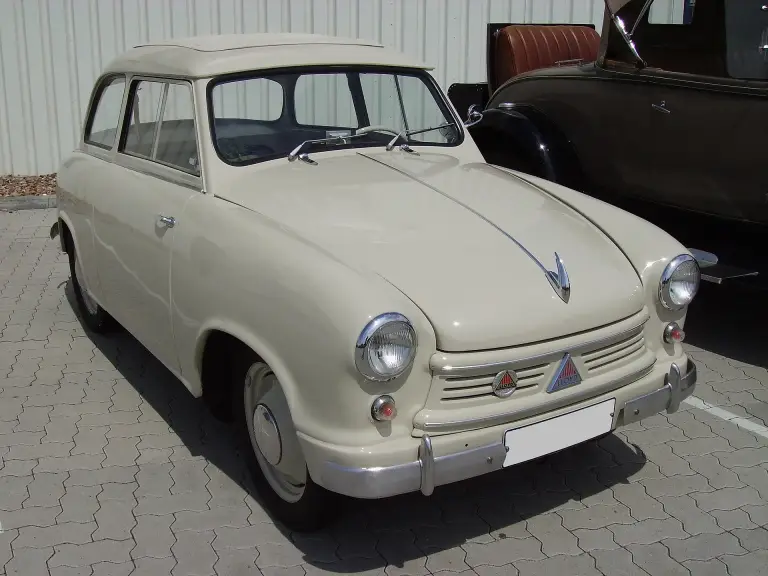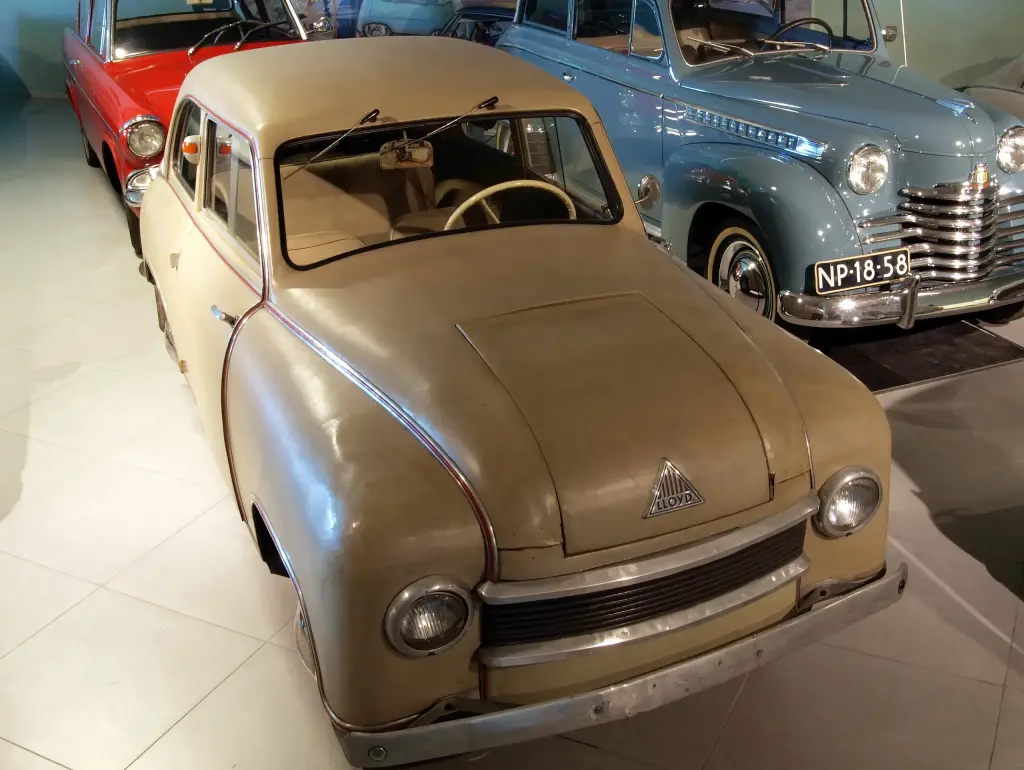
The Lloyd LP 300 was a small car built by the Borgward Group’s Lloyd Motoren Werke in Bremen between 1950 and 1952. Its two-letter prefix named the body shape: LP for the saloon, LC for the coupé, LS for the estate and LK for the panel van. At DM 3,334 it undercut the Volkswagen Beetle by more than a thousand marks.
Lloyd LP 300 at a glance
| Maker | Lloyd Motoren Werke GmbH, Bremen (Borgward Group) |
|---|---|
| Production | 1950–1952 |
| Body styles | LP 300 saloon, LC 300 coupé, LS 300 estate, LK 300 panel van |
| Engine | 293 cc air-cooled transverse twin, two-stroke |
| Power | 10 PS (7.4 kW) at 4,000 rpm |
| Top speed | 75 km/h (47 mph) |
| Drive | front wheels, three-speed gearbox without synchromesh |
| Fuel | petrol mixed 25:1 with oil, 18-litre tank |
| Suspension | independent front on transverse leaf springs, swing axle at the rear |
| Price at launch | DM 3,334 (May 1950) |
| Built | 18,087 |
Based on one source: the English Wikipedia article on the Lloyd 300.
History of the Lloyd LP 300
Launch and body styles
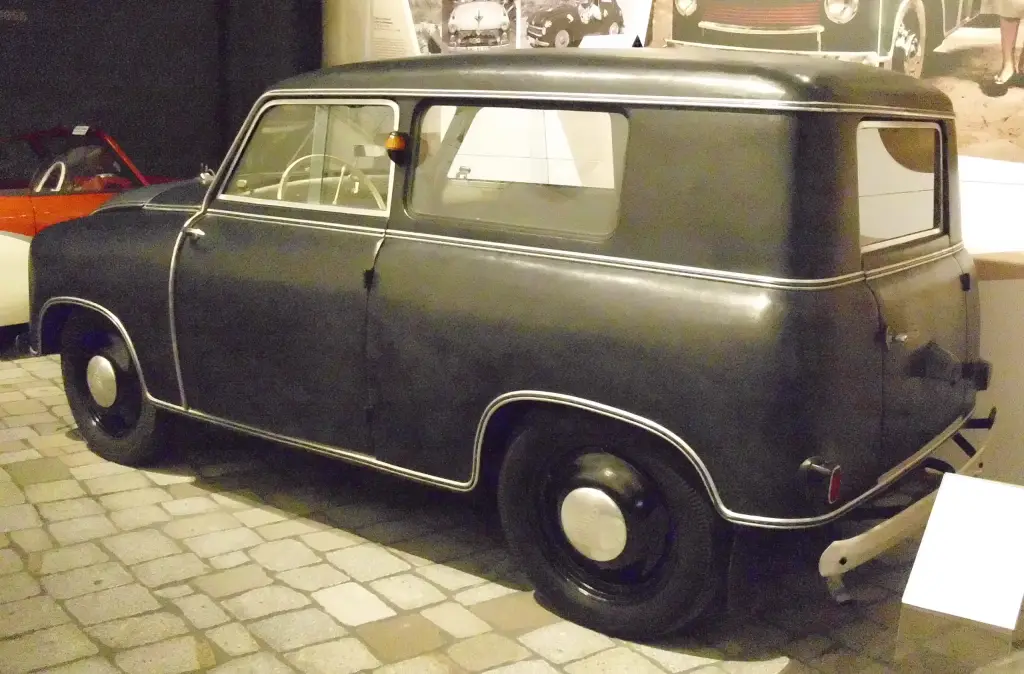
The LP 300 saloon was released in May 1950; the LC 300 coupé and the LS 300 estate followed early in 1951, and a panel van, the LK, completed the range. The full name carried a two-letter prefix that identified the body: LP was said to stand either for Limousine-Personenwagen or for Lloyd Personenwagen.
Engine and chassis
Power came from a transversely mounted air-cooled twin of 293 cc with a Solex 30 BFRH carburettor, giving 10 PS at 4,000 rpm and a claimed 75 km/h. The engine ran on petrol mixed 25:1 with oil, like a motorcycle, and the 18-litre tank shared the space under the front lid with the engine and a six-volt battery. Drive went to the front wheels through a three-speed gearbox without synchromesh. Borgward had contracted the engine and transmission package to INKA in Hude, a firm of engineers who had previously worked for Auto Union, and the resemblance to the pre-war DKW F8 was obvious from the driver’s seat.
The steering was rack and pinion, needing 2¼ turns between locks and giving an 11 m turning circle. The front wheels were suspended independently on two transverse leaf springs; at the back there was a swing axle on semi-elliptical leaf springs. Shock absorbers could be ordered from January 1952 for DM 70. The brakes worked through a cable linkage, and the mechanical handbrake acted on all four wheels.
Timber, plywood and synthetic leather
The four-seater body sat on a tubular steel chassis and was built from a timber and plywood frame covered in synthetic leather. That avoided the heavy presses and dies that steel panels would have required, and it reflected the steel shortage of the period. Some said the skin concealed imperfections in the timber frame, and the car quickly earned the nickname “Leukoplastbomber”, after the surgical tape that was supposedly suitable for repairing it. The doors were hinged at their rear edge, the windows slid open horizontally, and luggage had to be reached over the back seat because there was no rear hatch. The very narrow bonnet was widened at the end of 1951.
Commercial life
The Lloyd was advertised at DM 3,334 in May 1950 against DM 4,600 for a Beetle, although the two cars were in different classes. By February 1952 the price had risen to DM 3,664 while the Beetle had come down to DM 4,400, and Volkswagen’s scale advantage kept eroding the gap. Production reached 9,981 Lloyd cars in 1952, against 114,348 Beetles that year. By the end of 1952, when the Lloyd 400 took over, 18,087 of the earlier cars had been built.
Design and features
- Two-stroke twin: 293 cc, air-cooled and mounted transversely ahead of the front axle.
- Front-wheel drive: with a three-speed gearbox and no synchromesh.
- Timber-framed body: plywood and synthetic leather instead of pressed steel.
- Low price: DM 3,334 at launch, well below the Volkswagen Beetle.
- Nickname: the “Leukoplastbomber”, after the sticky tape of the era.
Lloyd LP 300 versions
- LP 300 (1950–1952): the four-seater saloon and the mainstay of production.
- LC 300 (1951–1952): the coupé version.
- LS 300 (1951–1952): the estate, or Stationswagen.
- LK 300: the Kastenwagen panel van.
- 1952 specification: optional shock absorbers and a wider bonnet.
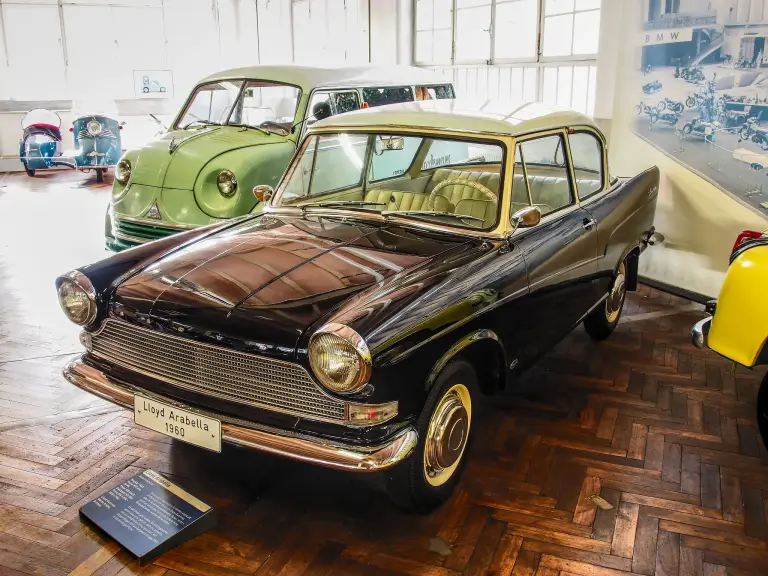
The LP 300 was replaced by the Lloyd 400, which in turn gave way to the four-stroke Lloyd 600. The Arabella was the last Lloyd. More cars are in the Lloyd collection.
Sources
- Lloyd 300, English Wikipedia: engines, body, prices, production