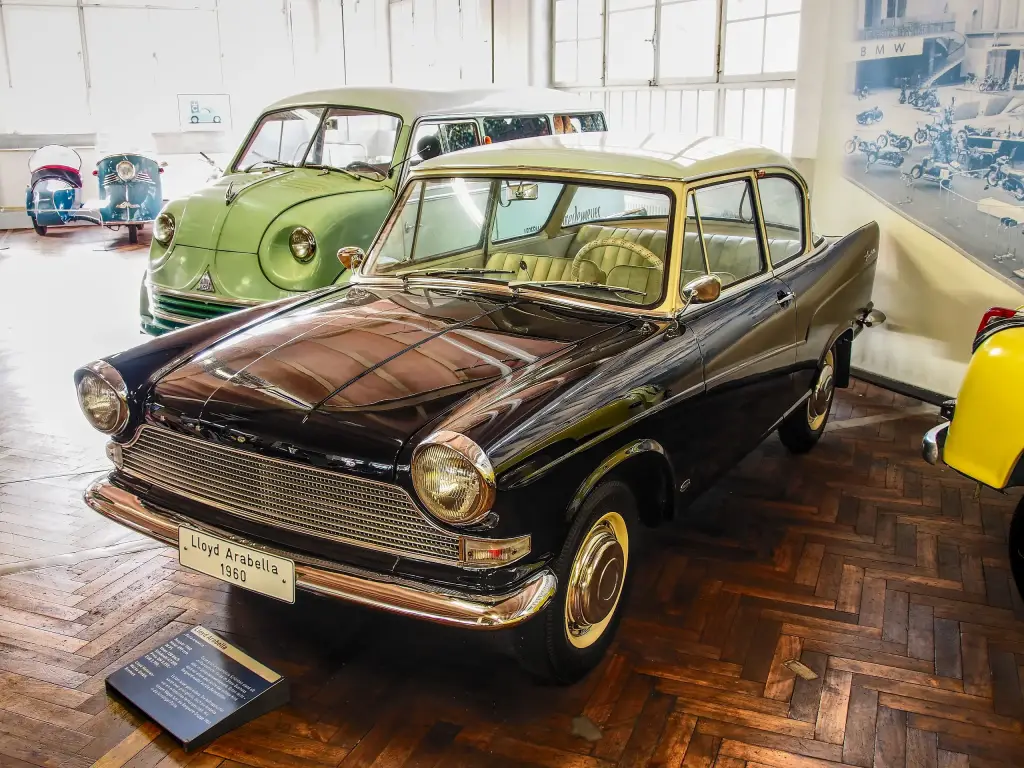
The Lloyd Arabella was built by the Borgward Group in Bremen from 1959 to 1961, and as the Borgward Arabella until 1963 after the group’s bankruptcy. It was the first and last Lloyd with a four-cylinder engine, and the first Lloyd with a fully modern all-steel body. Developed in only 23 months, it carried the hopes of the marque for barely two years.
Lloyd Arabella at a glance
| Maker | Lloyd Motoren Werke, Bremen; Borgward Arabella from 1961 |
|---|---|
| Production | 1959–1961 as Lloyd, until 1963 as Borgward |
| Engine | 897 cc water-cooled flat-four, longitudinally mounted |
| Power | 38 PS at 4,800 rpm; 34 PS in the 1960 economy version; 45 PS in the de Luxe |
| Top speed | 120 km/h; 133 km/h in the de Luxe |
| Acceleration | 0–100 km/h in 28 seconds; 23 seconds in the de Luxe |
| Drive | front wheels, gearbox ahead of the front axle |
| Suspension | double wishbones and coil springs at the front, trailing arms, coil springs and anti-roll bar at the rear |
| Brakes | hydraulic, four light-alloy 200 mm drums |
| Tyres | tubeless on 13-inch wheels |
| Steering | rack and pinion, 3.36 turns, 10.7 m turning circle |
| Body | all-steel four-seater with wrap-around rear window and tail fins |
Based on one source: the English Wikipedia article on the Lloyd Arabella.
History of the Lloyd Arabella
A new design in 23 months
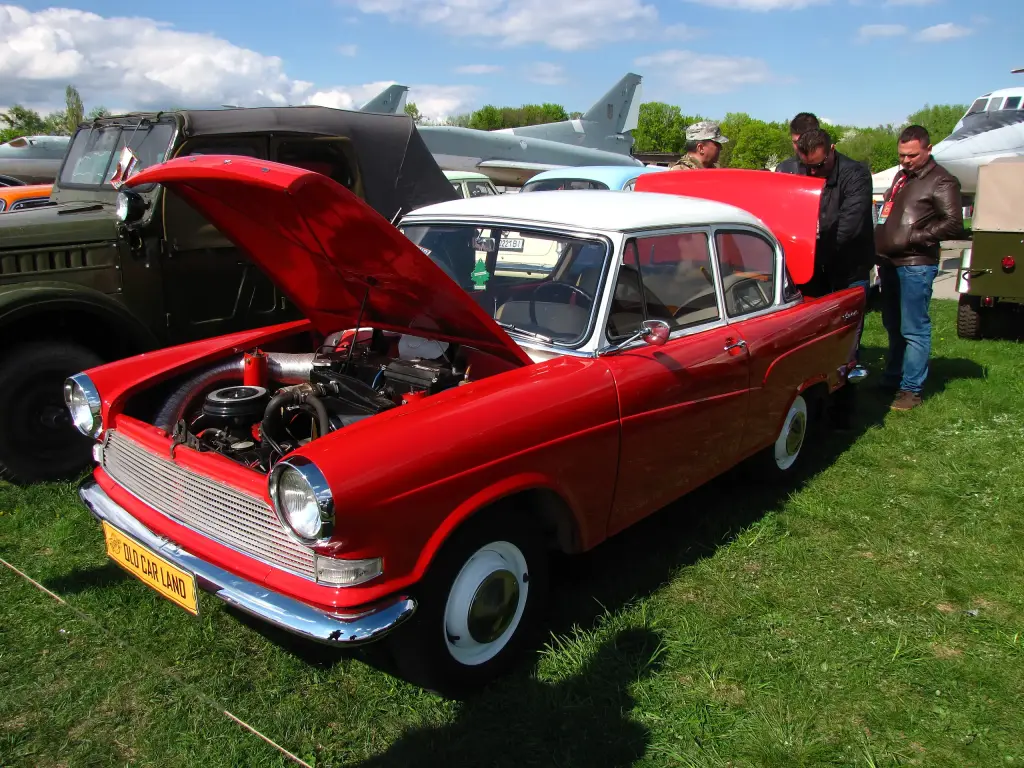
The Arabella was a completely new car, owing nothing to the Lloyd Alexander it first complemented and then replaced. It was developed in 23 months, a period later commentators thought far too short to sort out the car’s teething troubles before launch. The chassis was a tubular steel frame with cross members, and the all-steel body followed the styling trends of the day with a wrap-around rear window and tail fins. There was room for four, though headroom in the back was restricted.
Engine and running gear
The plan had been to use an uprated version of the Alexander’s two-cylinder four-stroke, but testing showed it would not fit under the finished bonnet, so a four-cylinder boxer was hastily developed. Its flat layout suited the low bonnet line, though the cooling fan had to be squeezed above the cylinders on the left, and unlike the smaller Lloyds the Arabella used water cooling. The engine sat longitudinally with the gearbox ahead of the front axle. Front suspension was by double wishbones with coil springs and telescopic shock absorbers; the rear used trailing arms, coil springs and an anti-roll bar. The hydraulic brakes had four light-alloy 200 mm drums, the handbrake worked on the rear wheels, and the 13-inch wheels wore tubeless tyres, then an innovative specification. Rack and pinion steering needed 3.36 turns between locks.
Safety and practicality
The sales material made much of passive safety: a two-spoke steering wheel with a recessed hub, rounded door handles, locks on the front seat backs to stop them tilting forward, a padded dashboard and padded window frames. By the standards of the class the Arabella was a step forward in crashworthiness. The spare wheel was stowed externally below the luggage compartment, so it could be reached without emptying the boot.
Three engines in two years
At launch in August 1959 the 897 cc engine gave 38 PS at 4,800 rpm. A major price rise during 1960 was softened by a cut-price model in July 1960, with the same engine detuned to 34 PS at 4,700 rpm. In October 1960 came the Arabella de Luxe: compression raised from 7.5:1 to 9:1, a larger Solex 34 PCI carburettor in place of the 28 mm unit, and 45 PS at 5,300 rpm. Top speed rose from 120 to 133 km/h and the 0–100 km/h time fell from 28 to 23 seconds, well ahead of the contemporary Volkswagen’s 112 km/h and 38 seconds. The de Luxe wore a revised grille with the Borgward rhombus and carried the name Borgward on its nose, although the car was only formally rebranded in 1961.
The end of Lloyd
After the Borgward group’s controversial bankruptcy the Arabella continued in greatly reduced quantities as the Borgward Arabella until 1963. It was the only four-cylinder car the Lloyd division ever built.
Design and features
- Water-cooled flat-four: 897 cc, the only four-cylinder engine in a Lloyd.
- All-steel body: wrap-around rear window and tail fins, with a four-seat cabin.
- Modern chassis: double wishbones at the front, trailing arms and an anti-roll bar at the rear.
- Passive safety: recessed steering hub, padded dashboard, rounded handles and seat-back locks.
- Externally stowed spare: reachable without unloading the boot.
Lloyd Arabella versions
- Arabella (1959–1960): 897 cc, 38 PS, 120 km/h.
- Economy Arabella (from July 1960): detuned to 34 PS after the price rise.
- Arabella de Luxe (from October 1960): 45 PS, 133 km/h, higher compression and a larger carburettor.
- Borgward Arabella (1961–1963): the rebranded car built after the bankruptcy.
The Arabella replaced the Lloyd 600 and Alexander, the last of the two-cylinder Lloyds that grew out of the Lloyd 400 and the Lloyd LP 300. More cars are in the Lloyd collection.
Sources
- Lloyd Arabella, English Wikipedia: design, engines, chassis, safety, production