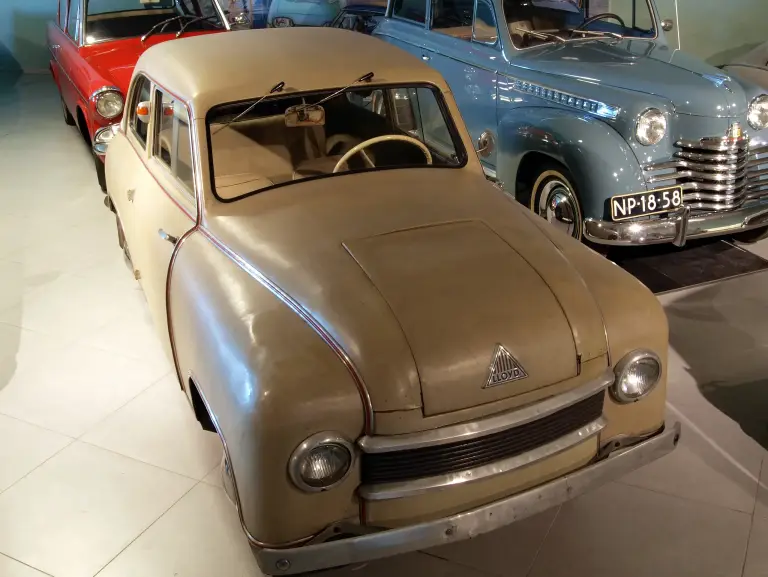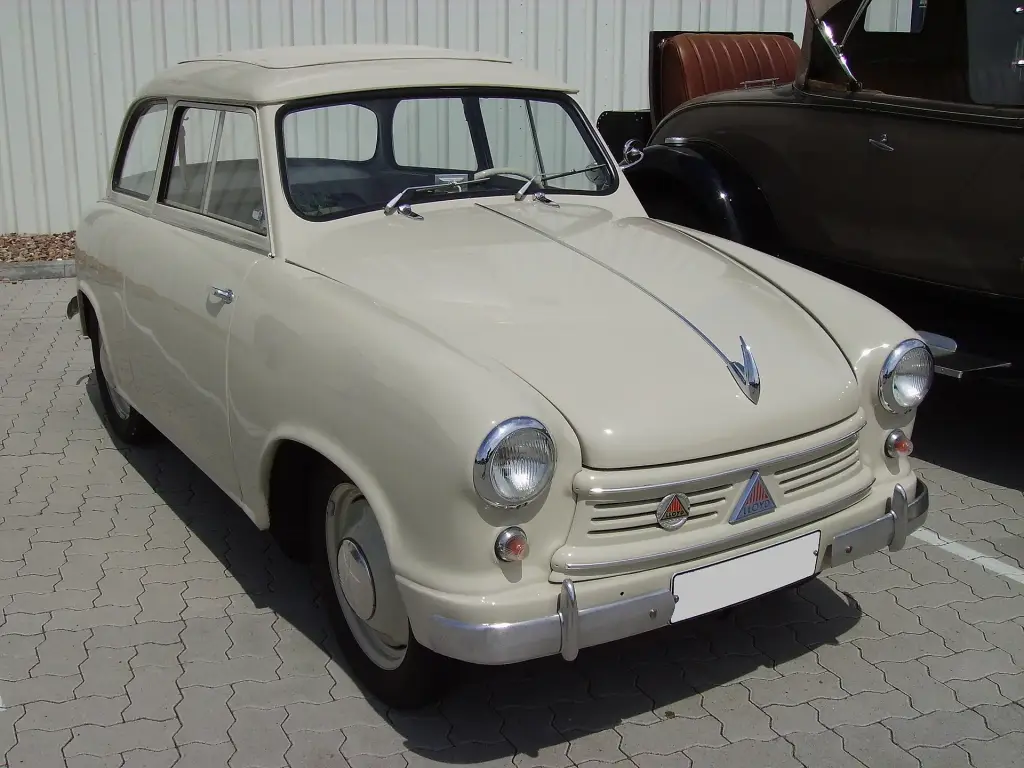
The Lloyd 400 was produced by the Borgward Group’s Lloyd Motoren Werke in Bremen between 1953 and 1957. It was an upgraded Lloyd 300 with a larger engine, and during its life the body changed from a timber frame covered in synthetic leather to bolted steel panels. Lloyd production peaked at 47,903 cars in 1955, the group’s best year.
Lloyd 400 at a glance
| Maker | Lloyd Motoren Werke GmbH, Bremen (Borgward Group) |
|---|---|
| Production | 1953–1957 |
| Body styles | LP 400 saloon, LK 400 panel van, LS 400 estate, LC 400 cabriolet saloon from 1955 |
| Engine | 386 cc air-cooled twin, two-stroke |
| Power | 13 PS (9.6 kW) at 3,750 rpm |
| Top speed | 75 km/h (47 mph) |
| Drive | front wheels, three-speed gearbox without synchromesh |
| Fuel | petrol mixed 25:1 with oil, 25-litre tank |
| Brakes | cable operated at first, hydraulic from March 1953 |
| Price | DM 3,780 for the LP 400 in 1953; DM 3,350 by September 1955 |
| Built | production of the Lloyd brand peaked at 47,903 cars in 1955 |
Based on one source: the English Wikipedia article on the Lloyd 400.
History of the Lloyd 400
The Lloyd 400 (1953–1957)
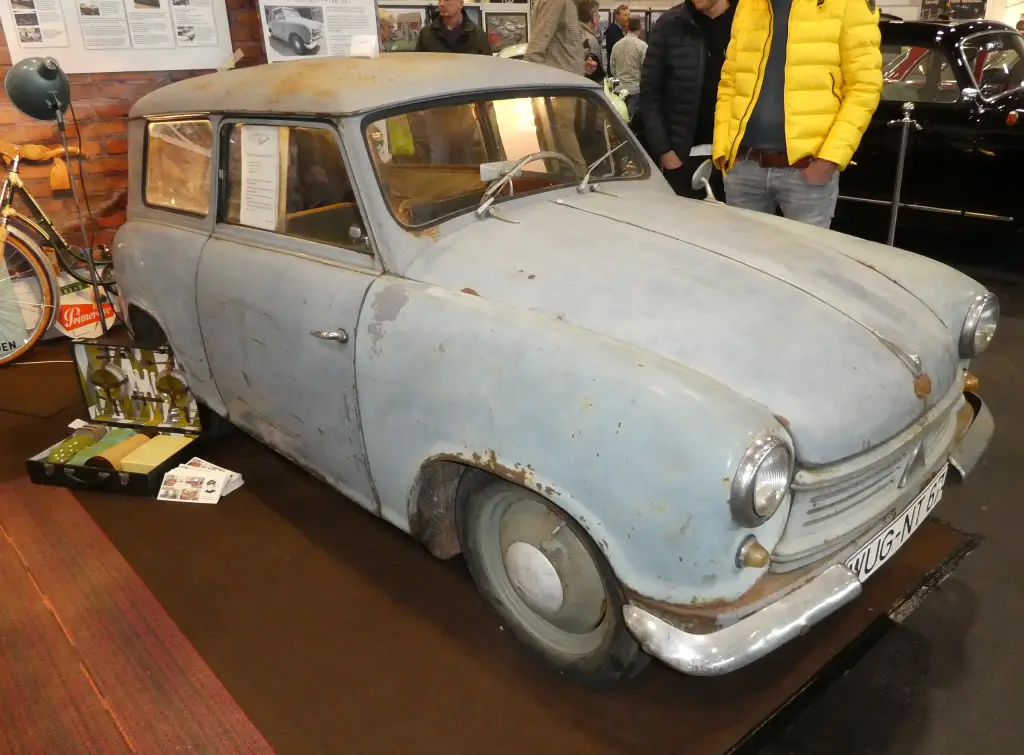
The 400 was an upgraded Lloyd 300 and kept the two-letter body prefixes: LP 400 for the saloon, LK 400 for the panel van and LS 400 for the estate. From 1955 an LC 400 cabriolet saloon joined the range. The engine was the air-cooled twin two-stroke with a Solex 30 BFRH carburettor, its bore increased by 8 mm to 62 mm, which raised capacity to 386 cc and output to 13 PS at 3,750 rpm. The top speed was quoted as 75 km/h, but the car was considerably quicker than its predecessor. The 25-litre tank again shared the front compartment with the engine and the six-volt battery, and the three-speed gearbox had no synchromesh.
The chassis followed the 300: rack and pinion steering with 2¼ turns between locks and an 11 m turning circle, independent front suspension on two transverse leaf springs, and a swing axle at the rear on semi-elliptical springs. Braking developed through three phases: the first cars had 180 mm drums with a cable linkage, hydraulic operation arrived in March 1953, and from August 1955 the drums grew to 200 mm. The mechanical handbrake worked on the front wheels.
From synthetic leather to steel
The car was launched with the timber frame and synthetic-leather skin of the 300, but after about 1,000 cars the wing panels were replaced with steel in March 1953. From January 1954 the bonnet and boot lids were steel as well, and cars built after November 1954 had a steel roof, recognised by the larger curved rear window. Lloyd still had no heavy presses of its own, so panels were bought in bare metal and finished, assembled and painted in Bremen. Most cars were LP 400 saloons; the LS 400 estate and LK 400 panel van were also available, and the doors were hinged at the rear edge in every case.
Prices and the Volkswagen yardstick
In 1953 the LP 400 was listed at DM 3,780 and the estate at DM 3,970; by September 1955 the saloon was down to DM 3,350 and the estate to DM 3,480. Volkswagen set the benchmark for the class, cutting its standard model from DM 4,150 to DM 3,950 in March 1954 and to DM 3,790 in August 1955, a price it held until 1961. Borgward went the other way, offering three brands and a wider range than any other West German maker; in 1955 the group built 91,810 passenger cars and Lloyd’s 47,903 accounted for more than half of them. The Lloyd 400 was considered a commercial success despite the price pressure.
The Lloyd 250
In April 1956 Lloyd added a stripped budget version, the Lloyd 250. Hub caps and bumpers were deleted and there was no backrest for the rear passengers; the smaller, less powerful engine allowed the car to be driven on a West German Class IV licence, which meant without a standard driving test.
Design and features
- Bigger two-stroke twin: 386 cc and 13 PS, against 293 cc and 10 PS in the Lloyd 300.
- Steel by degrees: wings from March 1953, lids from January 1954, roof from late 1954.
- Hydraulic brakes: from March 1953, with larger 200 mm drums from August 1955.
- Three body styles: saloon, estate and panel van, with a cabriolet saloon from 1955.
- Budget Lloyd 250: a cut-price version that could be driven on a Class IV licence.
Lloyd 400 versions
- LP 400 (1953–1957): the saloon and the bulk of production.
- LS 400 (1953–1957): the Kombi estate.
- LK 400: the Kastenwagen panel van.
- LC 400 (from 1955): the Cabrio-Limousine.
- Lloyd 250 (from April 1956): the stripped budget model.
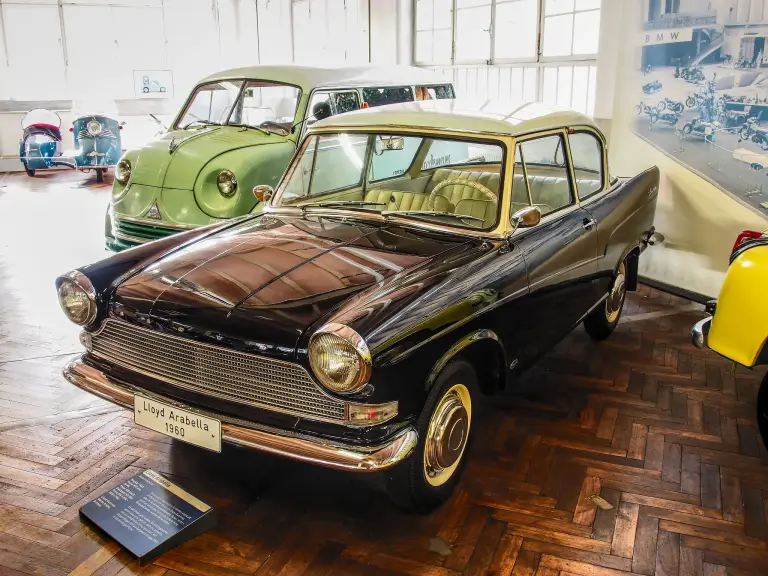
The Lloyd 400 replaced the Lloyd LP 300 and was itself replaced by the four-stroke Lloyd 600. The last Lloyd was the Arabella. More cars are in the Lloyd collection.
Sources
- Lloyd 400, English Wikipedia: engine, body phases, prices, production