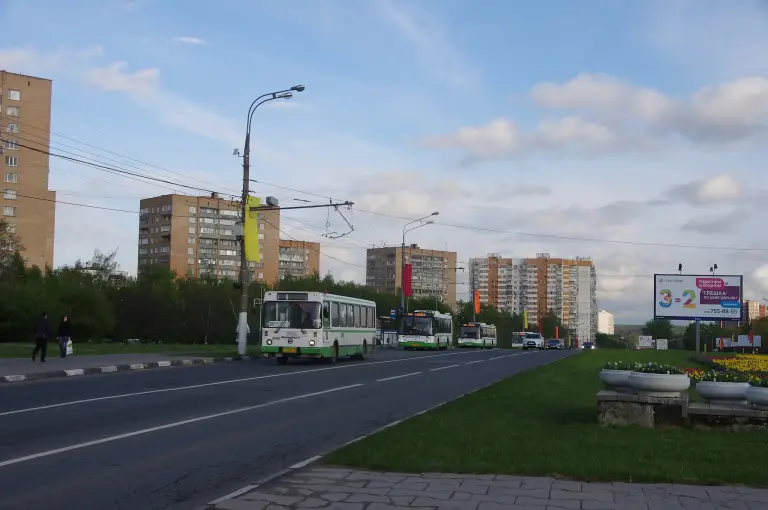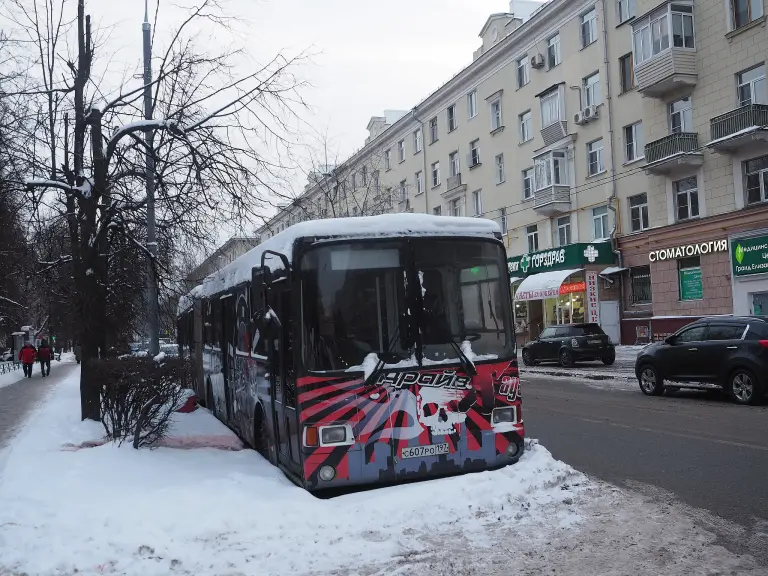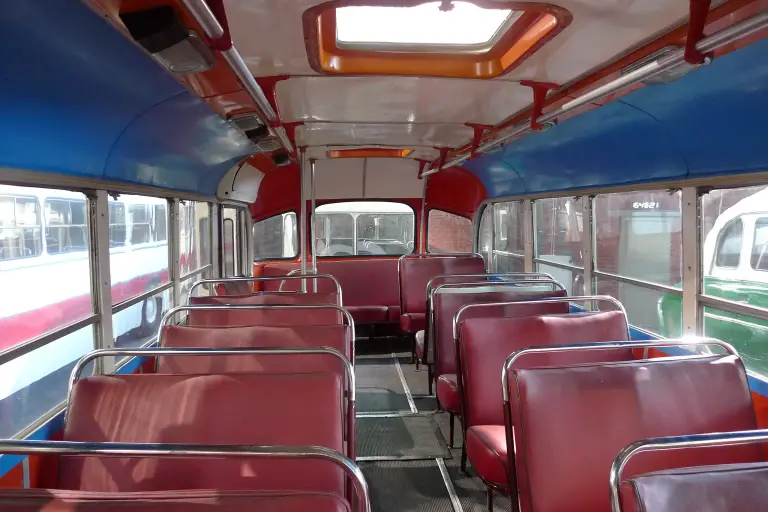
The LiAZ-677 was a Soviet and Russian high-floor city bus built by the Likinsky Bus Plant. It was the plant’s most popular model, the first Soviet bus with a hydromechanical automatic gearbox, and it worked on urban and suburban routes in almost every city of the Soviet Union.
LiAZ-677 at a glance
| Maker | Likinsky Bus Plant (LiAZ), Likino-Dulyovo |
|---|---|
| Production | 1967–1994; small-series assembly elsewhere until 2002 |
| Predecessor | ZiL-158V |
| Successor | LiAZ-5256 |
| Class | city and suburban high-floor bus |
| Gearbox | hydromechanical automatic — a first for a Soviet bus |
| Suspension | air springs from 1972 |
| Nickname | “Lunokhod” |
| Built | about 200,000 of all versions; 194,183 at LiAZ in 29 years |
The English article is short; the history, updates and the 677M come from the Russian Wikipedia article.
History of the LiAZ-677
Design and prototypes
Work on a replacement for the ZiL-158V began at LiAZ in 1960. The first prototype was ready on 6 November 1962, and in 1963 it was shown to the State Committee for Automation and Mechanisation, which approved it. A second prototype followed, and in 1964 the new buses were tested near Sochi; in 1965 a test run took them from Moscow through Kharkov, Novorossiysk, Sochi, Tbilisi, Yerevan and Ordzhonikidze and back to Moscow. Laboratory testing ran alongside the road work.
Into production
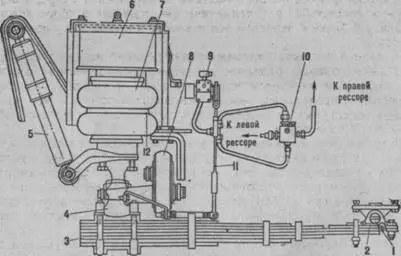
Pilot batches were built in 1967 and series production began in the spring of 1968, at first away from the main line; only in June 1970 did the 677 move onto the plant’s main conveyor. Early buses had opening vents in the side windows and marker lights on the roof slopes. In 1972 the bus received air-spring suspension, and until the mid-1970s it still wore the old ZiL-158V badge. The 1978 update brought emergency exits in the windows, square front indicators, three roof hatches and a sliding vent by the driver. Early buses were grey or white with a red skirt; from 1972 to 1979 they were white or beige with a coloured skirt and a stripe under the windows, and from the second half of 1979 they were painted a single ochre colour.
The 677M
A deep modernisation was planned as early as 1973. Two prototypes were built, one with a ZiL-375YaF pre-chamber engine, and they passed acceptance tests in 1976; a further prototype followed in 1977. Only small batches appeared — ten buses in 1977 and twenty-five in 1978 — and the planned 1979 batch of 100 was called off when the Ministry of Road Transport refused to agree a wholesale price. Series production of the LiAZ-677M began only in 1982. In practice the M was added to the index after the fact, because changes arrived almost every year: bumpers, roof hatches and window emergency exits in 1984, new rear lights in 1985 and new marker lights from 1987.
The end of the line
The last LiAZ-677M left the Likino conveyor in 1994, but assembly from kits continued until 2002 at repair plants in Bor, Yakhroma and Orekhovo-Zuyevo, at ToAZ in Tosno (as the ToAZ-677D with a Yaroslavl engine) and at the Volga Machine-Building Plant in Rybinsk. From 2000 the type was withdrawn en masse as outdated, unprofitable and unsuitable for turnstile entry systems. Moscow said goodbye on 7 November 2004 and St Petersburg on 1 April 2006; the last regular examples lingered in Arzamas until 2019, and a single 677M was still in service in Amursk in May 2022.
Design and features
- Automatic gearbox: the 677 was the first Soviet bus with a hydromechanical automatic transmission.
- Air suspension: air springs adopted in 1972 softened the ride of a bus designed in the early 1960s.
- Reach: for nearly three decades it was the standard city bus of the Soviet Union, used almost everywhere there were urban or suburban routes.
- Steady updating: outward-opening vents, roof hatches, window emergency exits and lighting changed almost every year.
- One colour: from the second half of 1979 every bus left the plant in the same ochre paint.
LiAZ-677 versions
- Early 677 (1967–1971): opening side vents, marker lights on the roof slopes and boxy interior lamps.
- 1972 specification: air-spring suspension instead of the earlier pneumatic system.
- 1978 update: window emergency exits, square indicators and three roof hatches.
- LiAZ-677M (series from 1982): the modernised version, with detail changes every year.
- ToAZ-677D: the Tosno-built version with a Yaroslavl engine, made until 2002.
The 677 replaced the LiAZ-158 and was itself replaced by the LiAZ-5256; more buses are in the LiAZ collection.
Video: Konakowo, LiAZ-677 / Конаково, ЛиАЗ-677
Video on YouTube.
Sources
- LiAZ-677, English Wikipedia: production years, gearbox, use
- ЛиАЗ-677, Russian Wikipedia: prototypes, updates, 677M, withdrawal
- LiAZ (Russia), English Wikipedia: 194,183 buses in 29 years