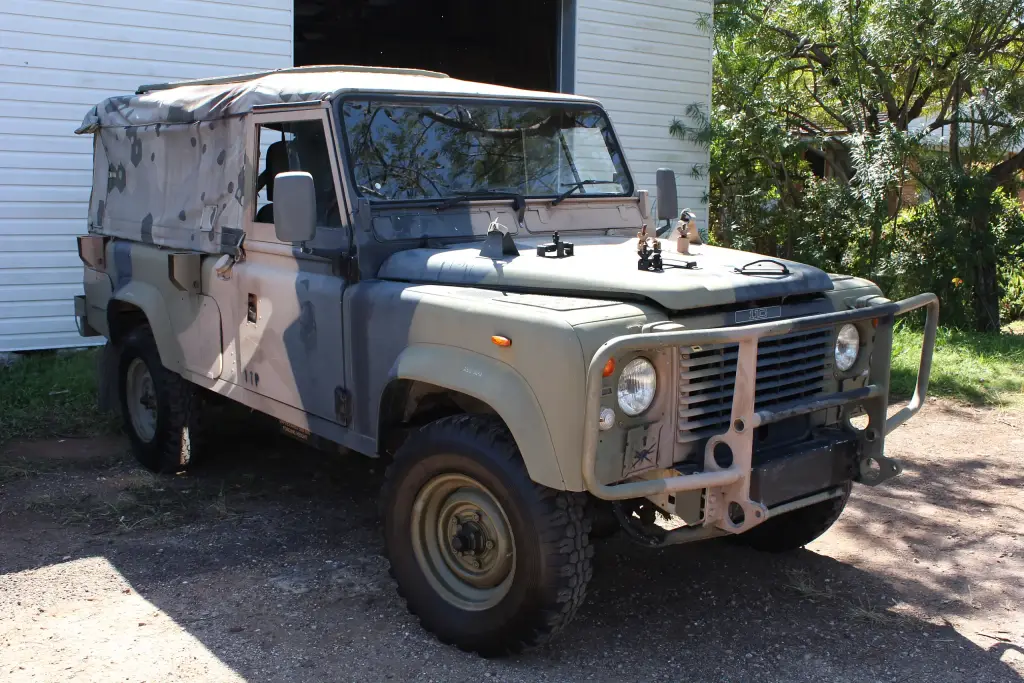
The Land Rover Perentie is the nickname of the Land Rover 110 built by JRA Limited for the Australian Army, partly manufactured and assembled at Moorebank in New South Wales during the 1980s and 1990s. There were two build contracts, the first in 1988 and the second a decade later.
Land Rover Perentie at a glance
| Built for | the Australian Army |
|---|---|
| Builder | JRA Limited, Moorebank, New South Wales |
| Based on | Land Rover Defender 110 |
| Introduced | 1987, replacing Series 2A and 3 Land Rovers |
| Contracts | Perentie 1984–1992, Bushranger 1992–1998 |
| Drive | 4×4 and 6×6 |
| Engine | Isuzu 3.9-litre 4BD1 diesel, turbocharged 4BD1-T |
| Chassis | galvanised |
| First order | 2,500 4×4 and 400 6×6 between 1987 and 1990 |
| 6×6 wheelbase | 3,040 mm to the second axle, 3,940 mm to the rear axle |
| Replaced by | Mercedes-Benz G-Wagen under Project Land 121 |
based on one source (English Wikipedia)
History of the Land Rover Perentie
The Perentie was based on the Land Rover Defender 110 and introduced in 1987 to replace the ageing fleet of Series 2A and 3 Land Rovers. The name comes from Project Perentie, the Australian Army’s trial to choose new one- and two-tonne light vehicles, in which the Land Rover/Isuzu 110 and 6×6 were compared with the Jeep AM10, the Mercedes-Benz 300GD and the Unimog, while the Toyota Land Cruiser was evaluated two years later. The perentie itself is Varanus giganteus, the largest goanna native to Australia.
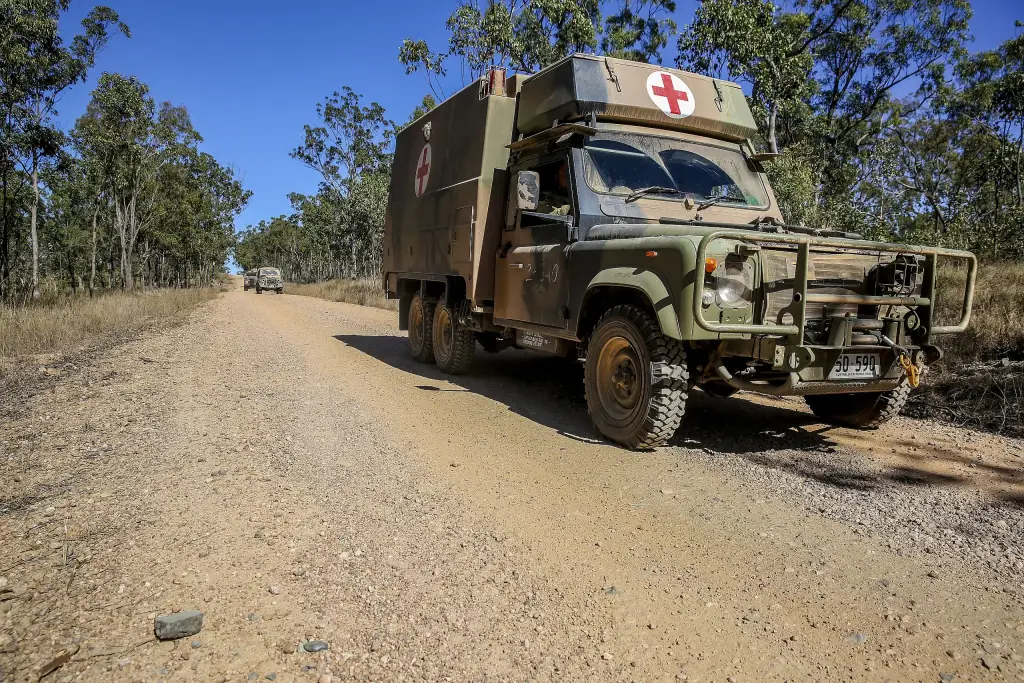
Three things set the Perentie apart from British Land Rovers: the spare wheel moved under the rear of the load area, the chassis was galvanised, and the engine was an Isuzu. Vehicles came in 4×4 and 6×6 form with the Isuzu 3.9-litre four-cylinder 4BD1 diesel or its turbocharged 4BD1-T version. The army contract asked for unusual abilities, including being hung from a helicopter by one corner without distorting the chassis. The 6×6 had a wider cab, load-sharing leaf-sprung rear axles and a turbocharger. All vehicles carried black-out and convoy lighting circuits.
The original order covered 2,500 4×4 and 400 6×6 vehicles between 1987 and 1990, with more added later under Project Bushranger. Perenties served in Australia and on operations in Somalia, Timor Leste, the Solomon Islands, Iraq and Afghanistan. From February 2013 they were being disposed of, with the remaining vehicles replaced by unarmoured Mercedes-Benz G-Wagens, the army’s new specification calling for optional armour because the Defender had proved vulnerable to mines and improvised explosive devices.
The 4×4 variants ran from utility and winch trucks to Fitted For Radio vehicles, a survey panel truck, senior commander and personnel carryalls and the Regional Forces Surveillance Vehicle. The 6×6 range covered cargo, ambulance, general maintenance, electronic repair, long range patrol, air defence and crew cab bodies.
Design and features
- Galvanised chassis: corrosion protection for long service in the field.
- Isuzu diesel: a 3.9-litre 4BD1, turbocharged in the 6×6.
- Spare wheel underneath: moved below the load floor, unlike the British 110.
- Helicopter-rated body: able to hang from one corner without the chassis distorting.
Land Rover Perentie versions
- 4×4 utility: the main light truck, also with winch and radio fits.
- RFSV: Regional Forces Surveillance Vehicle, 231 built.
- 6×6 cargo and ambulance: wider cab and load-sharing rear axles.
- 6×6 LRPV: Long Range Patrol Vehicle, 27 built.
- 6×6 air defence: 72 vehicles for missile work.
The Perentie is an Australian Land Rover Defender 110; the British military equivalent is the 101 Forward Control. More cars are in the Land Rover collection.
Sources
- Land Rover Perentie, English Wikipedia: design, contracts, variants