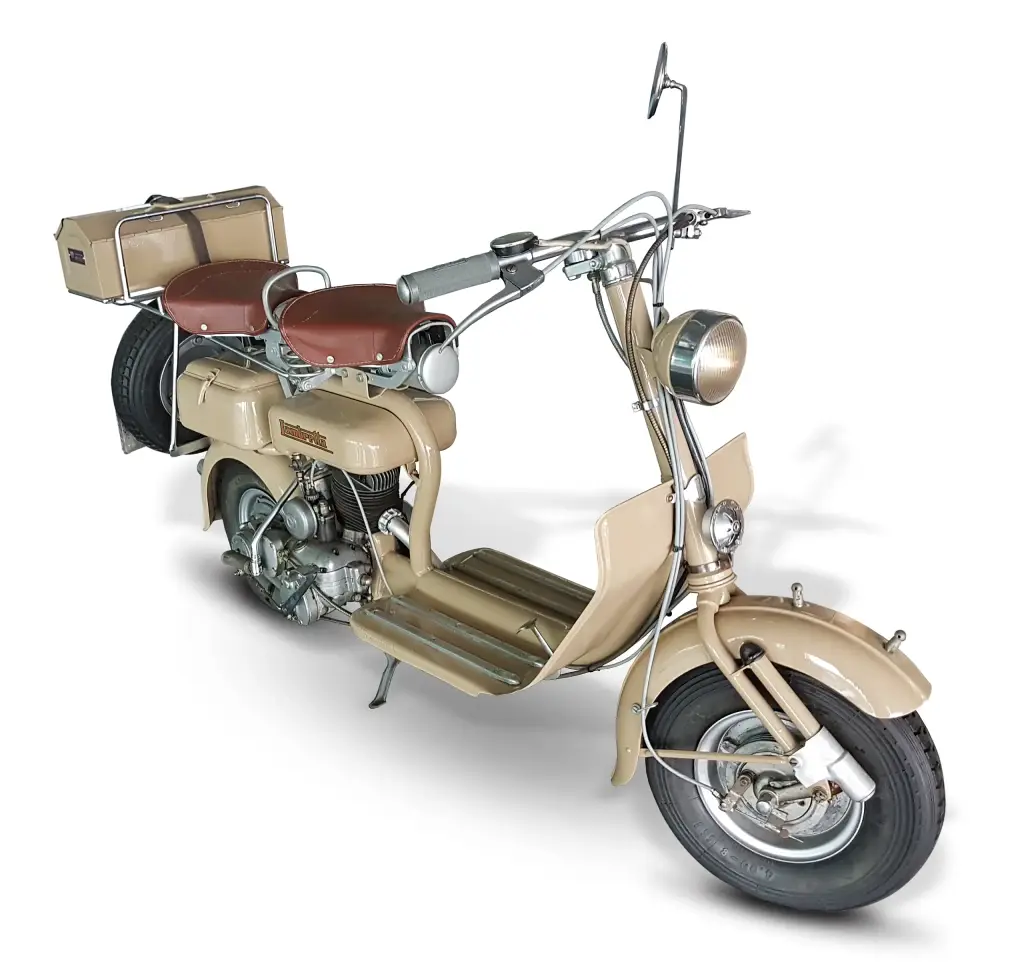
The Lambretta Model C arrived in 1950 as the successor to the open-bodied A and B. It was the first Innocenti scooter that could be ordered with an enclosed body, and that version, the LC, was successful enough to set the style that every later Lambretta followed.
Lambretta Model C at a glance
| Maker | Innocenti, Milan, Italy |
|---|---|
| Production | 1950–1952 |
| Predecessor | Lambretta Model B |
| Engine | 125 cc two-stroke |
| Body | open or enclosed |
| Enclosed version | Lambretta LC |
| Frame | tubular steel, bodywork assembled on it |
| Successor | Lambretta Model D and LD |
| Significance | first enclosed Lambretta body |
The Model C has no article of its own; this page is based on the Innocenti Lambretta article in Italian Wikipedia, which covers the model range.
History of the Lambretta Model C
Ferdinando Innocenti started scooter production in 1947, a year after Piaggio began building the Vespa. The first Lambrettas were designed around a steel-tubing frame, the trade in which Innocenti had made its name, and the bodywork was left largely open; that open look became the visual signature of the Milanese scooter.
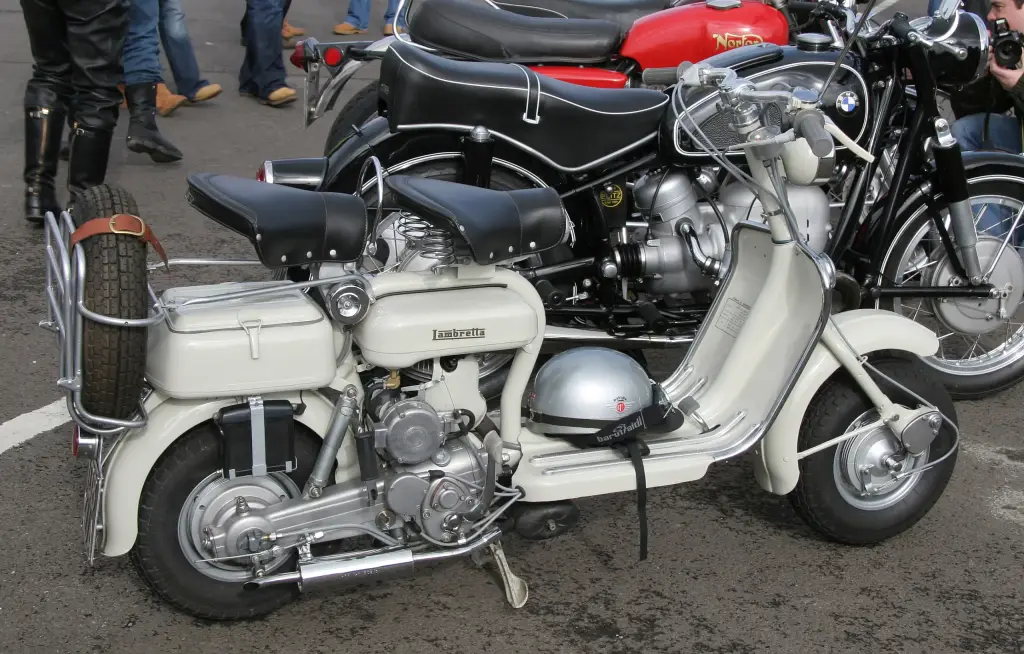
The Model C of 1950 changed that. It was offered both in the original open form and with a fully enclosed body, sold as the LC. The enclosed version was criticised by Piaggio, who saw it as a conceptual copy of the Vespa, but buyers liked it, and its success pushed Innocenti further in that direction. From 1957 onwards, with the exception of the LUI, every Lambretta was built with closed bodywork, a front mudguard integrated into the body and the engine mounted centrally.
The C was replaced by the D and LD models in 1951, which carried the enclosed idea into the 125 and 150 classes. The C and LC were thus a short but important step between the open scooters of the 1940s and the fully panelled machines of the 1960s.
Design and features
- Two bodies, one scooter: the Model C could be ordered open or fully enclosed.
- The LC version: the enclosed variant that gave the model its place in Lambretta history.
- Steel-tube frame: a rigid tubular structure with the panels assembled onto it, unlike the Vespa’s single-piece shell.
- Start of a direction: closed bodywork became standard on later Lambrettas.
Lambretta Model C versions
- Model C, open body (1950–1952): the traditional Lambretta look with exposed mechanical parts.
- Lambretta LC (1950–1952): the enclosed version, criticised by Piaggio and popular with buyers.
The C was replaced by the D and LD, and its enclosed body led to the Li series. More scooters are in the Lambretta collection.
Video: Lambretta model C 1951 125cc
Video on YouTube.
Sources
- Innocenti Lambretta, Italian Wikipedia: model dates, enclosed body, Piaggio criticism
- Lambretta, English Wikipedia: company history and design