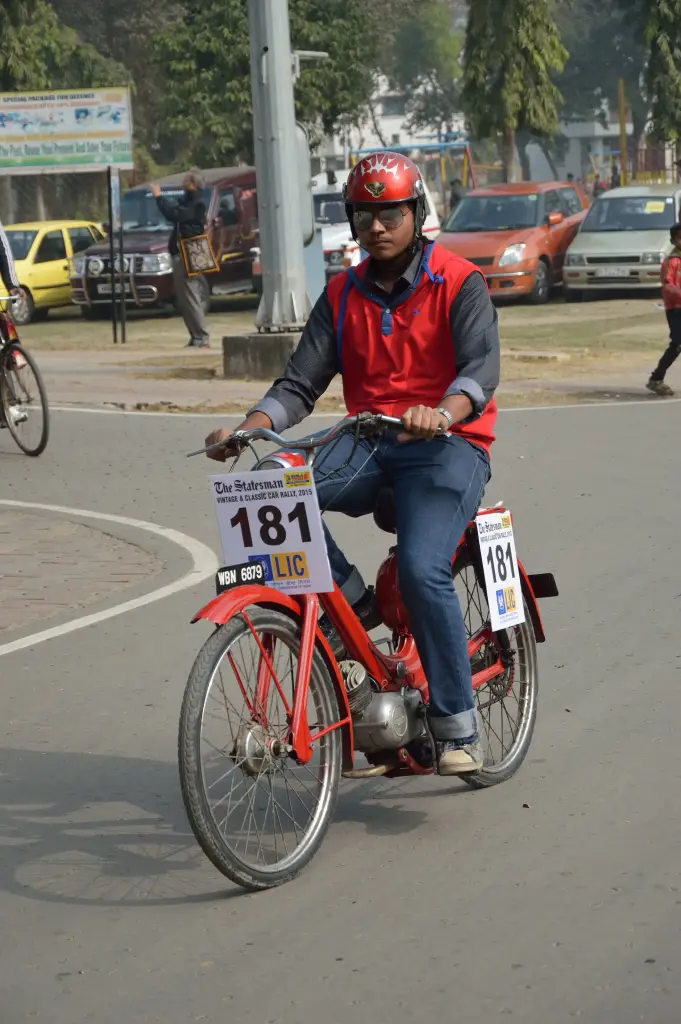
The Lambretta 48 was the only high-wheeled moped Innocenti ever built. Shown at Milan in 1954 and produced from August 1955 to March 1961, it was meant to answer the NSU Quickly, and its 48 cc two-stroke engine could reach 60 km/h while using one litre of fuel mixture every 80 kilometres.
Lambretta 48 at a glance
| Maker | Innocenti, Milan, Italy |
|---|---|
| Production | August 1955 – March 1961 |
| Class | 48 cc moped with high wheels |
| Engine | 48 cc two-stroke, air-cooled |
| Top speed | about 60 km/h |
| Fuel consumption | up to 80 km per litre of mixture |
| Oil in mixture | 6 per cent |
| Gearbox | two speeds, twistgrip change |
| Final drive | chain to the rear wheel |
| Tank | 2.7 litres, under the seat |
| Wheels and brakes | 2×22 wheels, cable-operated drum brakes |
| Price | 76,000 lire, unchanged through production |
| Series | Primissima, Prima, Seconda |
The Lambretta 48 has its own article only in Italian Wikipedia; this page is based on that article and on the Innocenti model list.
History of the Lambretta 48
Innocenti presented the Lambretta 48 at the Milan motorcycle show in 1954, but production started only in August 1955 at a price of 76,000 lire that stayed the same for the whole life of the model. The aim was to repeat the success of the NSU Quickly, the German moped that had shown how large the market for a simple light two-wheeler had become. Unlike every other Lambretta, the 48 had large wheels and a frame that looked closer to a bicycle than to a scooter, which earned it the nickname “Lambrettino del prete”, the priest’s little Lambretta.
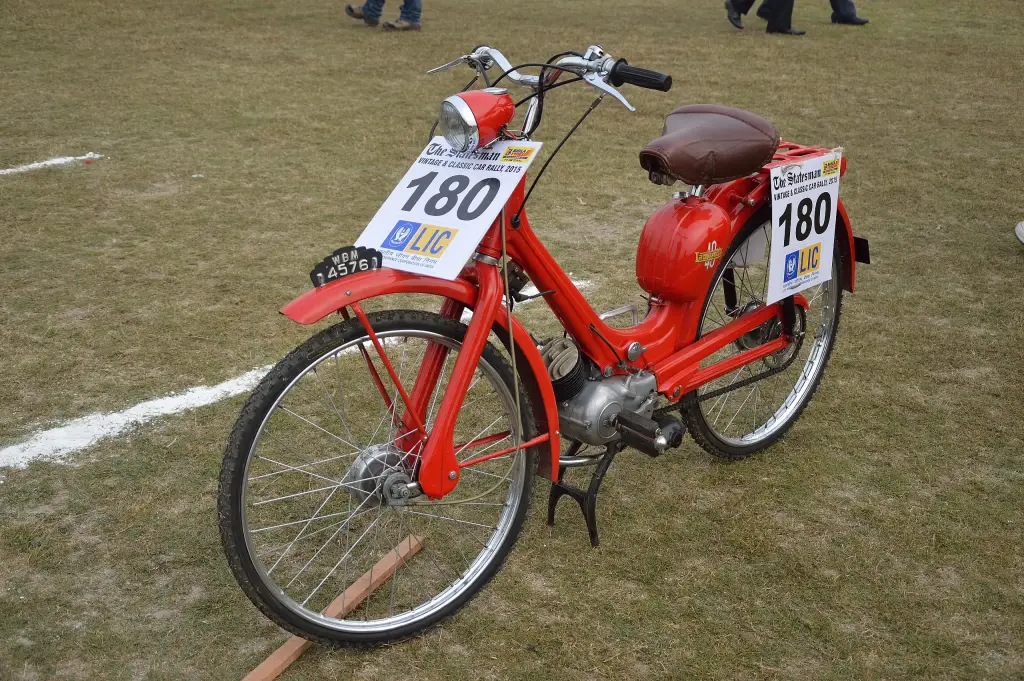
The moped was built in three series. The Primissima, made until October 1955, had a chrome disc and the Innocenti name in red on the left engine cover, a single-cable gear change with a spring inside the gearbox replacing the second cable, an externally mounted high-tension coil, a metal tool-box lid and a decompressor in the cylinder head. The Prima series, from October 1955 to October 1958, moved to a plastic tool-box lid and cast the Innocenti name into the left engine cover. The Seconda series, from October 1958 to March 1961, used a two-cable gear change for quicker shifts, moved the coil inside the generator and dropped the decompressor.
The 48 was a refined little machine: the steel frame hid its cables inside, the air filter sat within the frame rather than on the carburettor to cut induction noise, and the large silencer kept the exhaust quiet. The tank held 2.7 litres under a broad soft saddle, the rear rack was rated for 25 kg, and a Dell’Orto T5-11S carburettor was later replaced by a T4-12S. Innocenti stopped production in 1961 because sales were poor: the high ground clearance made the moped less stable than its rivals, it was expensive, and it had only two gears.
Design and features
- High wheels: the only Lambretta moped with large wheels, closer in look to a bicycle than to a scooter.
- Quiet engineering: air filter inside the frame, a large silencer and enclosed cables.
- Frugal two-stroke: 48 cc, 60 km/h and up to 80 km per litre of mixture.
- Practical details: 2.7-litre tank, 25 kg rack and a saddle that hinged over the fuel cap.
Lambretta 48 versions
- Primissima series (to October 1955): single-cable gear change, external coil, chrome disc on the engine cover.
- Prima series (October 1955–October 1958): plastic tool-box lid and cast Innocenti lettering.
- Seconda series (October 1958–March 1961): two-cable gear change, internal coil, no decompressor.
- Colours: Rosso Pompei, Grigio Lambro and the lighter Grigio Landa.
The 48 sat below the bigger Lambretta models such as the D and LD and the later Li. More scooters are in the Lambretta collection.
Video: Restauro Lambretta 48
Video on YouTube.
Sources
- Lambretta 48, Italian Wikipedia: production, series, technical data, colours
- Innocenti Lambretta, Italian Wikipedia: place of the 48 in the model range
- Lambretta, English Wikipedia: company history