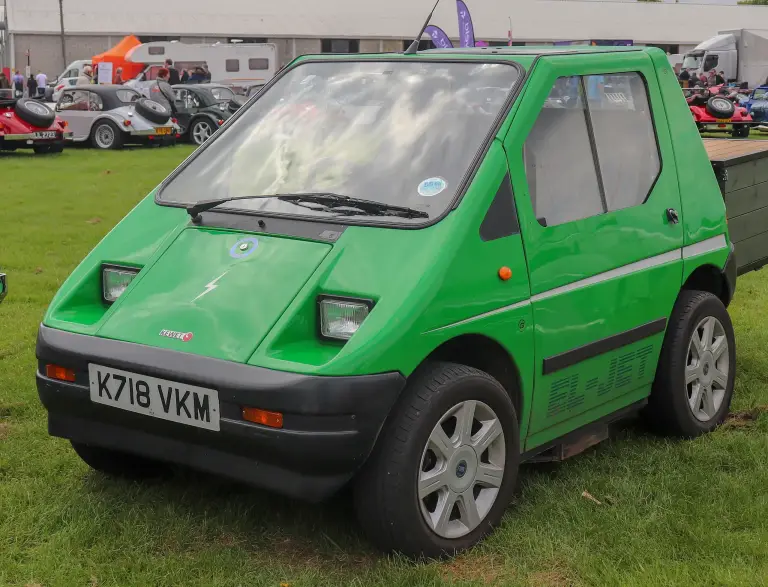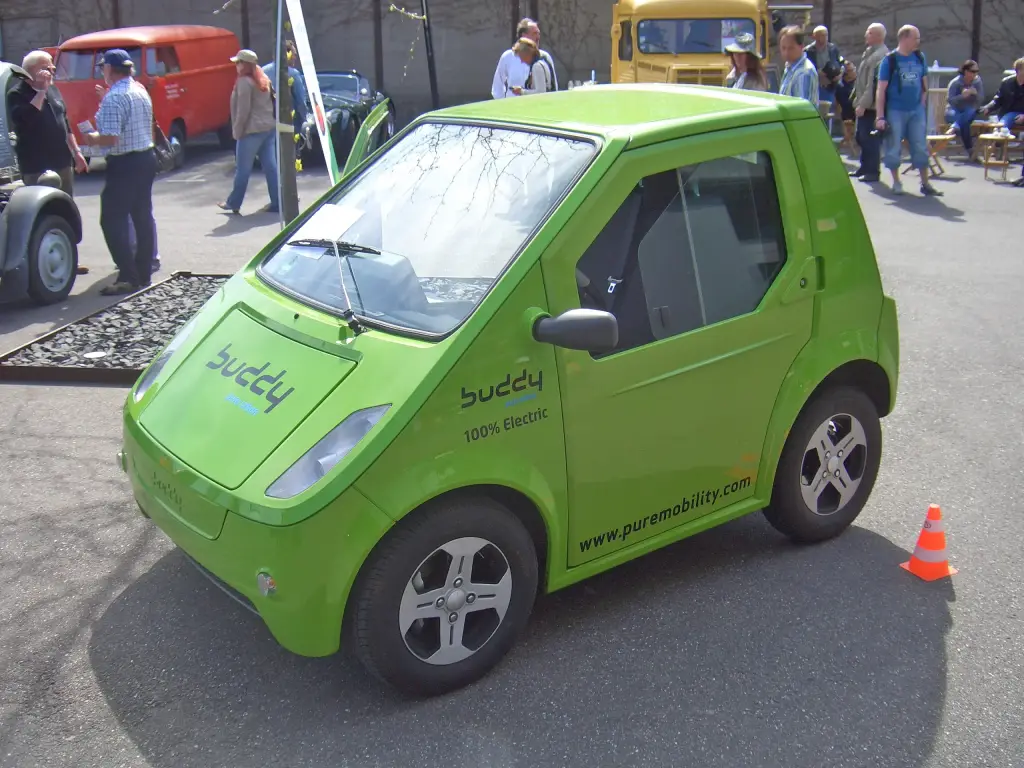
The Kewet Buddy was the sixth and final generation of the Kewet electric car, presented by the Norwegian company Elbil Norge in the autumn of 2005 as the Kewet Buddy Citi-Jet 6. Built at Økern in Oslo, it was a three-seat city car with a 72-volt, 13 kW motor, a galvanised steel tube frame and a body of glassfibre or polymer. In its later years it was sold simply as the Buddy, without the Kewet name.
Kewet Buddy at a glance
| Maker | Buddy Electric, formerly Elbil Norge AS and Pure Mobility, Økern, Oslo |
|---|---|
| Production | 2005–2013 |
| Generation | sixth of the Kewet line |
| Motor | 72 V SepEx direct-current motor with brushes, 13 kW |
| Top speed | 80 km/h, 80 to 90 km/h in the later specification |
| Range | 20 to 60 km depending on season, terrain and driving style |
| Length, width, height | 2,440 × 1,430 × 1,440 mm |
| Wheelbase | 1,550 mm; turning circle 7.0 m |
| Weight | 400 kg without batteries, 395 kg of lead-acid batteries, 1,020 kg maximum |
| Seats | three adults on a bench |
| Acceleration | 0 to 50 km/h in 7 s; hill starting ability 20% |
| EU class | heavy quadricycle, drivable on an ordinary licence |
The Buddy was the sixth generation of the Kewet and was sold under both names; the German Wikipedia has a separate article on the Kewet Buddy, used here together with the English article on the Buddy.
History of the Kewet Buddy
From Kewet to Buddy
The Buddy is the sixth generation of the Kewet, which was originally developed in Hadsund, Denmark, with the first model made in 1991. Production alternated between Hadsund and Nordhausen in Germany, and more than 1,000 cars of the first five generations were built and sold in 18 countries. In 1998 all rights were acquired by ElBil Norge AS, then called Kollega Bil AS, which continued to develop the car. In the autumn of 2005 the company presented a new model, first called the Kewet Buddy Citi-Jet 6 and later known simply as the Buddy. In 2007 the Buddy and its Kewet predecessor together made up 20% of the electric cars in Norway.
The Oslo years
The cars were assembled at Økern in Oslo, where production in 2007 ran at five or six vehicles a week against a theoretical capacity of 500 a year. In December 2008 the first 12 Buddys left the factory by boat for Copenhagen. In 2010 the company, by then renamed Pure Mobility, launched a new version initially marketed as the MetroBuddy, though the prefix was soon dropped because of confusing or negative associations. ElBil Norge later became Pure Mobility AS, which declared bankruptcy in 2011 and was liquidated in 2014; according to the German Wikipedia production restarted in small numbers in 2013, and the Buddy went out of production after the 2013 model year. Plans for a second factory in Portugal, with a projected output of 5,000 cars a year, came to nothing.
How it is built
The Buddy has a hot-galvanised steel tube frame with a safety cage but no proper deformation zones. The body was originally thin glassfibre; the later version used the polymer pDCPD, which was cheaper, lighter and more resistant to impact. Other metal parts are treated so that further rustproofing is unnecessary. The motor is a brushed 72-volt SepEx direct-current unit of 13 kW, and the car has no power steering and no brake servo, so the response of the brakes and front wheels is vague and hard to modulate. It also lacks ABS, ESP and airbags. In the European Union the Buddy is classified as a heavy quadricycle, an electric four-wheel motorcycle, which means it can be used as an ordinary vehicle and needs only an ordinary driving licence.
Batteries and range
The production car used lead-acid batteries, which take six to eight hours to charge from empty; an hour of charging gives about 10 km of driving. Charging uses an ordinary earthed socket with a circuit of at least 10 A. Battery life is two to five years, or about 20,000 km, depending on driving and charging habits, and a complete set cost from £2,800 excluding VAT. ElBil Norge also built a development fleet with various lithium-ion batteries, and existing cars were expected to be upgradable once the technology became available commercially. The German Wikipedia quotes a range of up to 80 km on lead-acid batteries and up to 120 km on nickel-metal-hydride cells, at a consumption of about 10 to 17 kWh per 100 km.
Sales and colours
In 2006 the Buddy ranked 29th among car brands in Norway by sales, ahead of Jaguar, Fiat, Smart and Porsche. Most cars in Norway are dark or muted in colour, but about 80% of Buddys were delivered in strong, bright colours, many with decorative flowers, hearts, clouds or flames. In 2011, 125 Buddys were sold in Norway, a 6% share of all electric vehicles sold there that year. By September 2013, 1,087 cars of the Kewet-Buddy line were registered in Norway, including 634 Kewet Buddy Citi-Jet 6s of 2005 to 2009 and 379 Buddy M9s of 2010 to 2013.
Design and features
- Steel tube frame: a hot-galvanised tube chassis with a safety cage, but without crumple zones.
- Polymer body: thin glassfibre at first, later the impact-resistant polymer pDCPD.
- Three-seat bench: room for three adults where the first five Kewet generations seated two.
- Simple running gear: no power steering, no brake servo, no ABS or airbags; disc brakes all round with regenerative braking.
- Quadricycle class: an EU heavy quadricycle, so an ordinary driving licence is enough.
Kewet Buddy versions
- Kewet Buddy Citi-Jet 6 (2005–2009): the original version of the sixth generation, with the Kewet name.
- Buddy: the standard car after the Kewet badge was dropped.
- Buddy Cab: a variant with a folding roof.
- MetroBuddy (2010): a relaunched version whose Metro prefix was soon removed.
- Buddy M9 (2010–2013): the final model, of which 379 were registered in Norway.
The earlier cars are described in our pages on the Kewet EL-Jet and the Kewet City-Jet; more electric cars are in the Kewet collection.
Video: Kewet Buddy EV Test Drive
Video on YouTube.
Sources
- Buddy (electric car), English Wikipedia: history, construction, batteries, specifications, sales
- Kewet Buddy, German Wikipedia: body materials, NiMH range, 2012 insolvency and 2013 restart
- Kewet, English Wikipedia: six generations, place of the Buddy among them