The 900 series arrived in 1956 with an all-new drop-frame chassis, replacing the 500 series of 1939. It was the generation in which the cab-over line passed from the Bull-nose CSE to the K series, and in 1961 it produced the W900 and the K900, the models that began Kenworth’s modern range.
Kenworth 900 series at a glance
| Introduced | 1956 |
|---|---|
| Replaced | 500 series of 1939 |
| Chassis | all-new drop-frame |
| Hood | side-opening “butterfly” hood standard; forward-tilting fibreglass hood optional |
| Cab-over line | Bull-nose COE replaced by the K100 |
| 1961 models | W900 conventional and K900 (later renamed K100) |
| Model prefixes | W from Worthington, K from Kent, the company’s founders |
| Replaced by | W900 in 1961 |
| Last model | 953, built from 1958 to 2004 |
| Successor of the 953 | 963 off-road heavy-haul truck of 2005 |
History of the Kenworth 900 series
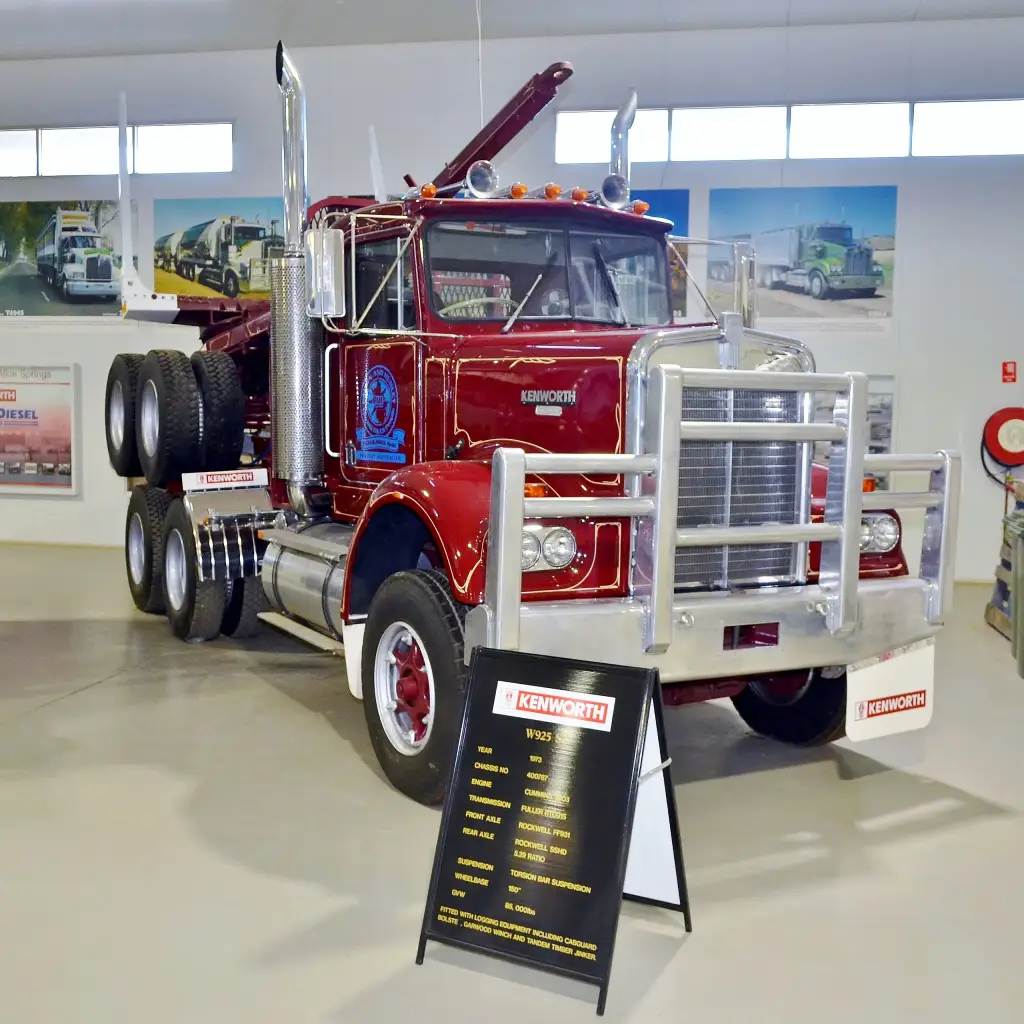
In 1956 Pacific Car and Foundry changed its ownership of Kenworth from an independent subsidiary to a division. That same year the company introduced the 900-series conventional, built on an all-new drop-frame chassis. It replaced the 500 series that had carried the range since 1939, and it shared its chassis with the cab-over line: the Bull-nose CSE gave way to the K-series, the cab-over that later became the K100. A side-opening “butterfly” hood was standard, and for the first time a forward-tilting fibreglass hood could be ordered.
The big step came for 1961 production, when the W900 and the K900 were launched as replacements for the 900-series conventional. The two prefixes come from the founders’ names, Worthington for W and Kent for K; the K900 was later renamed K100. The W900 brought the first complete redesign of the Kenworth conventional cab since 1939, with a taller cab, a wider radiator and a standard tilting hood.
The 900 series did not end with the W900, however. The 953, built from 1958 to 2004, was the final vehicle of the series, and in 2005 it was replaced by the 963, the largest truck Kenworth has ever mass-produced, a 6×6 built for off-road heavy haul, mainly in desert oilfields, and rated to pull up to 500,000 pounds. The W900 itself has been produced continuously since 1961, and more than 280,000 had been built by the 2020s.
Design and features
- Drop-frame chassis: new for 1956, replacing the 500-series layout.
- Two hood types: a side-opening butterfly hood as standard, a tilting fibreglass hood as an option.
- K-series cab-over: the Bull-nose gave way to the cab-over that became the K100.
- W900 and K900: the 1961 models that started Kenworth’s modern naming.
- 953 and 963: the last model of the series and the giant that followed it.
Kenworth 900 series versions
- Early 900-series conventional: the 1956 generation, sold under W-prefixed model numbers.
- W900 (1961–): the conventional that is still in production.
- K900/K100 (1961–): the cab-over version of the same generation.
- 953 (1958–2004): the last vehicle of the 900 series.
- 963 (2005–): the off-road heavy-haul truck that replaced the 953.
The 900 series replaced the 500 series and grew into the W900 and the cab-over K100; its heavy-haul side lives on in the C500. More trucks are in the Kenworth collection.
Video: 1969 Kenworth W924 Extended Cowl, with 12V71 Detroit
Video by Mercus135 on YouTube.
Sources
- Kenworth W900, English Wikipedia: 900 series of 1956, butterfly hood, replacement by the W900, 953 and 963
- Kenworth, English Wikipedia: 900 series, drop-frame chassis, K-series, W900 and K900 of 1961