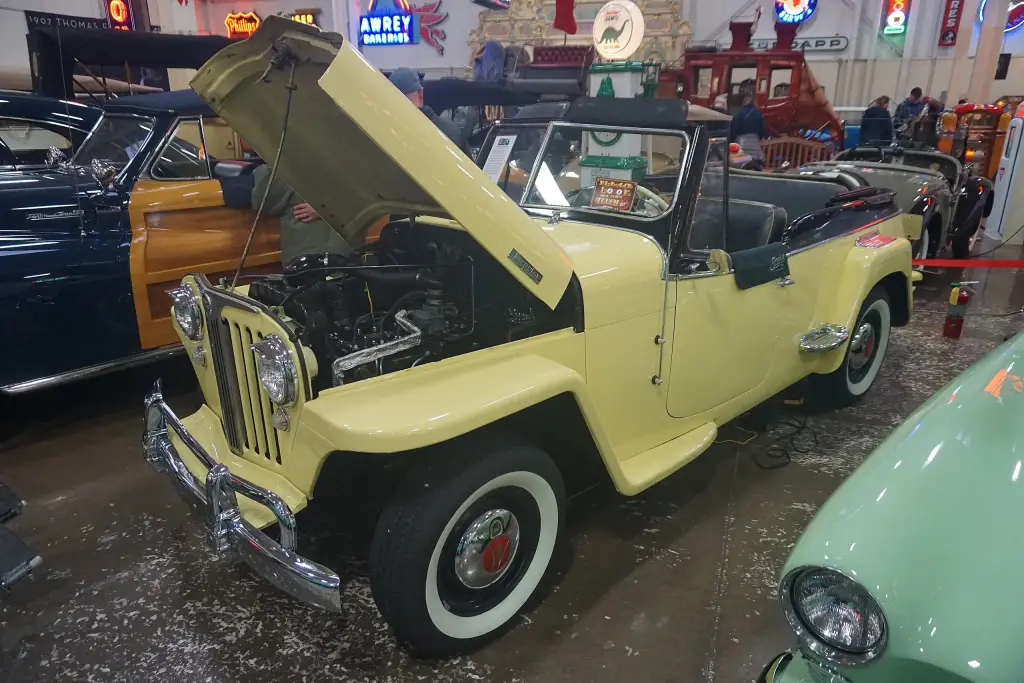
The Willys-Overland Jeepster is an automobile originally produced by Willys-Overland Motors from 1948 until 1950. It was developed to fill a gap in the company’s product line, crossing over from its utilitarian Jeeps and trucks into the passenger-car market. Almost 20,000 were built, and the name was revived in 1966 on the C-101 Jeepster Commando.
Willys-Overland Jeepster at a glance
| Maker | Willys-Overland Motors |
|---|---|
| Production | 1948–1950; some leftovers sold as 1951 |
| Introduced | April 1948 |
| Body | two-door open car with side curtains |
| Drive | rear-wheel drive only |
| Styling | Brooks Stevens |
| 1948 engine | 134.2 cu in (2.2 L) Go Devil four, 63 hp |
| 1949 engine added | 148.5 cu in Lightning six |
| 1950 engines | F134 Hurricane four and 161 cu in Lightning six |
| Gearbox | Borg-Warner T-96 three-speed with overdrive |
| 1948 price | $1,765 |
| 1949 price | $1,495 |
| Total built | 19,132 |
based on one source: the English Wikipedia article on the Willys-Overland Jeepster.
History of the Willys-Overland Jeepster
Between Jeep and car
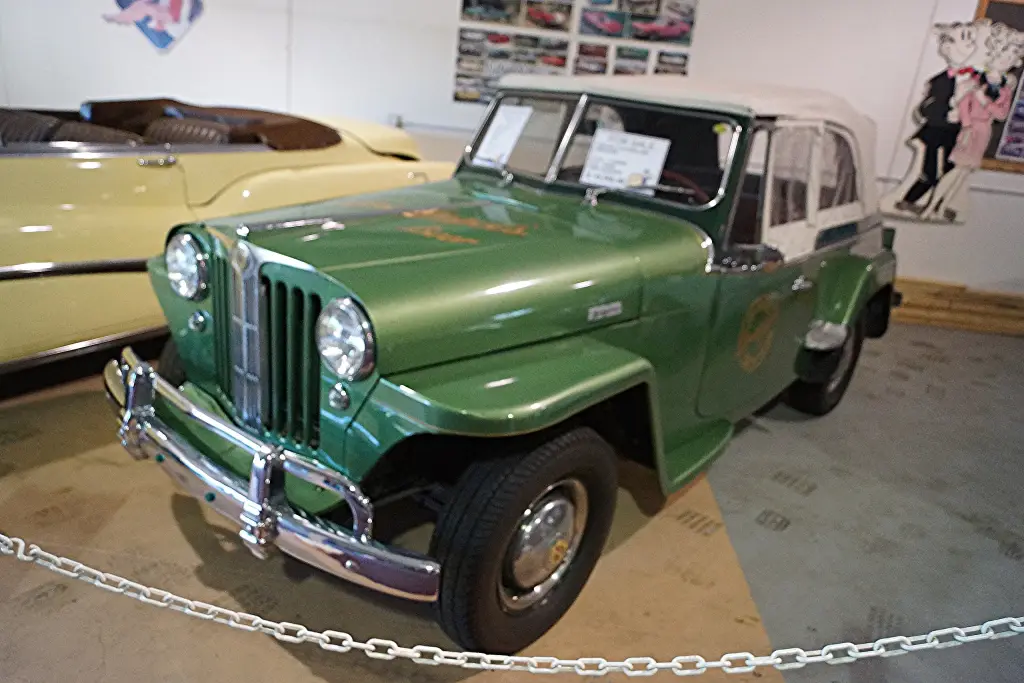
After the Second World War Willys, owner of the Jeep trademark, sold the CJ to farmers, foresters and other users with utilitarian needs. It added the Jeep Wagon, Panel Utility and Pick-up in 1946 and the Jeep Truck in 1947. Seeing a gap in the range, Willys developed the Jeepster to cross over from its trucks into the passenger-car market, with a sporty rear-wheel-drive model advertised as having a “dual personality for city and country driving” and as “America’s greatest value in sports cars”.
Willys-Overland lacked the machinery to form deep-drawn fenders or complicated shapes, so the body had to be simple and slab-sided. The industrial designer Brooks Stevens styled a line of post-war vehicles for Willys on a common platform that included the Jeep pick-up and station wagon as well as a sporty two-door open car, which he envisaged as a sports car for veterans of the war. The Jeepster, known internally as the VJ, was introduced in April 1948 and produced through 1950, with some leftover models sold under the 1951 model year.
Deluxe equipment, modest sales
The basic 1948 Jeepster included numerous deluxe features and interior fittings on top of a high level of standard equipment that cost extra on other cars: whitewall tyres, hubcaps with bright trim rings, sun visors, a deluxe steering wheel, wind wings, a locking glovebox, a cigar lighter and a continental tyre with a fabric cover. It used Willys’ wartime-proven 134.2 cu in Go Devil four of 63 hp, and had plastic side curtains rather than roll-up windows. At $1,765 it cost about the same as a Ford Super DeLuxe Club convertible with roll-down windows, better styling and a V8. The boxy styling and performance were praised by journalists, but the car did not catch on with its intended buyers, and sparse advertising and a thin dealer network held sales back.
The Jeepster was rear-wheel drive only, which limited its appeal to typical Jeep customers. Its Planadyne single transverse leaf spring independent front suspension, drivetrain, front end, rear suspension, steering and four-wheel drum brakes came from the Willys Station Wagon, and the flat-topped rear fenders from the Jeep truck line. For 1949 there was one model with one engine and the price came down to $1,495, with some previously standard features returning as extra-cost options; towards the middle of the year the VJ3-6 was added with Willys’ new L148 Lightning six. The 1950 cars had their first styling revisions, a new instrument panel and a V-shaped grille with horizontal chrome trim, and a new model with reduced standard equipment at a lower price. The 161 cu in Lightning six joined the Go Devil four.
Why it failed
The Jeepster’s problems were its limited utility and practicality. It looked rugged and off-road capable but was not, and its appeal was limited by basic construction, poor all-weather protection and low performance with the four-cylinder engine. Even with an optional six and the cheaper VJ3, it did not draw many new buyers because of its relatively high price, low performance and the lack of roll-up door windows. Sales were 10,326 in 1948, 2,960 in 1949 and 5,836 in 1950, a total of 19,132.
The 1966 revival
Kaiser revived the Jeepster name for 1967 as the C-101 Jeepster Commando, with roll-up door windows, a V6 engine and four-wheel drive, offered as a pick-up, convertible, station wagon and roadster. American Motors bought Kaiser’s Jeep operations in 1970 and re-engineered the Jeepster with AMC engines, a 232 or 258 cu in six or a 304 cu in V8. The Jeepster name was removed after 1971; for 1972 the wheelbase was extended and the car received a full-width grille, and Commando production ended in 1973 in favour of the full-sized SJ Cherokee.
Design and features
- Passenger-car crossover: a sporty two-door built to bring Willys buyers from trucks into cars.
- Brooks Stevens styling: simple slab sides dictated by the lack of deep-drawing machinery at Willys.
- Deluxe equipment: whitewall tyres, trim rings, wind wings, locking glovebox and a continental tyre were standard in 1948.
- Willys running gear: the front suspension, axles, steering and brakes came from the Station Wagon.
- No off-road ability: rear-wheel drive only, despite the Jeep look.
Willys-Overland Jeepster versions
- 1948 Jeepster: one model with the 63 hp Go Devil four and side curtains.
- 1949 Jeepster: lower price, then the VJ3-6 with the 148.5 cu in Lightning six.
- 1950 Jeepster: V-shaped grille, new instrument panel, Hurricane four and 161 cu in six.
- VJ3 and VJ-3 663: model codes for four- and six-cylinder cars, later VJ-473 and VJ-673.
- Jeepster Commando (1967–1973): the revived name on a four-wheel-drive V6 model.
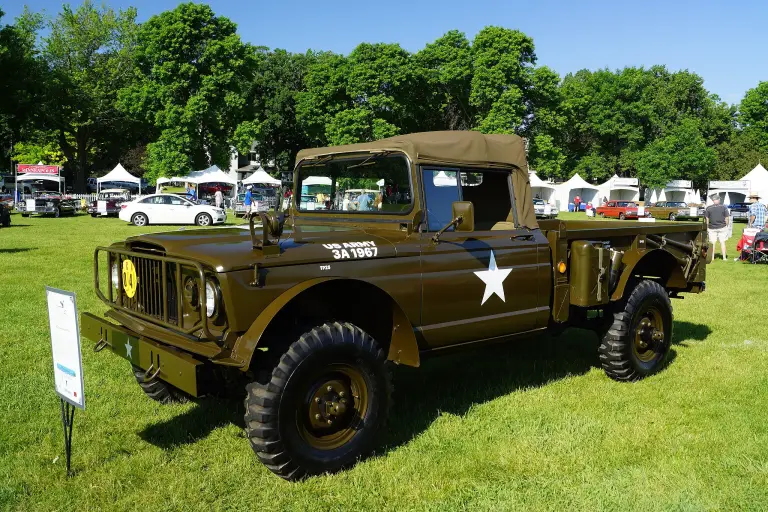
The Jeepster was one of the Willys vehicles that came into the Kaiser range when Kaiser bought Willys-Overland in 1953, and its military relatives are described under the Kaiser Jeep M715 and the M35 truck.
Video: 1967 Kaiser Jeepster for Sale – Rare V6 with Automatic Transmission
Video on YouTube.
Sources
- Willys-Overland Jeepster, English Wikipedia: development, equipment, engines, prices, sales, revival