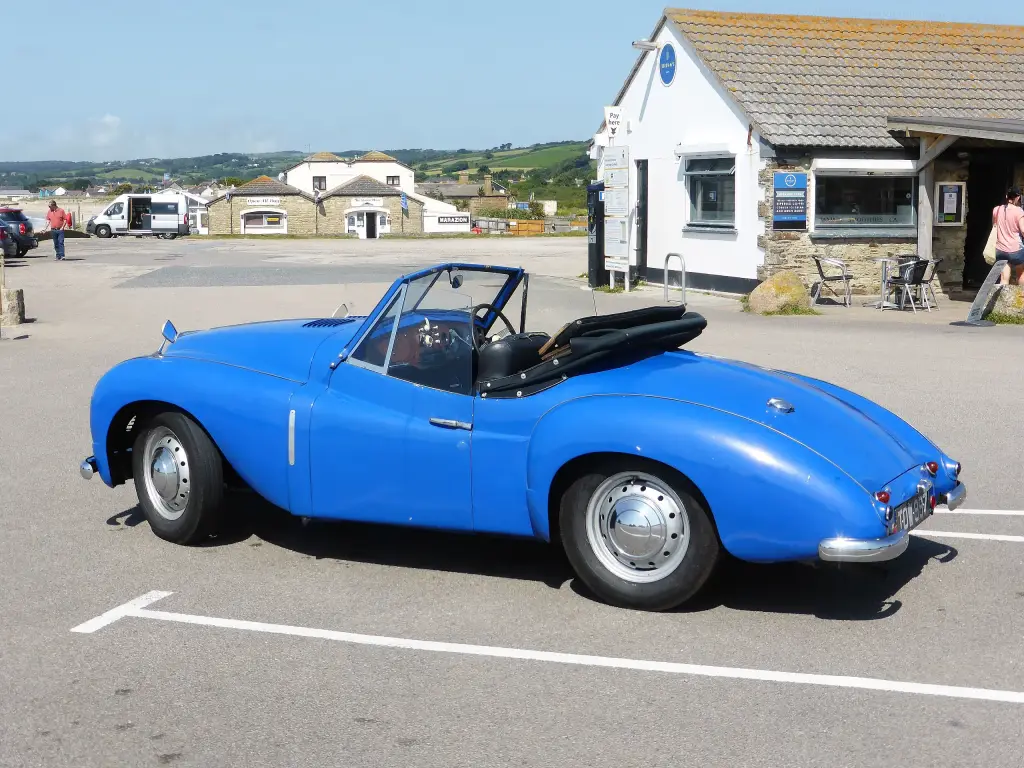
The Jowett Jupiter was the Bradford firm’s sports car, launched in 1950 to earn export sales and steel allocation. Its chassis was designed by Eberan von Eberhorst, formerly of Auto Union, and its tuned 1486 cc flat four gave 60 bhp, 85 mph and a fine competition record, including class wins at Le Mans in three consecutive years.
Jowett Jupiter at a glance
| Maker | Jowett Cars Ltd, Idle, Bradford |
|---|---|
| Production | 1950–1954 |
| Chassis designer | Eberan von Eberhorst, for ERA |
| Body | steel-framed aluminium drophead coupé, three-seat bench |
| Engine | 1486 cc flat four, compression raised to 8.0:1 |
| Power | 60 bhp at 4,500 rpm; 63 bhp in the Mk 1a |
| Gearbox | four-speed, column change |
| Top speed | 85 mph; 86.1 mph on The Motor’s 1950 test |
| 0–60 mph | 18.0 seconds on test |
| Test car price | £1,086 including taxes |
| Factory-built | 731 Mk 1 and 94 Mk 1a |
History of the Jowett Jupiter
### A sports car for export
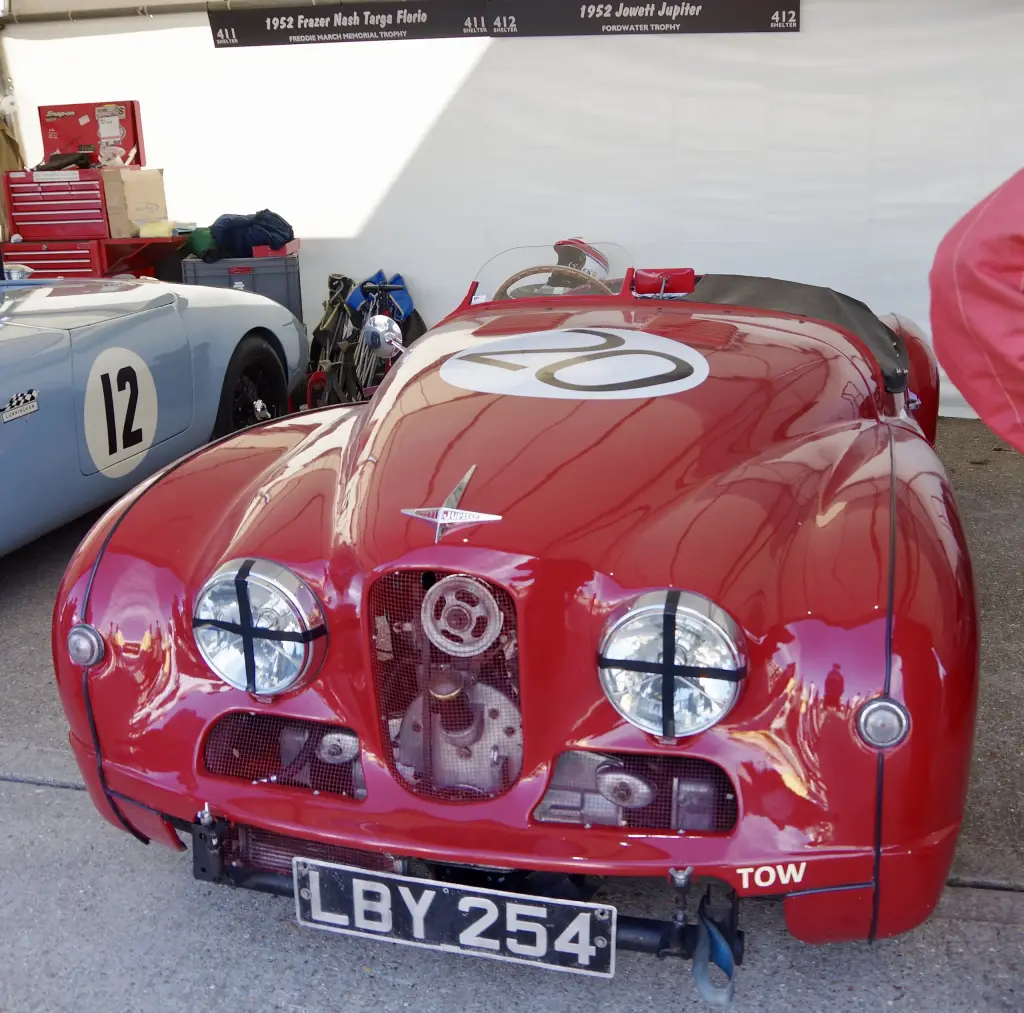
After the Javelin’s competition successes, Jowett decided to use the same powertrain in a sports car for export, hoping to increase its inadequate steel allocation. The chassis alone was shown at the London Motor Show that opened on 28 September 1949; the complete car appeared for the first time in New York in April 1950, and the chassis had its continental launch at Geneva in March 1950. It was first called the Jowett Javelin Jupiter, but the Javelin part was dropped in February 1951.
### The chassis
Jowett, through Lawrence Pomeroy of The Motor, joined forces with ERA and persuaded Eberan von Eberhorst, formerly with Auto Union, to come to England. He joined ERA at Dunstable and designed the Jupiter’s tubular steel chassis. Suspension used soft torsion bars and anti-roll bars front and rear, independent at the front, and the anti-roll bars could be adjusted to tune oversteer and understeer. The engine sat very far forward, ahead of the front axle, with the radiator low behind it over the gearbox.
### Body and production
Reg Korner of Jowett put a steel-framed aluminium drophead coupé body with a bench seat for three on the frame. Because Eberan’s chassis had been designed for a closed coupé, it needed strengthening and the anti-roll bars were abandoned. There was no external access to the boot, and the rear-hinged bonnet opened complete with the wings. An initial 75 chassis went to coachbuilders such as Stabilimenti Farina, Ghia Suisse and Abbott of Farnham; their high cost for a 1500 cc car led Jowett to build complete cars itself, 731 Mk 1 and 94 Mk 1a. The Mk 1a of late 1952 had 63 bhp and an opening boot lid.
### Motorsport
The Jupiter took a class win at the 1950 Le Mans 24 Hours, a class one-two on the 1951 Monte Carlo International Rally, an outright win on the 1951 Lisbon International Rally and a class one-two in a four-hour sports car race at Dundrod in September 1951. Le Mans was won in class again in 1951 and 1952, but by 1953 newer, faster cars were a match for the Jupiter, which was after all a well-appointed touring car first.
Design and features
- Tubular chassis: designed by Eberan von Eberhorst at ERA, with torsion bars and independent front suspension.
- Tuned flat four: compression raised from 7.2:1 to 8.0:1 for 60 bhp.
- Three-seat drophead: aluminium body on a steel frame, with a bench seat.
- Competition record: class wins at Le Mans in 1950, 1951 and 1952.
Jowett Jupiter versions
- Coachbuilt cars: the first 75 chassis, bodied by Farina, Ghia Suisse, Abbott and others.
- Mk 1: the factory drophead coupé, 731 built.
- Mk 1a (1952): 63 bhp and an opening boot lid of larger capacity, 94 built.
- R1: racing derivative, three made, one surviving; won at Watkins Glen in 1951 and its class at Le Mans in 1952.
- R4: fibreglass-bodied successor with a lighter chassis and 100 mph potential; three prototypes, two surviving.
The Jupiter used the engine of the Jowett Javelin and was the sporting descendant of the Jowett Seven; the van of the range was the Jowett Bradford. More cars are in the Jowett collection.
Video: Leo Bolter and his Jowett Jupiter
Video on YouTube.
Sources
- Jowett Jupiter, English Wikipedia: chassis, engine, bodies, motorsport, road tests