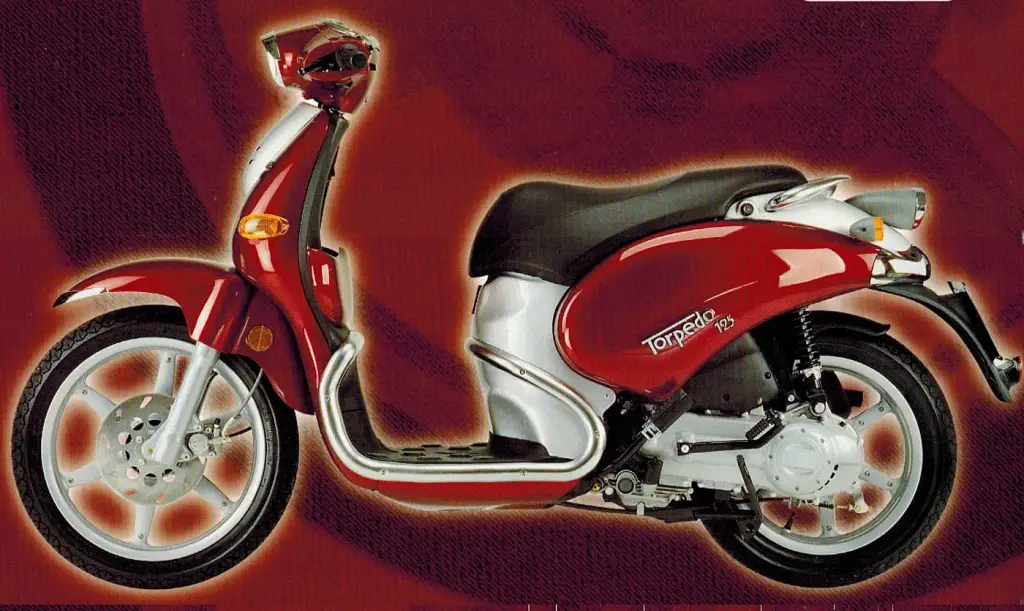
The Italjet Torpedo is a scooter that Italjet produced from 1997 to 2003. It was the Bologna firm’s first high-wheel scooter, with 16-inch wheels, a flat floor and rounded retro styling with plenty of chrome, and it went up against the Honda SH Fifty, the Piaggio Free and the Malaguti Centro.
Italjet Torpedo at a glance
| Maker | Italjet, Italy |
|---|---|
| Production | 1997–2003 |
| Prototype | Milan motorcycle show, November 1996 |
| Unveiled | 20 May 1997 |
| Project cost | 3 billion lire |
| Tyres | 90/80–16 front and rear |
| Length and width | 1,940 mm and 660 mm |
| Wheelbase | 1,260 mm |
| Weight | 85 kg, seat 790 mm from the ground |
| Engine at launch | 50 cc two-stroke, Franco Morini, 4 hp at 5,000 rpm |
| Brakes | 220 mm front disc, 120 mm rear drum |
| From 1999 | Piaggio 50 two- and four-stroke, 125 and 150 four-stroke |
This page is based on the Italian Wikipedia article on the Torpedo, the only source available for the model (based on one source).
History of the Italjet Torpedo
Launch
The Torpedo was shown as a prototype at the Milan motorcycle show in November 1996, and the final version was unveiled on 20 May 1997. It came out of a project that cost 3 billion lire. As the first high-wheel scooter from Italjet, it entered a market segment that was growing quickly at the time and went directly against successful models such as the Honda SH Fifty, the Piaggio Free and the Malaguti Centro. Besides the 16-inch wheels, it had a flat floor and a rounded, retro design with a lot of chrome and spoked wheels.
Chassis and engines
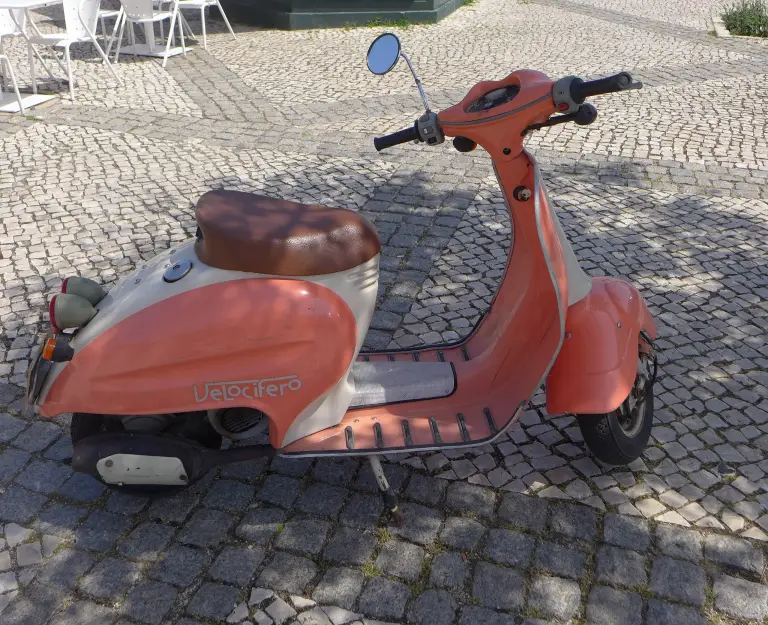
The frame used a front fork with 35 mm stanchions and a rear monoshock with variable pitch. Braking was a 220 mm hydraulic front disc and a 120 mm rear drum, and the tyres were the same size front and rear at 90/80–16. The scooter measured 1,940 mm long and 660 mm wide, with a 1,260 mm wheelbase, a weight of 85 kg and a seat 790 mm from the ground. The launch engine was a 50 cc two-stroke from Franco Morini, the same unit as in the Velocifero: air-cooled with electronic ignition, it produced 4 hp at 5,000 rpm.
The range grows, 1998–2003
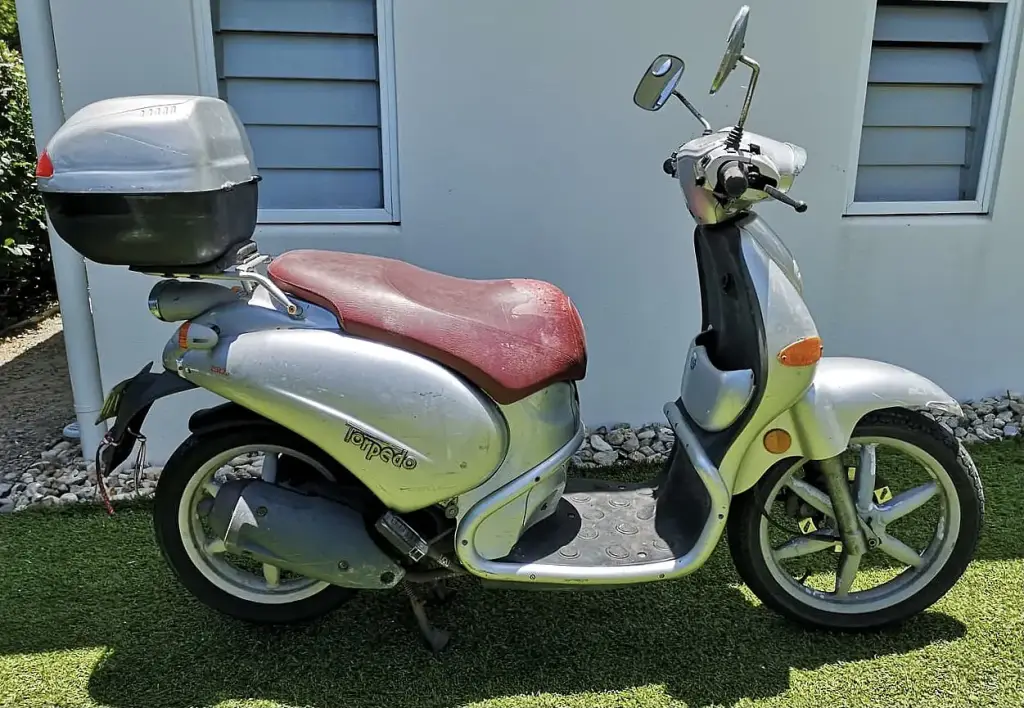
In 1998 Italjet added a special “Riccardo Gay Design” version, more accessorised and exclusive, with a removable aluminium top box and four-layer aluminium paint as standard. In October 1998 the company presented a new range, on sale from 1999, with four engines of Piaggio origin: the 50 two-stroke Hyper2, the 50 four-stroke Hyper4 and the 125 and 150 four-stroke Leader units, all with a catalytic converter and Euro 1 approval. The update also brought new colours, cast alloy wheels instead of spoked ones, a 110/80–14 rear tyre and a revised rear suspension for better comfort over bumps. The two-stroke Hyper2 had 49.38 cc and 4.0 hp at 6,000 rpm; the four-stroke Hyper4 had 49.9 cc and 4.4 hp at 8,500 rpm; both were limited to 45 km/h and weighed 96 and 95 kg. The 125 had 124.04 cc, 10.12 hp at 7,500 rpm, a top speed of 92 km/h and a weight of 105 kg; the 150 produced 11.6 hp at 7,000 rpm, reached 95 km/h and weighed the same. In July 2001 the 125 and 150 were slightly uprated, and production ended in 2003.
Design and features
- 16-inch wheels: the first high-wheel scooter from Italjet, with the same tyre size front and rear.
- Flat floor: a practical layout combined with a rounded, retro body and chrome details.
- Spoked wheels: replaced by cast alloy wheels with the 1999 range.
- Two engine families: a Franco Morini two-stroke at launch, then Piaggio two- and four-stroke units.
- Special version: the 1998 Riccardo Gay Design with an aluminium top box and four-layer paint.
Italjet Torpedo versions
- Torpedo 50 (1997): Franco Morini two-stroke, 4 hp, spoked wheels.
- Riccardo Gay Design (1998): special version with a removable aluminium top box and four-layer aluminium paint.
- 1999 range: Piaggio Hyper2 and Hyper4 50, plus 125 and 150 Leader four-strokes, all with catalysts.
- 2001 update: the 125 and 150 engines slightly uprated.
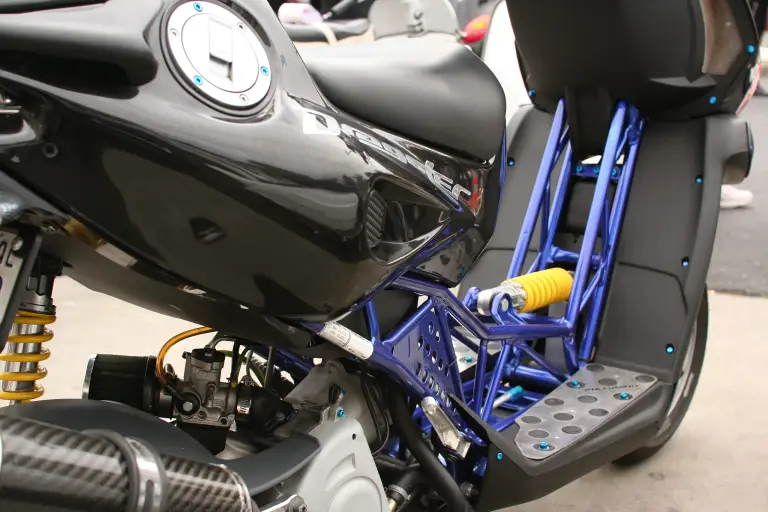
The Torpedo shared its 50 cc Franco Morini engine with the Velocifero, and it joined the Dragster in Italjet’s 1990s scooter range. More machines are in the Italjet collection.
Video: Italjet Torpedo
Video on YouTube.
Sources
- Italjet Torpedo, Italian Wikipedia: launch, dimensions, engines, 1999 range, production