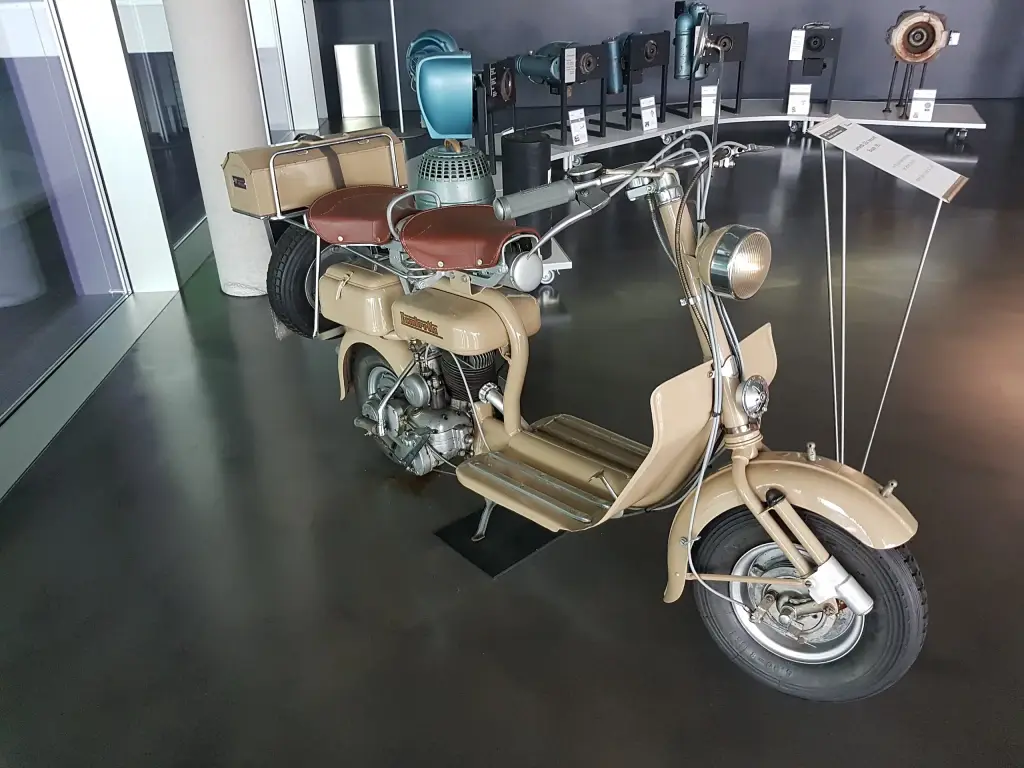
The Innocenti Lambretta was the Milanese scooter that made Ferdinando Innocenti’s company famous. Built in Lambrate from 1947 to 1971, it competed directly with the Vespa and was eventually built under licence in Europe, India and South America.
Innocenti Lambretta at a glance
| Maker | Innocenti, Lambrate, Milan |
|---|---|
| Production | 1947-1971 |
| Type | motor scooter |
| Engine | two-stroke, 48 to 198 cc |
| Gearbox | three or four speeds |
| Frame | tubular structure with separate bodywork |
| Designers | Cesare Pallavicino and Pierluigi Torre |
| Name | from the Lambro river and the Lambretto canal |
| Licence production | NSU in Germany, Serveta in Spain, API and SIL in India, and others |
| Related vehicles | Lambro three-wheelers and the Lui scooter |
History of the Innocenti Lambretta
From steel tubing to scooters
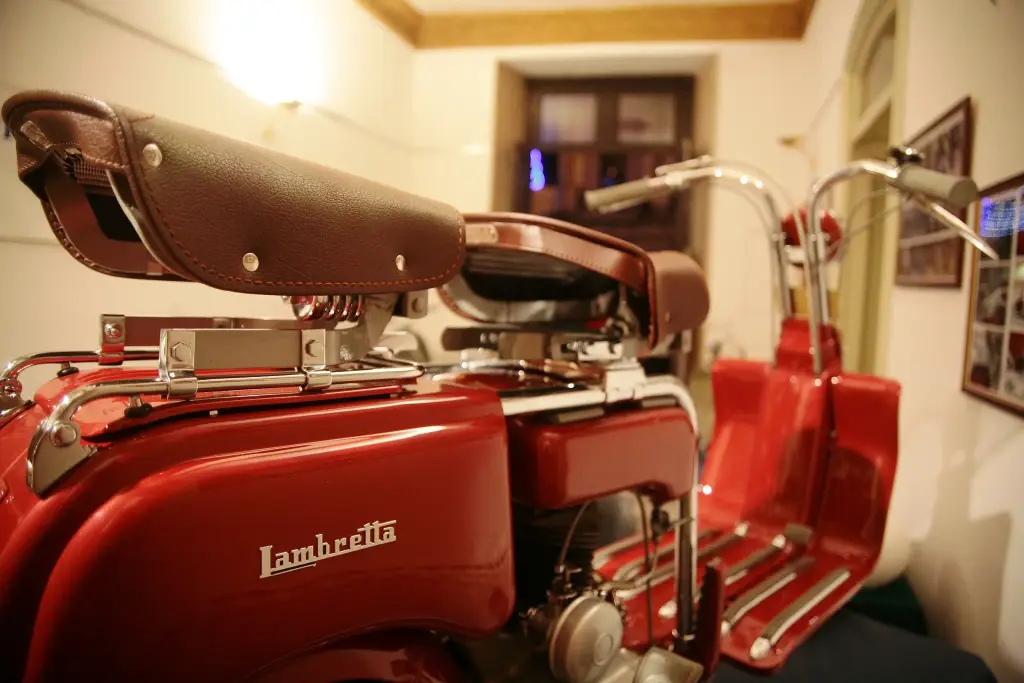
In 1922 Ferdinando Innocenti set up a steel tubing business in Rome; in 1931 he moved to Milan and in 1933 built a large factory at Lambrate. The works was bombed and partly destroyed during the Second World War. While waiting to recover the Milan plant, Innocenti studied a product for post-war reconversion, taking inspiration from the American military scooters that had arrived in Italy and from the new need for motorisation. The project was first given to the aeronautical engineer Cesare Pallavicino and then to Pierluigi Torre, who had worked on the engines of the Savoia-Marchetti S.55A flying boat. At the end of 1946 the name Lambretta was chosen, after the Lambro river that ran through the factory and, more precisely, the Lambretto canal.
A different kind of scooter
The Lambretta had a two-stroke engine running on a petrol-oil mixture, three or four gears and a displacement from 48 to 198 cc. Unlike the Vespa, built on a single-piece monocoque, the Lambretta used a more rigid tubular structure on which the bodywork was assembled. The earliest models had exposed bodywork, which distinguished them from the fully panelled Vespa and became a recognisable sign of the Milanese scooter. From the 1950 model C, fully panelled versions were also offered, and from 1957 onwards, with the exception of the Lui, the Lambretta was always built with closed bodywork, a front mudguard integral with the body and a centrally mounted engine.
Success and the end
Innocenti started Lambretta production in 1947, a year after Piaggio began the Vespa. The scooter was built under licence in Germany by NSU, in Spain by Serveta, in Argentina, Brazil, Chile, India and elsewhere, sometimes under other names. In the late 1950s demand fell as the small car became affordable, and Innocenti’s finances weakened. The company was eventually sold to British Leyland, and scooter production ended in 1971. In 1972 the Indian government bought the assembly line; Scooters India Limited continued building the original Lambretta until 1997. Today the Lambretta is a collector’s machine, supported by clubs around the world.
Design and features
- Tubular frame: a rigid structure carrying separate bodywork, unlike the Vespa monocoque.
- Two-stroke engines: from 48 to 198 cc, with three or four gears.
- Front shield and leg guard: practical weather protection and a clean riding position.
- Racing and sport versions: the TV was the first scooter in the world with a front disc brake.
Innocenti Lambretta versions
- Model B (1948): an early exposed-body scooter.
- Li series: the 1950s and early 1960s backbone of the range.
- TV (Turismo Veloce): the sporting version, with the first front disc brake on a scooter.
- SX (Special X): the sporty 1960s model.
- DL: the final series, built until 1971.
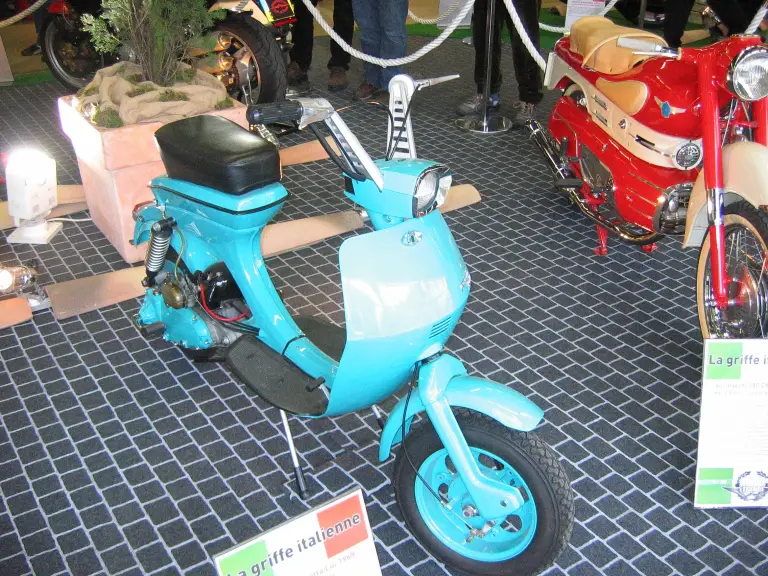
The Lambretta mechanics also produced the Innocenti Lambro three-wheeler, and the later Innocenti Lui was a Bertone-styled small scooter. More models are in the Innocenti collection.
Video: Lambretta Innocenti Special 150 engine first run after rebuilding
Video on YouTube.
Sources
- Lambretta, English Wikipedia: design, production, licence manufacture, end of production
- Innocenti Lambretta, Italian Wikipedia: history, models, technical details