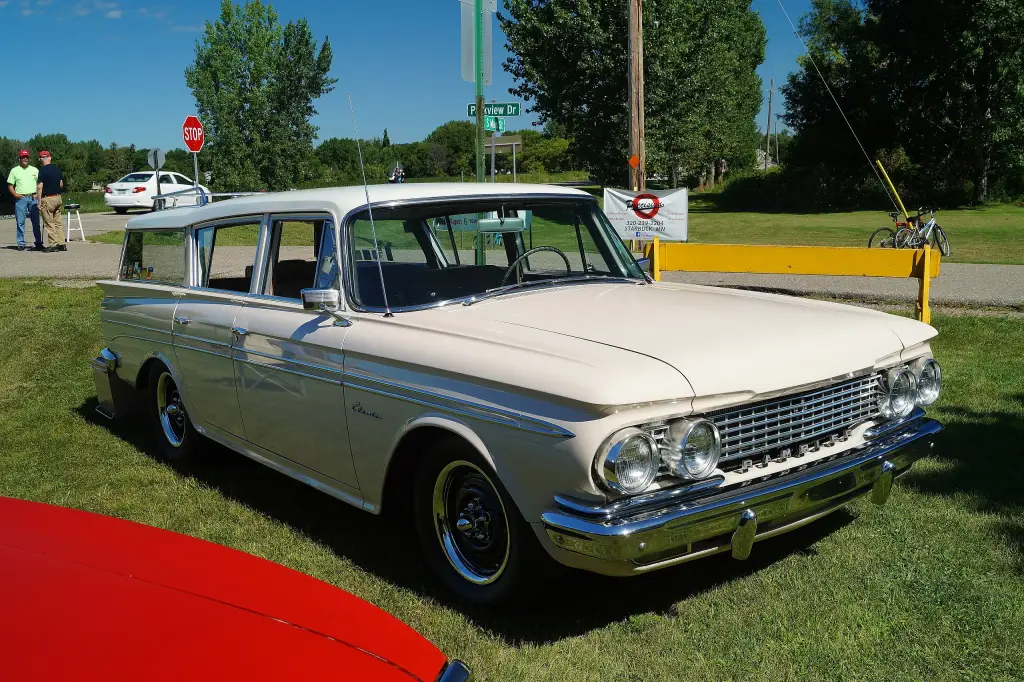
The Rambler line was IKA’s replacement for its Kaiser models. Built in Argentina from 1962 to 1972, it offered the Classic saloon, the Ambassador and the Cross Country estate, all with six-cylinder engines, and it was the range from which the IKA Torino grew.
IKA Rambler at a glance
| Maker | Industrias Kaiser Argentina, Barrio Santa Isabel, Córdoba |
|---|---|
| Production | 1962–1972; Ambassador 990 to 1975 |
| Models | Classic, Ambassador, Cross Country |
| Bodies | four-door saloon and estate |
| Engines | Continental 226 (3700 cc) and Tornado Jet 230 (3770 cc), six cylinders |
| Power | 119 hp at 4000 rpm (first generation) |
| Gearbox | three-speed manual; four-speed in the Ambassador 990 Tornado |
| Trim codes | 400, 440, 550, 660, 990, 380 |
| Second generation | from 1963, 4920 mm long |
| Replaced by | IKA Torino |
based on one source (Spanish Wikipedia).
History of the IKA Rambler
The Rambler arrived in Argentina in 1962, when IKA needed a modern compact to answer the Ford Falcon and the Chevrolet 400. The line replaced the Kaiser Carabela and the Bergantín, and it was developed from the Rambler Classic and the AMC Ambassador under the licence agreement with American Motors. Three body names were used: Classic for the base saloon, Ambassador for the luxury saloon and Cross Country for the estate, with numeric trim levels 400, 440, 550, 660, 990 and 380.
The first generation was presented in 1962 as a replica of the 1961 American Rambler Classic. It was a four-door unitary saloon for six passengers, with bench seats front and rear, powered by a Continental six of 226 cu in (3700 cc) producing 119 hp at 4000 rpm through a three-speed gearbox with a column lever. Its versions were the Classic Custom, the Classic Custom De Luxe and the Ambassador 440, and the estate was sold as the Rambler Cross Country. Saloon and estate were exactly the same length, because the saloon’s boot was as long as the estate’s load area.
The second generation followed the American change of 1963 and went into production at Santa Isabel the same year. It was a completely new body with straight waistline creases and a semi-pyramidal roof, and at 4920 mm it was one of the longest cars ever built in Argentina. Its angular front earned it the nickname «boca de pescado», fish mouth. The engine stayed the Continental 226 of 119 hp with a three-speed gearbox, and the numeric model names continued, with 550 for the Classic line.
Mechanically the range used the IKA Continental 226 of 3700 cc or the Tornado Jet 230 of 3770 cc, both six-cylinder units in line, with a three-speed manual gearbox and four speeds in the Ambassador 990 Tornado. Production of the range ended in 1972, although the Ambassador 990 continued to be built to order until 1975. By then the company had already turned to the Pininfarina-styled Torino, which took the Rambler American body as its starting point.
Design and features
- Three model names: Classic, Ambassador and Cross Country estate.
- Six-cylinder engines: Continental 226 of 3700 cc or Tornado Jet 230 of 3770 cc.
- Six seats: bench seats front and rear in the saloon.
- Numeric trim: 400, 440, 550, 660, 990 and 380 levels.
- Long body: the second generation measured 4920 mm, one of the longest Argentine cars.
IKA Rambler versions
- Classic Custom (1962–): the base saloon of the first generation.
- Classic Custom De Luxe: the intermediate trim.
- Ambassador 440: the luxury saloon of the first generation.
- Cross Country: the estate version of the Classic.
- Second generation (1963–): new body, nicknamed «boca de pescado».
- Ambassador 990 Tornado: four-speed gearbox, built to order until 1975.
The Rambler replaced the Kaiser Carabela and led directly to the IKA Torino, which used the Rambler American body. More cars are in the IKA collection.
Video: Rambler Ika Classic 1967
Video on YouTube.
Sources
- Rambler (Argentina), Spanish Wikipedia: production, models, engines, generations