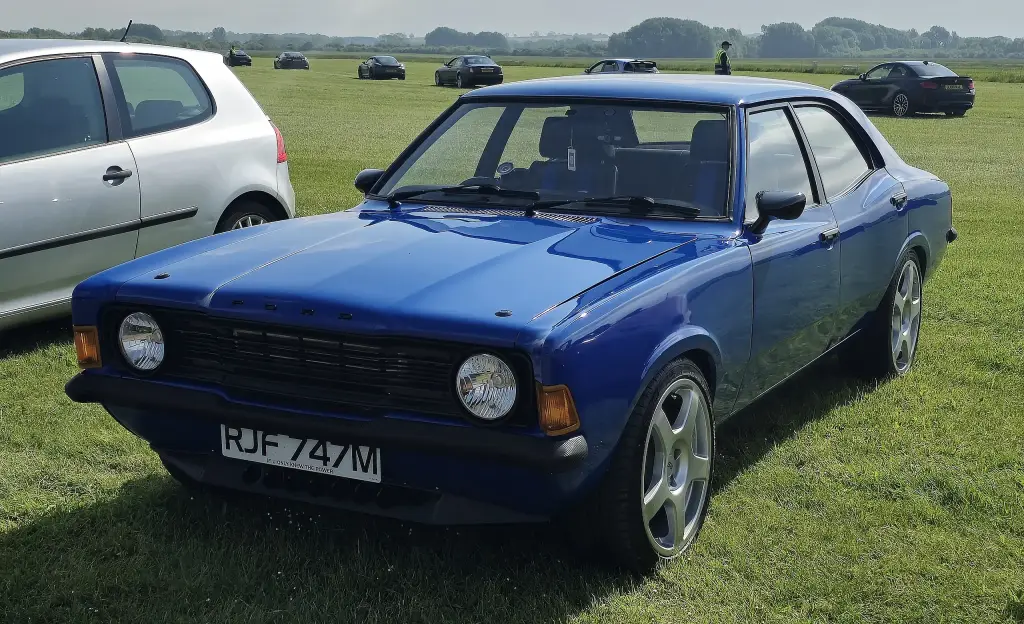
The Hyundai Cortina is the Korean-built version of the Ford Cortina, the mid-sized family car that Ford of Britain made from 1962 to 1982. The Cortina was the best-selling car in the United Kingdom during the 1970s, and its name came from the Italian ski resort of Cortina d’Ampezzo, host of the 1956 Winter Olympics.
Hyundai Cortina at a glance
| Model | Ford Cortina, assembled in Korea by Hyundai |
|---|---|
| Maker of the car | Ford of Britain, Dagenham |
| Production | 1962–1982 |
| Generations | Mark I to Mark V (the last a facelift of the Mk IV) |
| Bodies | two and four-door saloon, five-door estate |
| Launch engines | 1,198 cc and, from 1963, 1,498 cc four-cylinder |
| From 1964 | front disc brakes standard across the range |
| Sister car | Ford Taunus, almost identical from 1970 |
| Name origin | Cortina d’Ampezzo, Italy |
| Replaced by | Ford Sierra, 1982 |
Based on one source, the English Wikipedia article on the Ford Cortina; Korean assembly by Hyundai is not described there, so this page covers the car as Ford built it.
History of the Hyundai Cortina
The Cortina was launched by Ford of Britain on 20 September 1962. The car was designed to be cheap to buy, cheap to run and inexpensive to build in Britain, and it was aimed at buyers of the Morris Oxford Farina and the Vauxhall Victor. It first appeared as the Consul Cortina; after a modest facelift in 1964 it was sold simply as the Cortina. Rear-wheel drive was chosen over the front-wheel-drive layout Ford of Germany used for the Taunus.
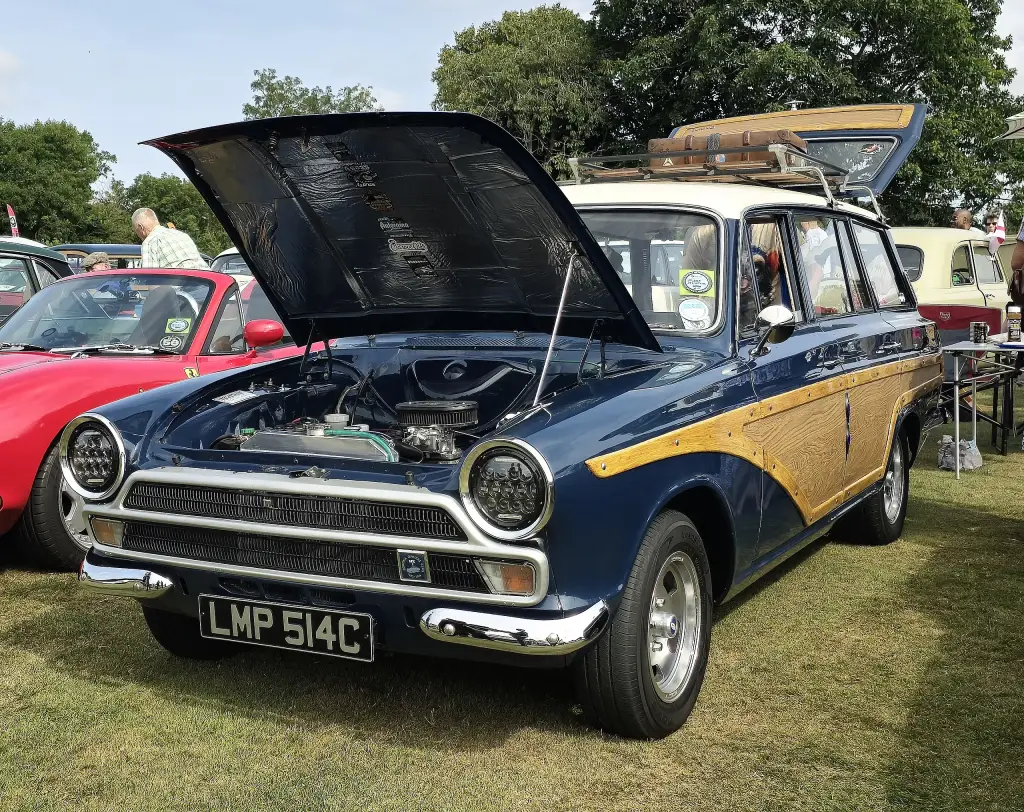
The Mark I came with 1,198 cc and, from early 1963, 1,498 cc four-cylinder engines, in two and four-door saloons and, from March 1963, a five-door estate. Standard, Deluxe, Super and GT trims were offered. The 1964 revision brought through-flow ventilation, marked outside by extractor vents on the rear pillars, a revised dashboard and standard front disc brakes. The sporting Cortina Lotus used a 1,558 cc twin-cam engine from Lotus in a two-door shell with aluminium panels.
The Cortina was produced in five generations, the last of them officially only a Cortina 80 facelift of the Mark IV. From 1970 the car was almost identical to the German Ford Taunus, as Ford tried to unify its European operations; by 1976, when the revised Taunus appeared, the two cars were the same. The Cortina was replaced in 1982 by the Ford Sierra, although it was assembled in South Africa until 1984, with the pick-up version lasting there until 1987.
Hyundai assembled the Cortina in Korea. The source used here describes the Ford car rather than Korean production, so the generations and specifications above are those of the Cortina as Ford built it.
Design and features
- Cheap to build: the design was shaped by Ford of Britain’s wish to produce it inexpensively.
- Five generations: from the 1962 Mark I to the 1980 Cortina 80.
- Taunus twin: from 1970 the Cortina was almost identical to the German Ford Taunus.
- Lotus version: the Cortina Lotus put a twin-cam Lotus engine into the two-door shell.
Hyundai Cortina versions
- Consul Cortina and Cortina 1200/1500: the Mark I of 1962–1966.
- Cortina GT: the tuned 1,498 cc version with lowered suspension.
- Cortina Lotus: two-door, twin-cam, white with a green side flash.
- Mark II to Mark V: later generations up to the 1982 Sierra.
The Cortina was the car Hyundai assembled in Korea before the Stellar; Ford replaced it in 1982 with the Sierra. Hyundai’s own mid-sized family car of the same era was the Pony. More Hyundai models are in the Hyundai collection.
Sources
- Ford Cortina, English Wikipedia: generations, engines, trims, facelifts, replacement