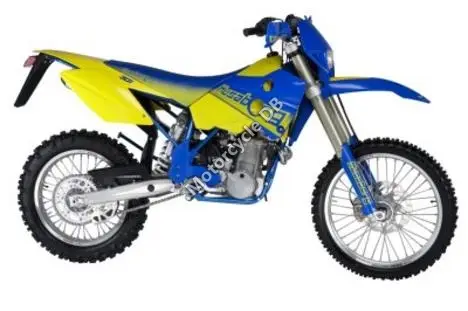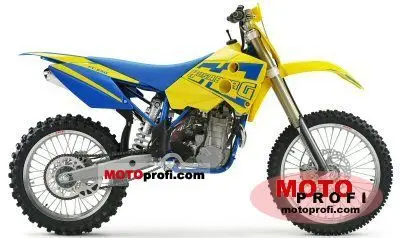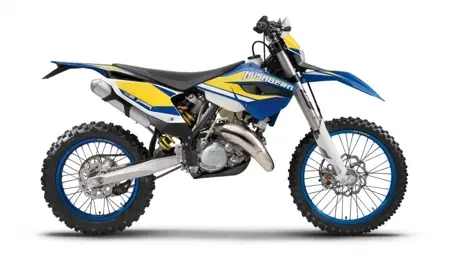
The Husaberg TE was the two-stroke enduro line of a company that had built four-strokes only for its first two decades. The TE 250 and TE 300 arrived in 2011, the TE 125 followed in 2012, and the three models formed the last two-stroke range of the brand before it was folded into Husqvarna in 2014.
Husaberg TE at a glance
| Maker | Husaberg Motor AB, Sweden; KTM from 1995 |
|---|---|
| Built in | Mattighofen, Austria |
| Class | two-stroke enduro |
| Name | T for two-stroke, E for enduro |
| First two-strokes | TE 250 and TE 300, presented in July 2010 for 2011 |
| TE 125 | added for 2012 |
| Final line-up | TE 125, TE 250 and TE 300 in 2014 |
| Engines | KTM two-stroke units |
| Slogan | ‘4 Stroke force’ until 2012, then ‘Pure Enduro’ |
| Brand ended | 2014 (Husqvarna from then on) |
No Wikipedia article covers the TE on its own: the facts here come from the Husaberg brand articles in English, German, Swedish and Italian, which are in effect a single source.
History of the Husaberg TE
2011: the first two-strokes
Husaberg was founded in 1988 by engineers left in Sweden after Husqvarna’s motorcycle division was sold to Cagiva, and for more than twenty years it built four-stroke motorcycles only, under the slogan ‘4 Stroke force’. For the 2011 model year, presented in July 2010, the company offered two-stroke models for the first time in its history: the TE 250 and the TE 300 enduros, alongside the four-stroke FE 390, FE 450 and FE 570 and the supermoto FS 570.
2012: the TE 125
The Swedish Wikipedia records that Husaberg presented its first TE 125 in 2012, which completed the two-stroke range at 125, 250 and 300 cc. The two-stroke engines came from KTM, the Austrian manufacturer that had owned Husaberg since 1995 and had built the bikes at Mattighofen since 2003; the Italian Wikipedia notes that the last production was made up of seven enduro models, four four-stroke and three two-stroke, all with KTM engines.
2014: enduro only, and the end
In 2014, the brand’s 25th anniversary and its last model year, Husaberg offered enduro models only: the FE 250, FE 350, FE 450 and FE 501 four-strokes and the TE 125, TE 250 and TE 300 two-strokes. All had special anniversary graphics and new suspension settings, the 4CS USD WP closed-cartridge forks were extensively revised and every model received a new Trail Tech speedometer. That year the final slogan was ‘Pure Enduro’, and after KTM’s majority owner bought Husqvarna in 2013 the Husaberg models were sold under the Husqvarna name.
Design and features
- Two-stroke line: the TE models were Husaberg’s first two-strokes, twenty-two years after the company was founded.
- Naming: T for two-stroke, E for enduro, with the displacement in the number.
- KTM engines: the last range used KTM power units, as Italian Wikipedia records.
- Enduro only: by 2014 supermoto, motocross and cross-country models had been dropped from the range.
- 2014 equipment: revised WP 4CS closed-cartridge forks, new settings and a new Trail Tech speedometer.
Husaberg TE versions
- TE 250 (2011–2014): the 250 cc two-stroke enduro, one of the first two Husabergs of the line.
- TE 300 (2011–2014): the largest two-stroke enduro of the range.
- TE 125 (2012–2014): the smallest, added a year after the first two-strokes.
- 2014 anniversary models: the final versions, with 25th anniversary graphics and revised suspension.
The two-stroke TE line stood beside the four-stroke enduros, the Husaberg FE 450 and the Husaberg FE 501; the competition models of the earlier range are covered by the Husaberg FC. All models are in the Husaberg collection.
Video: Husaberg TE 250 2T 2013
Video on YouTube.
Sources
- Husaberg, English Wikipedia: first two-strokes, naming, 2011 and 2014 ranges
- Husaberg, German Wikipedia: 2011 two-strokes, end of the brand
- Husaberg, Swedish Wikipedia: TE 250 and TE 300 in 2010, TE 125 in 2012
- Husaberg, Italian Wikipedia: final range, KTM engines