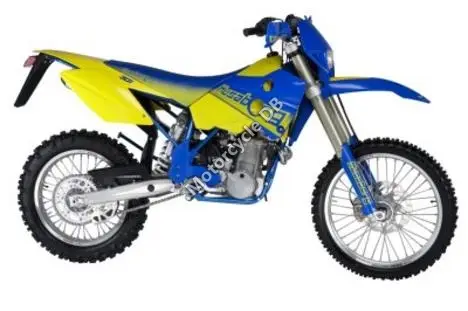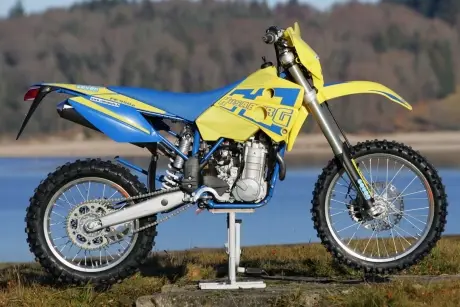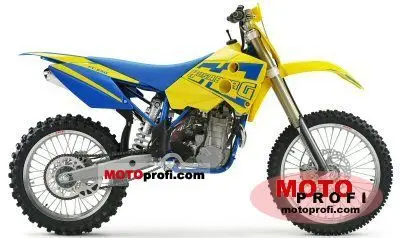
The Husaberg FC was the cross-country branch of a range built almost entirely on four-stroke singles. Its name followed the brand’s two-letter system, with F for four-stroke and C for cross-country, and like the motocross and supermoto lines it was gone from the catalogue before Husaberg’s final year.
Husaberg FC at a glance
| Maker | Husaberg Motor AB, Sweden; KTM from 1995 |
|---|---|
| Built in | Sweden until 2003, then Mattighofen, Austria |
| Class | four-stroke cross-country |
| Name | F for four-stroke, C for cross-country |
| Other letters | E enduro, X motocross, S supermoto |
| Engines | single-cylinder four-strokes, 450 to 650 cc |
| Cross-country layout | wide-ratio gearing and no lighting kit |
| Last line-up | enduro models only, from 2014 |
| Brand ended | 2014 (Husqvarna from then on) |
No Wikipedia article covers the FC on its own: the facts here come from the Husaberg brand articles in English, German, Swedish and Italian, which are in effect a single source.
History of the Husaberg FC
The letters in the name
Husaberg gave every model two letters and a number. The first letter gave the engine type, F for four-stroke or T for two-stroke; the second gave the purpose, E for enduro, X for motocross, C for cross-country and S for supermoto. The FC therefore described a four-stroke motorcycle set up for cross-country work, a class the English Wikipedia describes as having wide-ratio gearing and no lighting kit. Some older models also carried the number of gears, four or six, in their names, and a lower-case ‘e’ suffix marked an electric starter.
Four-strokes first
The company was founded in 1988 by Husqvarna engineers who stayed in Sweden after the motorcycle division was sold to Cagiva, and it built four-stroke motorcycles only until 2011. Its reputation was made with them: Husaberg won the FIM 500 cc Motocross World Championship with the Belgian rider Joël Smets in 1995, 1997 and 1998, and took six Enduro World Championships between 1990 and 1998. The slogan ‘Ready to Race’ was later adopted by KTM, the owner since 1995, and Husaberg replaced it with ‘4 Stroke force’.
The end of the off-road lines
By the 2011 model year the range mixed four-stroke enduros, a motocross and cross-country model listed as the FX 450, the FS 570 supermoto and the first two-stroke TE enduros. In the last years the supermoto, motocross and cross-country models were discontinued, and the final 2014 line-up, the brand’s 25th anniversary, was enduro-only: the FE 250, FE 350, FE 450 and FE 501 and the TE 125, TE 250 and TE 300. After KTM’s majority owner bought Husqvarna in 2013, the Husaberg models were sold under the Husqvarna name.
Design and features
- Naming: F for four-stroke and C for cross-country, in a range where E meant enduro and X motocross.
- Cross-country set-up: wide-ratio gearing and no lighting kit, according to English Wikipedia.
- Four-stroke expertise: the brand built nothing but four-strokes until 2011.
- Racing record: three 500 cc Motocross World Championships with Joël Smets, in 1995, 1997 and 1998.
- Short life: the motocross and cross-country lines were gone from the catalogue before 2014.
Husaberg FC versions
- FC models: the four-stroke cross-country machines of the range.
- FX 450 (2011): the 450 cc four-stroke listed as the motocross and cross-country model of that year.
- FS 570 (2011): the supermoto, using the S letter of the naming system.
- Final enduro range (2014): FE 250, FE 350, FE 450, FE 501 and TE 125, TE 250, TE 300, with no cross-country models.
The four-stroke enduros that outlived the FC line are the Husaberg FE 450 and the Husaberg FE 501, and the two-strokes of the final years are the Husaberg TE. All models are in the Husaberg collection.
Video: husaberg fc 450 a homokmenő
Video on YouTube.
Sources
- Husaberg, English Wikipedia: model naming, palmares, 2011 and 2014 ranges
- Husaberg, German Wikipedia: founding, KTM takeover, Mattighofen production
- Husaberg, Swedish Wikipedia: four-stroke-only years, model years
- Husaberg, Italian Wikipedia: naming system, engines from KTM