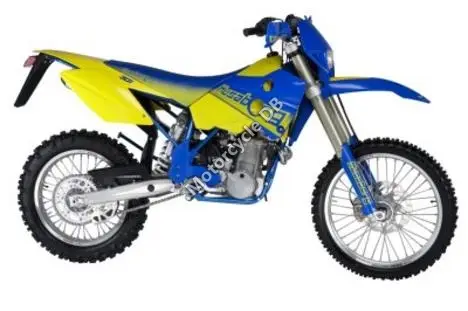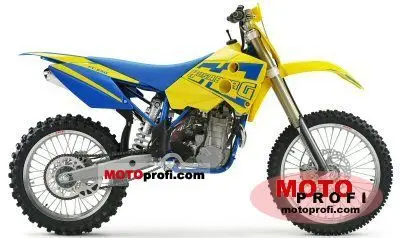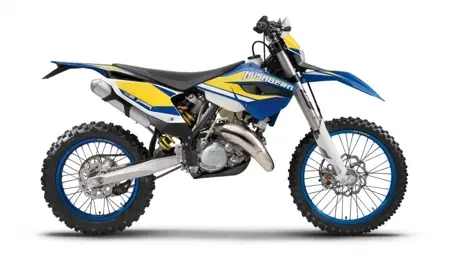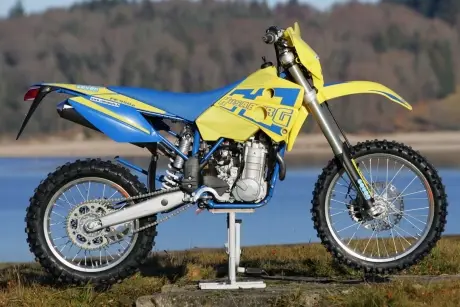
The Husaberg FE 450 is a 450 cc four-stroke enduro from the Swedish brand founded by former Husqvarna engineers. It joined the range in 2003, was part of the new laid-down-engine generation presented in 2009, and from 2013 used KTM engines until the Husaberg name was retired at the end of 2014.
Husaberg FE 450 at a glance
| Maker | Husaberg Motor AB, Sweden; KTM from 1995 |
|---|---|
| Built in | Sweden, then Mattighofen, Austria, from 2003 |
| Class | four-stroke enduro |
| Displacement | 450 cc |
| In the range from | 2003 |
| Engine | single-cylinder four-stroke; KTM engine from 2013 |
| Name | F for four-stroke, E for enduro |
| Electric start | marked by an ‘e’ suffix, as in FE 450e |
| New for 2009 | laid-down engine in the FE 390 / FE 450 / FE 570 range |
| Model years listed | 2010, 2011, 2014 |
| Final year | 2014 |
| Successor brand | Husqvarna |
No Wikipedia article covers the FE 450 on its own: the facts here come from the Husaberg brand articles in English, German, Swedish and Italian, which are in effect a single source.
History of the Husaberg FE 450
2003: the 450 cc enduro arrives
The 450 cc class entered the Husaberg range in 2003, according to the Italian Wikipedia list of the brand’s displacements, which gives 450 cc four-strokes as produced from that year. It was also the year in which production and the development department moved from Sweden to the KTM factory in Mattighofen, Austria, eight years after the Austrian manufacturer had bought Husaberg. The model carried the naming used across the range: F for four-stroke, E for enduro, with an optional ‘e’ suffix for the electric-start version.
2009: the laid-down engine
In 2009 Husaberg launched a new motorcycle with a laid-down engine, fitted for a more central centre of rotation, in four versions: the FE 390, FE 450 and FE 570 enduros and the FS 570 supermoto. The Swedish Wikipedia notes that the new model collected top marks in motorcycle magazines around the world, and quotes the Dakar rider Thomas Berglund calling it very manageable with power that arrives directly. The 2010 range was built on the chassis and engine introduced in 2009, and the FE 450 stayed in the line-up for 2011 together with the FE 390 and the FE 570.
2011–2014: the last years
Husaberg had built four-strokes only until 2011, when the first two-stroke enduros were added, and from 2013 the Italian Wikipedia records that the 450 used a KTM engine. The 2014 model year was both the brand’s 25th anniversary and its last: the range was enduro-only, with the FE 450 alongside the FE 250, FE 350 and FE 501, all with anniversary graphics, revised suspension settings and extensively reworked WP 4CS closed-cartridge forks. After KTM’s majority owner bought Husqvarna in 2013, the Husaberg models were sold under the Husqvarna name from 2014.
Design and features
- Naming: F for four-stroke, E for enduro, and an ‘e’ suffix for the electric-start version.
- Engine: a single-cylinder four-stroke of 450 cc, replaced by a KTM engine in 2013.
- 2009 generation: laid-down cylinder giving a more central centre of rotation.
- Suspension: the WP 4CS closed-cartridge forks were extensively revised for 2014, with new settings across the range.
- Long run: in the range from 2003 to the brand’s final model year, 2014.
Husaberg FE 450 versions
- FE 450 (from 2003): the original 450 cc enduro of the range.
- FE 450e: the electric-start version, identified by the ‘e’ suffix.
- 2009–2012 generation: the laid-down-engine bike shared with the FE 390 and FE 570.
- 2014 FE 450: the final model year, with 25th anniversary graphics and revised suspension.
The FE 450 sits with the other four-stroke enduros of the brand, the FE 501 and the FE 550; the two-stroke line is covered by the Husaberg TE. All Husaberg models are in the Husaberg collection.
Sources
- Husaberg, English Wikipedia: history, model naming, 2010 and 2014 ranges
- Husaberg, German Wikipedia: founding, Mattighofen production, 25th anniversary
- Husaberg, Swedish Wikipedia: 2009 laid-down engine, press reception
- Husaberg, Italian Wikipedia: production years by displacement, KTM engines