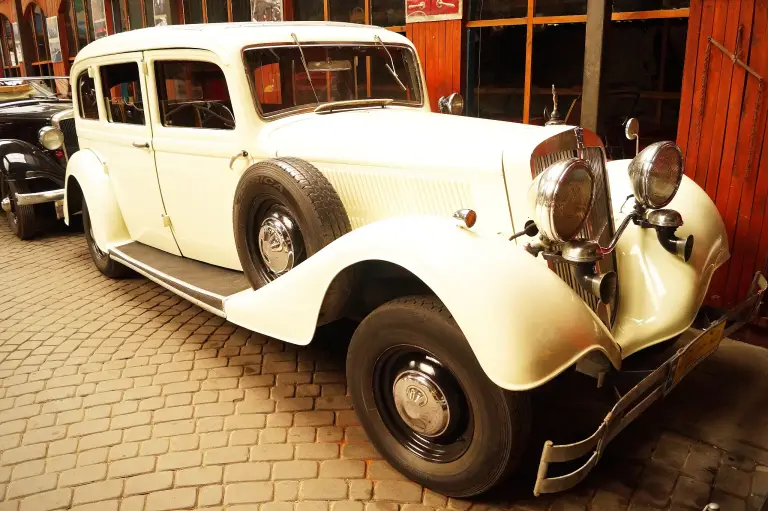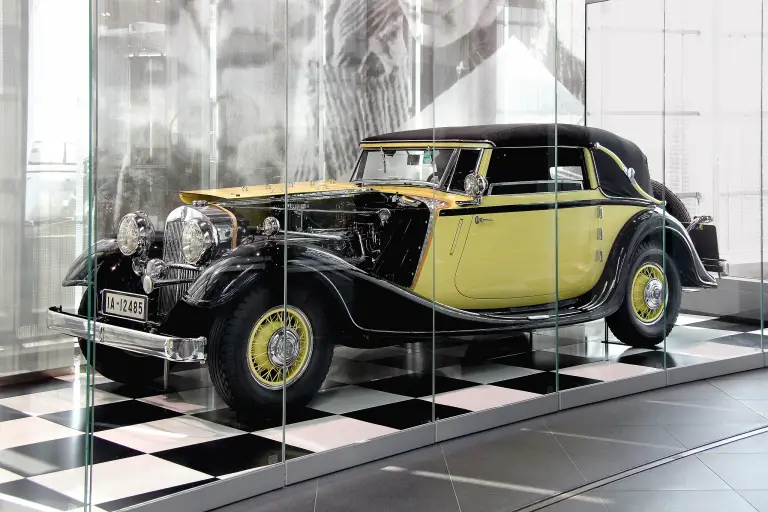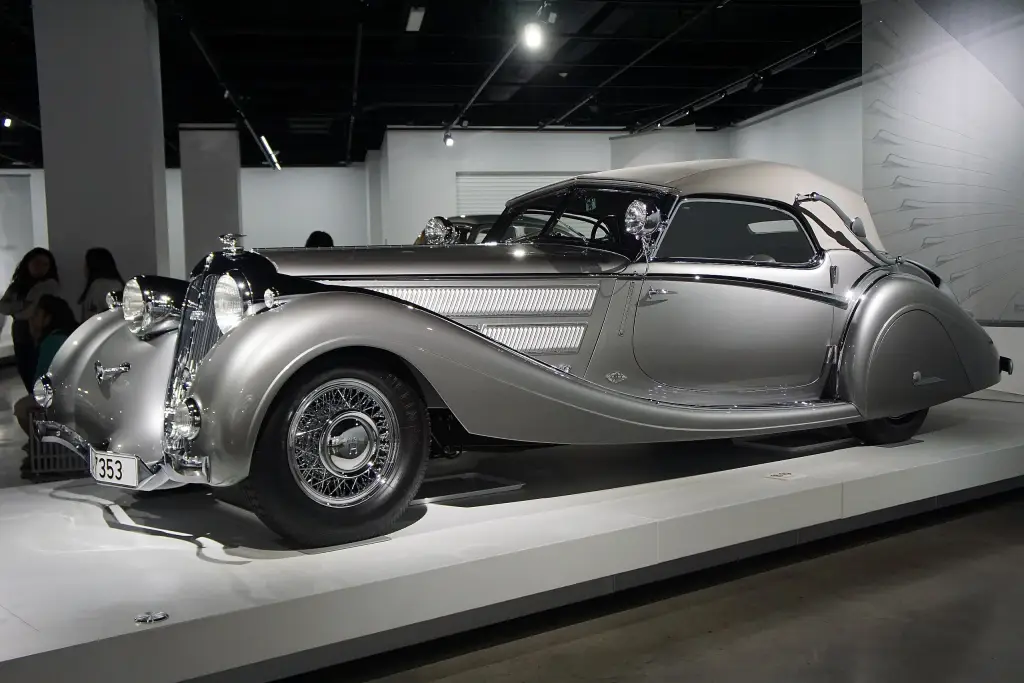
The Horch 850 was a luxury car built by Horch in Zwickau from 1935 to 1940. With its 5.0-litre straight-eight it succeeded both the Horch 8 series and the V12 600 and 670 as Horch’s top model, aimed at wealthy buyers, officials and diplomats. Around 2,200 cars of all variants, including the 851, 853, 855 and 951, were built before the war ended production.
Horch 850 at a glance
| Maker | Horch, Zwickau (Auto Union) |
|---|---|
| Production | 1935–1940 |
| Engine | 4,944 cc straight-eight, overhead camshaft |
| Bore and stroke | 87 × 104 mm |
| Power | 100 PS (74 kW), 120 PS (88 kW) from 1937 |
| Transmission | four-speed manual, overdrive optional |
| Chassis | ladder frame, 3.75 m wheelbase |
| Rear axle | rigid, De Dion on 853 and 951 |
| Brakes | hydraulic drums with vacuum servo |
| Fuel | 95 litres, about 22–23 l/100 km |
| Bodies | Pullman limousine, convertible, sport cabriolet, roadster |
| Built | about 2,200 of all variants |
History of the Horch 850
A new flagship
Horch introduced the 850 in 1935 as a larger, more expensive companion to the V8-powered 830. It had a front-mounted 5.0-litre straight-eight with an overhead camshaft driven by a vertical shaft, 100 PS at first, and a four-speed gearbox with a central lever; overdrive was optional from the start. The frame followed the previous 500 B but used box-section rails with a cross member, and the front suspension used two transverse leaf springs.
The Pullman range
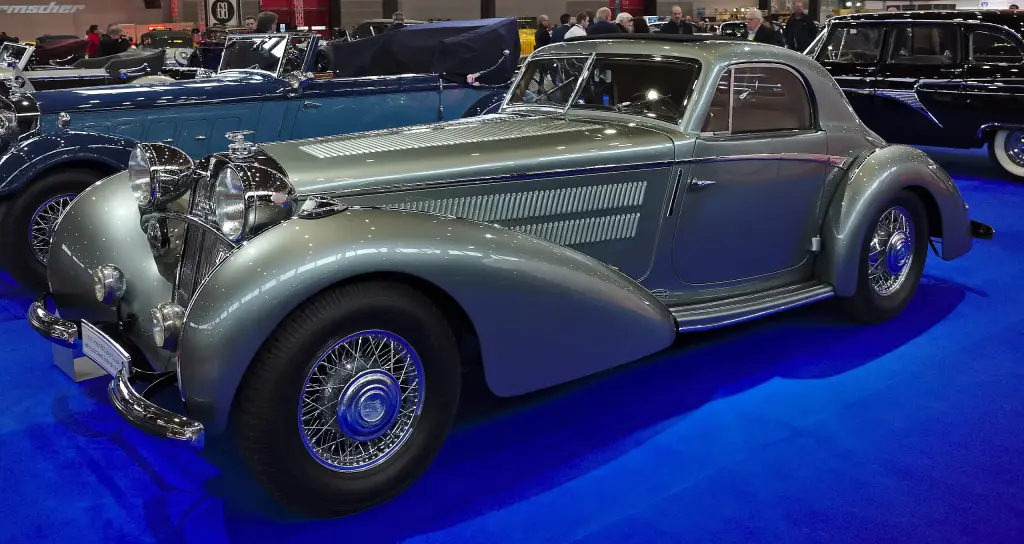
Under the works code 851 Horch offered a Pullman version with a retractable partition behind the driver, double bumpers and larger tyres. The Pullman limousines and sport cabriolets were bodied by Horch itself, while Gläser in Dresden built the four-door Pullman convertibles on chassis supplied from Zwickau. Special bodies from other coachbuilders were available on request.
1937 and the 951
A revised camshaft and a compression ratio raised from 5.8 to 6.1:1 lifted output to 120 PS in 1937, and the special bodies were dropped. In the same year the 951 replaced the 851 with a body 9 cm longer and the De Dion rear axle of the 853; the 951 A added overdrive as standard. The 853 sport cabriolet, now officially named, also received the 120 PS engine and a wheelbase 5 cm shorter than the 850 Sport. Its successor, the 853 A, came in the same year with standard overdrive, and the 855 roadster of 1938 sat on a chassis shortened to 3.3 m. Wartime restrictions ended sport cabriolet and roadster production in 1939.
Design and features
- Straight-eight of 4,944 cc: ten main bearings, an overhead camshaft driven by a vertical shaft and a compression ratio of 5.8:1, later 6.1:1.
- Chassis: box-section ladder frame with X-shaped reinforcement and independent front suspension on transverse leaf springs.
- De Dion rear axle: fitted to the 853 and later the 951, replacing the rigid axle of the early cars.
- Comfort and equipment: hydraulic brakes with Bosch Dewandre servo, a 95-litre tank and a 12-volt electrical system.
- Coachwork: in-house Pullman limousines and cabriolets, Gläser four-door convertibles, and special bodies such as the 1937 “Manuela” coupé by Erdmann & Rossi for Bernd Rosemeyer.
Horch 850 versions
- 850 (1935–1940): the standard Pullman limousine and convertible, 100 PS then 120 PS.
- 851 (1935–1937): Pullman version with a retractable partition, double bumpers and larger tyres.
- 850 Sport / 853 (1935–1939): two-door sport cabriolet on a 3.5 m wheelbase, De Dion rear axle.
- 853 A (1937–1939): 120 PS and overdrive as standard.
- 951 and 951 A (1937–1940): longer body, De Dion axle; overdrive standard on the 951 A.
- 855 (1938–1939): short 3.3 m roadster, three built according to Horch, up to seven by other accounts.
The 850 sat above the V8 Horch 830 and replaced the V12 Horch 670 at the top of the range. More cars are in the Horch collection.
Sources
- Horch 850, English Wikipedia: history, design, production split
- Horch 850, German Wikipedia: model history, bodies, production totals
- Horch, Italian Wikipedia: place of the 850 in the range