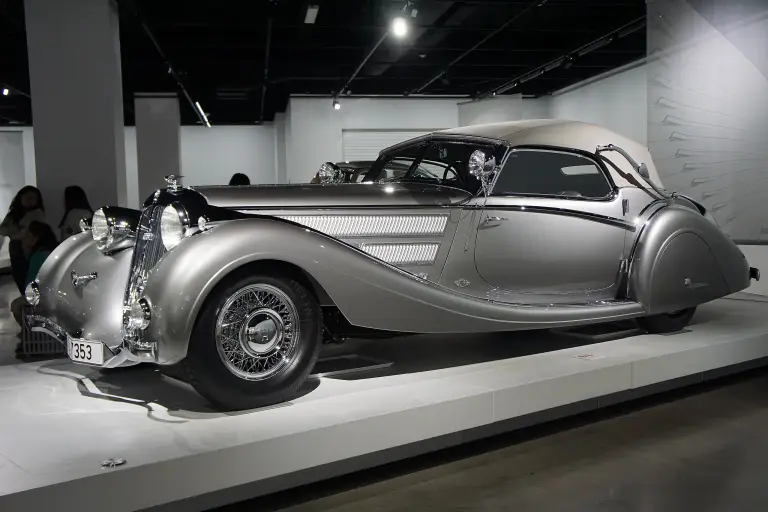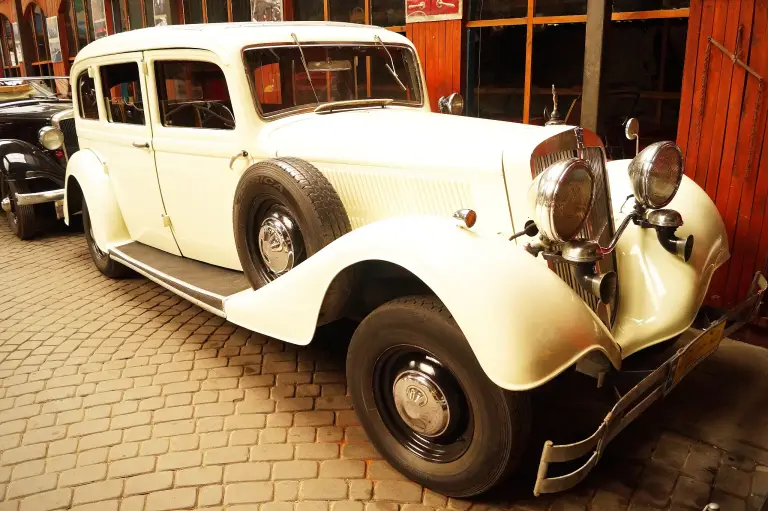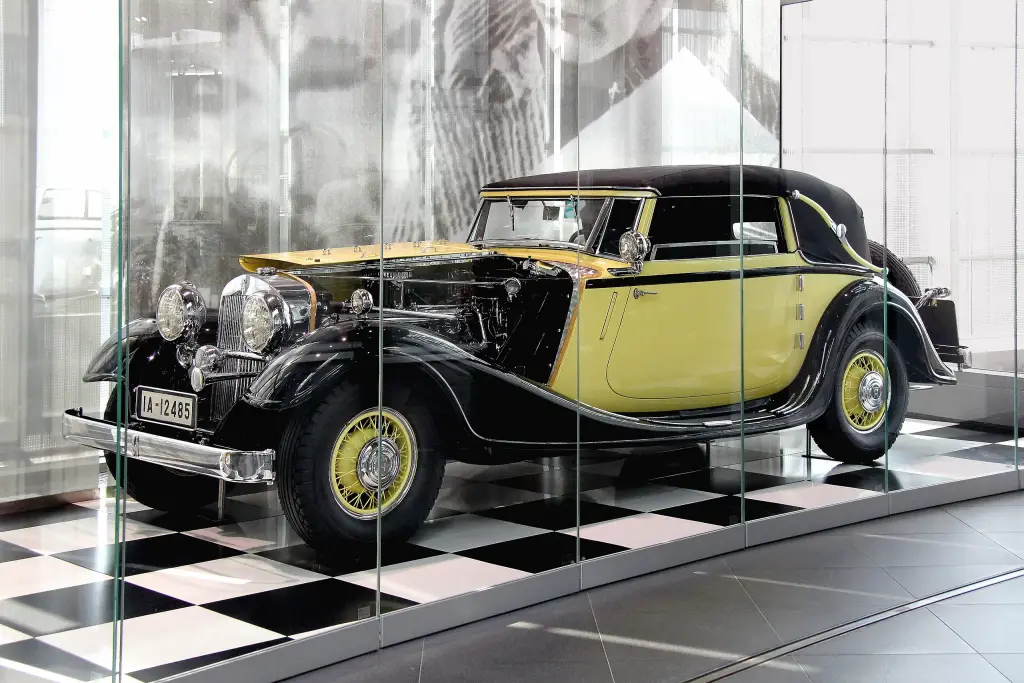
The Horch 670 was the first and only Horch to use a V12 engine. Presented at the Paris Motor Show in September 1931, it was a very large two-door, four-seat convertible by Gläser of Dresden, built on the chassis of the Horch 8. It was joined in 1932 by the longer, four-door 600, and 58 of the 670 were made between 1932 and 1934.
Horch 670 at a glance
| Maker | Horch, Zwickau (Auto Union from 1932) |
|---|---|
| Production | 1931–1934 |
| Engine | 6,021 cc V12, 66 degrees, sidevalves |
| Power | 120 PS (88 kW) at 3,200 rpm |
| Transmission | four-speed manual with ZF overdrive |
| Top speed | 145 km/h |
| Body | two-door, four-seat convertible by Gläser |
| Chassis | Horch 8 frame, 3.45 m wheelbase |
| Suspension | rigid axles with leaf springs |
| Brakes | hydraulic with Bosch Dewandre servo |
| Related model | Horch 600, longer 3.75 m chassis |
| Built | 58 (670), 23 (600) |
Based on one source: the English Wikipedia article on the Horch 12.
History of the Horch 670
A V12 above the eight-cylinder range
The Horch 12 was the first and only Horch powered by a V12, and it was placed above the Horch 8 series with its inline-eight. The Wall Street crash of 1929 made such a car hard to sell, even though the Horch was priced considerably lower than rivals such as the Maybach Zeppelin, the Hispano-Suiza J12 and the Grosser Mercedes.
Paris 1931
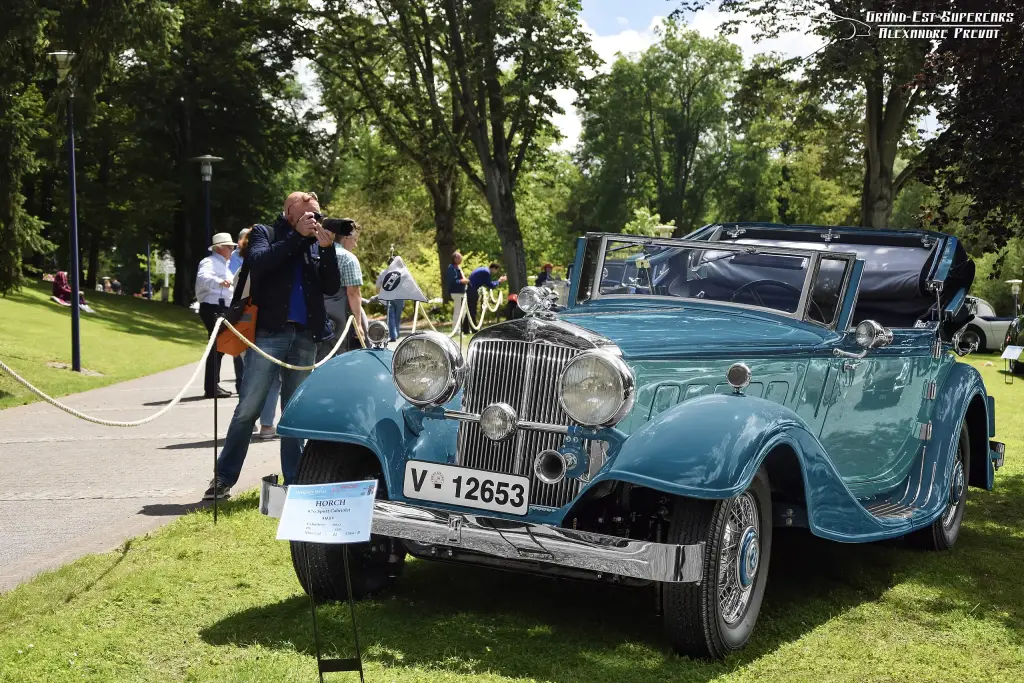
The first model in the series, the 670, was shown at the Paris Motor Show in September 1931. It was a huge two-door, four-seat convertible bodied by Gläser of Dresden, and it used the same chassis as the Horch 8 with a wheelbase of 3.45 metres.
The 600 and the end
In 1932 the 600 was introduced at the Geneva Motor Show. It was structurally and mechanically identical to the 670, but it used the chassis of the 500B with a 3.75 m wheelbase, which allowed a four-door limousine or a six-seat convertible. Twenty-three 600s were produced between 1932 and 1933. After the 600 was discontinued only the 670 remained, and 58 were made between 1932 and 1934, for a total of 81 V12 chassis. The Horch 12 had no direct successor, so the range from then on consisted only of eight-cylinder models.
Design and features
- V12 of 6,021 cc: two banks of six cylinders at 66 degrees, a seven-bearing crankshaft and a central camshaft driven by a chain with an automatic tensioner.
- Unusual valve gear: the camshaft operated horizontally arranged sidevalves through rocker arms, and the head gasket sat on an angled sealing surface.
- Hydraulic valve control: the driver could supply lubricating oil to the cylinders and pistons from the dashboard, raising compression and easing cold starts.
- Advanced chassis details: hydraulic brakes with a Bosch Dewandre servo and permanently installed hydraulic jacks for changing wheels.
- Rare survivors: four 670 convertibles are known to survive, and examples are kept at the Audi museum mobile in Ingolstadt, the Cité de l’Automobile in Mulhouse and the ZeitHaus in Wolfsburg.
Horch 670 versions
- 670 (1931–1934): the short-chassis two-door Gläser convertible, 145 km/h.
- 600 (1932–1933): the longer 3.75 m chassis with four-door limousine or six-seat convertible bodywork, slightly slower than the 670.
- V12 chassis total: 81 chassis built, of which 58 were 670s and 23 were 600s.
The 670 sat above the eight-cylinder Horch 830, and the big eight-cylinder flagship that followed it was the Horch 850. More cars are in the Horch collection.
Video: Horch 670 Sportcabriolet V12 Baujahr 1931
Video on YouTube.
Sources
- Horch 12, English Wikipedia: history, design, production, survivors