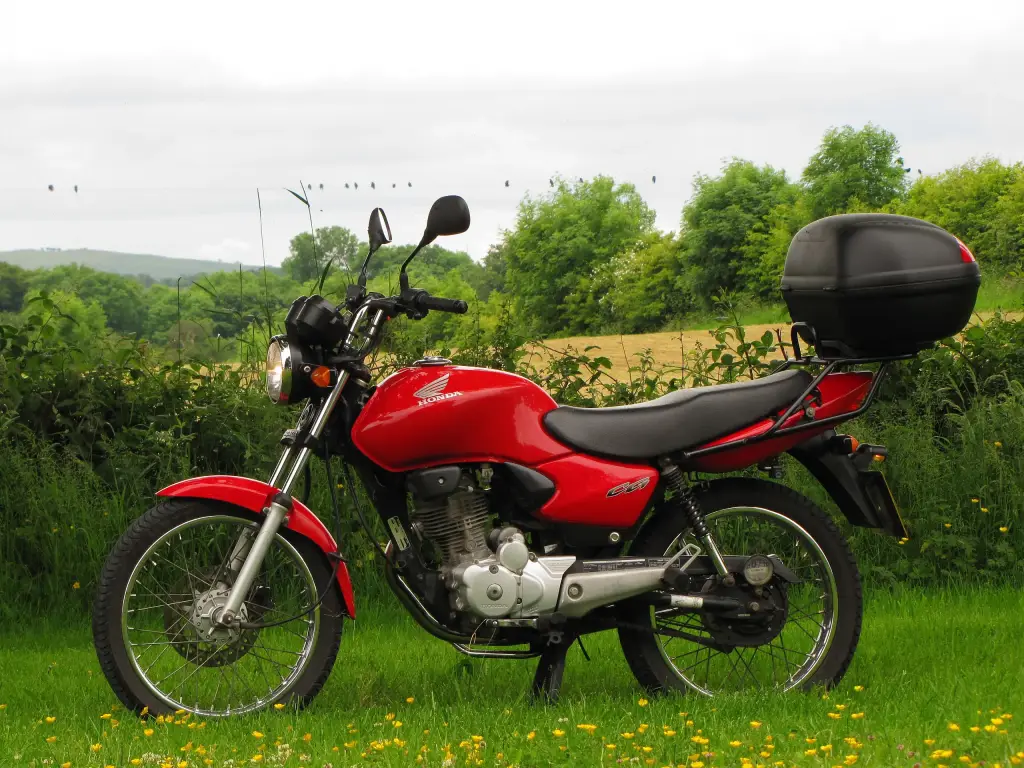
The CG125, or Honda CG, is a commuter motorcycle made by Honda. It was in production from 1976 to 2008 in Japan and has been built in Pakistan since 1992, powered by a 124 cc four-stroke overhead-valve single that has changed little over the years.
Honda CG125 at a glance
| Maker | Honda |
|---|---|
| Production in Japan | 1976–2008 |
| Production in Pakistan | since 1992 |
| Engine | 124 cc four-stroke overhead-valve single |
| Developed from | Honda CB125 |
| Valvetrain | pushrods, overhead valves |
| Air filter | washable foam |
| Chain | fully enclosed until 2004 |
| Global source from 1985 | Brazil |
| Pakistan and Turkey from 1992 | W and M models |
| Pakistani price, Sept 2025 | 238,500 rupees |
| Tank | 9.2 litres |
Based on one source, the English Wikipedia article on the CG125.
History of the Honda CG125
Built for hard use
The CG125 was developed from the CB125 for developing countries’ markets. The two models were very similar and shared many parts; the main difference was the top end, because the CB used an overhead cam. Many Honda OHC engines of that era had weak cam chains and tensioners and tended to wear camshaft bearings if oil changes were skipped. Honda knew that riders in developing countries did little preventive maintenance, so the CG was designed to be reliable with minimal servicing.
Simple engineering
The CG125 uses overhead valves with pushrods, a washable foam air filter and a fully enclosed chain. The enclosed chain was dropped in 2004.
Production around the world
The CG was originally manufactured in Japan, but the source for the global market moved to Brazil in 1985 and to Pakistan and Turkey in 1992 for the W and M models. In Pakistan the original CG125 is still produced by Atlas Honda; apart from cosmetic changes it has remained the same as the 1980s Japanese bike, with a 9.2-litre tank and a Euro 2-compliant overhead-valve engine with kick start.
Copied everywhere
The CG125 engine design has been widely replicated and reverse-engineered, particularly in Asia, Africa and Latin America. These unlicensed or locally produced variants are common in budget commuter motorcycles because of their low cost, simplicity and ease of maintenance, although build quality varies.
Design and features
- Pushrod overhead-valve engine: chosen for reliability without regular servicing.
- Washable foam air filter: cleanable instead of replaceable.
- Enclosed chain: protected from dirt until 2004.
- Worldwide production: Japan, Brazil, Turkey and Pakistan.
Honda CG125 versions
- CG125 (1976): the original Japanese commuter.
- Brazilian production (1985): source for the global market.
- W and M models (1992): Pakistani and Turkish production.
- Pakistani CG125 (to the present): essentially the 1980s design.
The CG125 replaced the CB line’s small-capacity role with a simpler engine and was itself replaced in Europe by the CBF125. More Hondas are in the Honda collection.
Sources
- Honda CG125, English Wikipedia: engine, production, copies