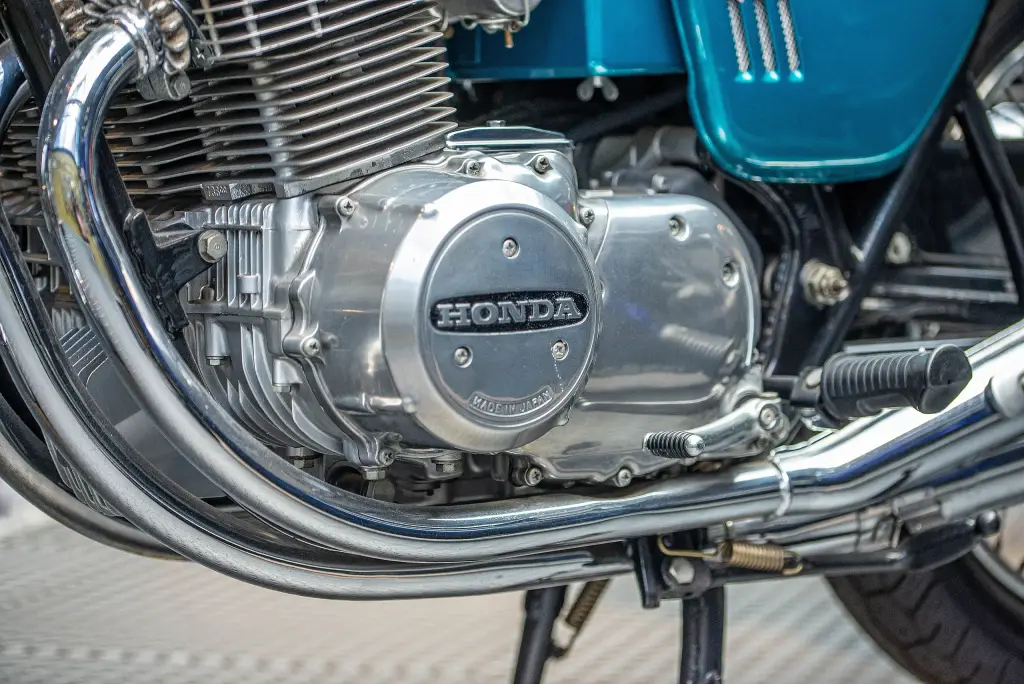
The Honda CB750 is an air-cooled, transverse inline-four motorcycle made by Honda in several generations from the 1969 to 2008 model years, with an upright standard riding posture. It is often called the original Universal Japanese Motorcycle and is regarded as the first motorcycle to be called a superbike. The CR750 was its works racing version.
Honda CB750 at a glance
| Maker | Honda |
|---|---|
| Model years | 1969–2008 |
| Engine | air-cooled transverse inline four |
| Riding position | upright, standard |
| Racing version | CR750 |
| Reputation | the first superbike and original UJM |
| Legacy | the inline-four layout became dominant in sport bikes |
| Later line | replaced by the CBX750 in 1983 |
| Recognition | AMA Hall of Fame, Art of the Motorcycle exhibition |
| SAEJ landmark | 1969 CB750 named one of 240 Japanese automotive landmarks |
Based on one source, the English Wikipedia article on the CB750 and CR750.
History of the Honda CB750
Born for America
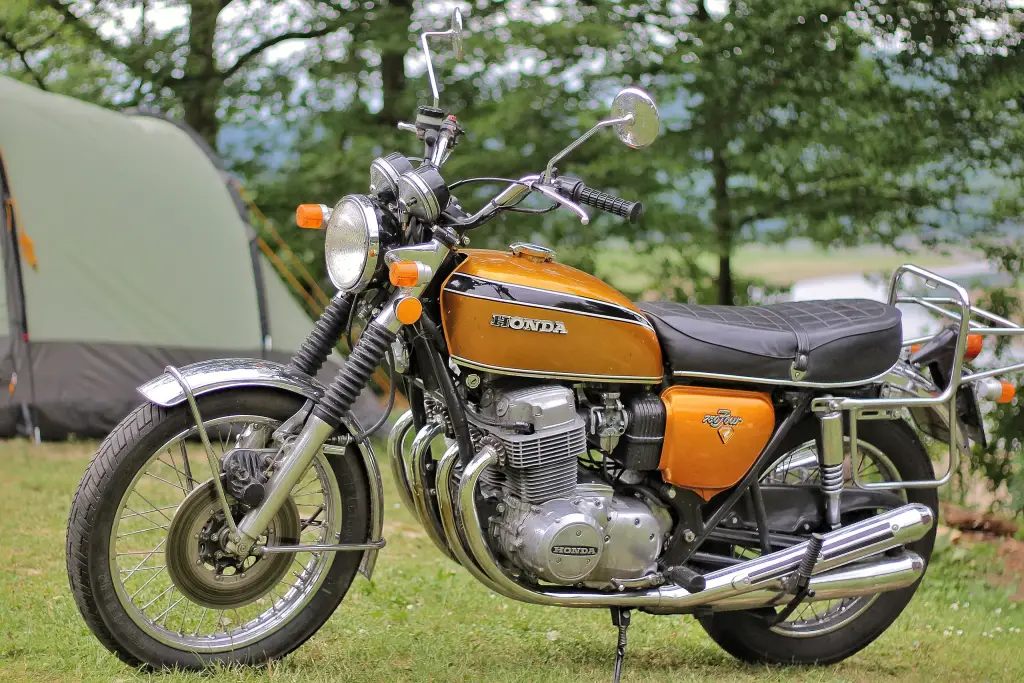
Honda introduced the CB750 to the US and European markets in 1969 after success with smaller motorcycles. In the late 1960s Honda was the world’s biggest motorcycle seller, with the C100 Cub, the C71/C72/C77 and CA77 Dreams and the CB72/77 Super Hawks. Profits from those machines financed Honda’s racing programme, and lessons from racing went into the CB750, which was aimed directly at the US market after Honda officials met American dealers and saw the demand for a larger bike.
Racing roots
In 1967 American Honda’s service manager Bob Hansen discussed with Soichiro Honda the idea of using Grand Prix technology in bikes for American events. AMA rules allowed racing by production machines only and restricted overhead-valve engines to 500 cc while side-valve Harley-Davidsons could run 750 cc, which shaped the project that produced the CB750 and its CR750 racer.
A layout that won
Other makers had already used transverse overhead-camshaft inline fours, and the layout had appeared in racing engines before the Second World War, but Honda popularised it with the CB750 and it subsequently became the dominant sport bike engine layout. The original CB750 line of 1969–1983 was succeeded by the CBX750, which carried the CB750 designation for several derivatives.
Recognition
The CB750 is in the AMA Motorcycle Hall of Fame Classic Bikes, was named in the Discovery Channel’s Greatest Motorbikes Ever, appeared in The Art of the Motorcycle exhibition and is in the UK National Motor Museum. The Society of Automotive Engineers of Japan rates the 1969 CB750 as one of the 240 Landmarks of Japanese Automotive Technology.
Design and features
- Transverse inline four: the layout that became standard for sport bikes.
- Superbike status: the first production motorcycle widely described as a superbike.
- CR750 racer: the works version developed from the road bike.
- Long nameplate life: generations from 1969 to 2008.
Honda CB750 versions
- CB750 (1969): the original air-cooled four.
- CR750: the works racing version.
- Later CB750 generations: the name carried through to 2008.
- CBX750: the 1983 successor that reused the CB750 name on some derivatives.
The CB750 began Honda’s big four-cylinder line, continued by the CBX, CB1100 and CB1300. More Hondas are in the Honda collection.
Sources
- Honda CB750 and CR750, English Wikipedia: history, racing, legacy, recognition