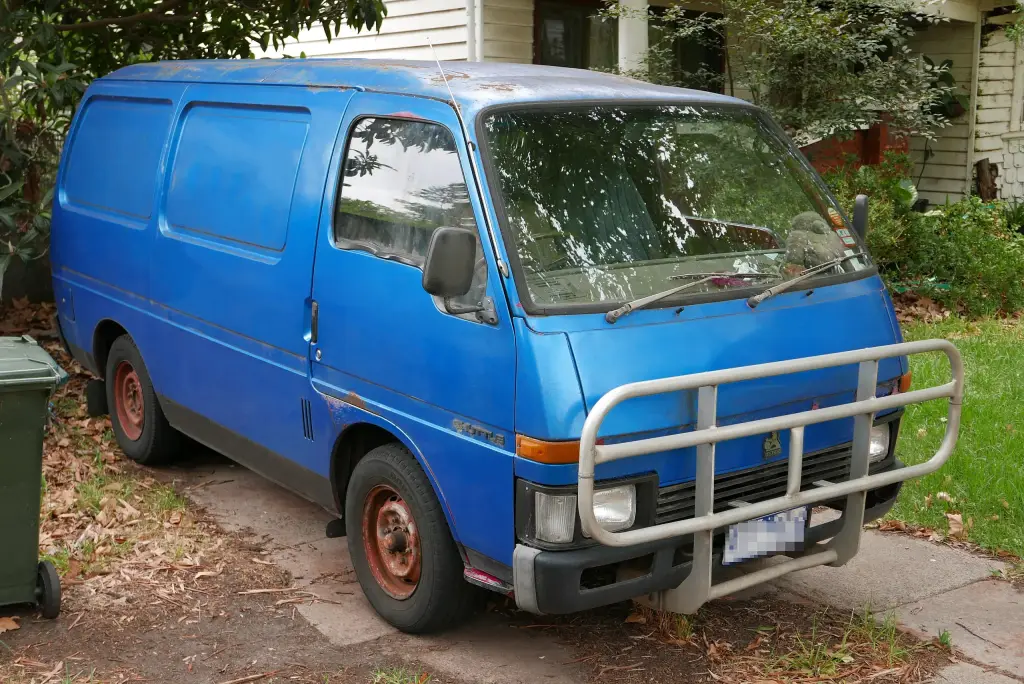
The Holden Shuttle was Holden’s version of the Isuzu Fargo light commercial van. General Motors’ Australian subsidiary released it in February 1982 as the WFR series, and it was sold in Australia until 1990.
Holden Shuttle at a glance
| Maker | Isuzu, Japan |
|---|---|
| Sold by Holden | February 1982 to 1990 |
| Model code | WFR |
| Bodies | short or long wheelbase, low or high roof |
| Side windows | with or without side cargo windows |
| First engines | 1.8-litre 4ZB1 petrol, 65 kW (87 hp); 2.0-litre 4FC1 diesel, 44 kW (59 hp) |
| From 1986 | 2.0-litre 4ZC1 petrol, 69 kW (93 hp), replacing the 1.8 |
| Gearbox | four-speed manual |
| LS edition | 9-seater people mover, October 1982, 250 built |
| LT | 9-seater people mover from August 1983 |
| Isuzu Fargo production | 1980–2001 |
History of the Holden Shuttle
An Isuzu van for Australia
The Isuzu Fargo was a light commercial van built in Japan from 1980 to 2001, spanning two generations. The first was sold from 1980 to 1995 as both van and pickup, while the second, introduced in 1995, was a badge-engineered Nissan Caravan rather than an Isuzu design.
Between 1982 and 1990 the first-generation Fargo was marketed in Australia by Holden as the Holden Shuttle. Elsewhere the same van was sold as the Isuzu WFR in Europe and New Zealand, the Chevrolet WFR in Colombia, and in the United Kingdom it was built by Vauxhall Motors and sold as the Bedford Midi and then the Vauxhall Midi.
What Holden sold
The original Shuttle came in short and long wheelbase form, with low or high roofs, each available with or without side cargo windows. Two engines were offered: a 1.8-litre 4ZB1 petrol rated at 65 kW (87 hp) and a 2.0-litre 4FC1 diesel putting out 44 kW (59 hp), both with a four-speed manual transmission. In 1986 the 1.8 petrol was withdrawn and replaced by the 2.0-litre 4ZC1 petrol producing 69 kW (93 hp).
The LS and LT people movers
Alongside the single cargo-carrying model Holden offered a limited edition LS, a highly specified nine-seater people mover, in October 1982. Only 250 were built for Australia. In August 1983 Holden introduced the LT nine-seater, a lower specification that lacked many of the LS’s luxury features including its dual-zone air conditioning. An AM/FM radio with cassette player and a digital clock were standard equipment.
The Fargo underneath
The first-generation Fargo was introduced in December 1980 with 1.6 and 1.8-litre petrol engines and a 1.8-litre diesel, plus a 2.0-litre diesel that was at first available only in the wagon and reached the commercial van in August 1981. It had an underfloor engine, in the manner of Japanese vans of the period. Through the 1980s the Fargo gained a facelift in January 1986 with wider, more trapezoidal headlights and a new instrument panel, an automatic transmission on rear-wheel drive variants in 1987, and in 1991 the 2.4-litre 4FG1 diesel that replaced the earlier units.
Design and features
- Isuzu design: the Shuttle was an Isuzu Fargo with Holden badges, not a Holden design.
- Body choice: short or long wheelbase, low or high roof, with or without side windows.
- Underfloor engine: a layout typical of Japanese vans of the period.
- LS people mover: a 9-seater edition limited to 250 cars for Australia.
- Global twin: also sold as the Bedford Midi and Vauxhall Midi in Britain.
Holden Shuttle versions
- Cargo van: the single load-carrying model of the Shuttle range.
- LS (1982): 9-seater people mover, 250 built.
- LT (1983): lower-specification 9-seater people mover.
- Bedford Midi and Vauxhall Midi: the British-built versions of the same van.
The Shuttle was Holden’s van of the 1980s, smaller than the Holden Rodeo pickup and unrelated to the Holden Commodore. More cars are in the Holden collection.
Sources
- Isuzu Fargo, English Wikipedia: Shuttle history, engines, bodies