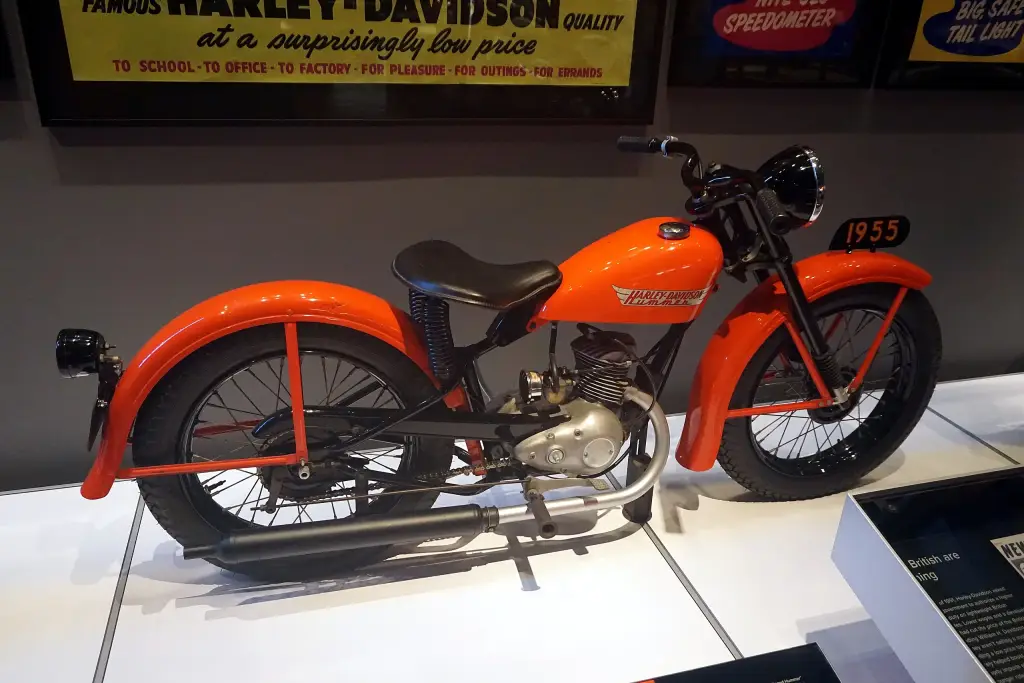
The Harley-Davidson 125 was a small two-stroke motorcycle built from 1948 to 1952. It was a near-copy of the DKW RT 125, whose design was no longer protected after the war, and it was meant to put a cheap motorcycle under the American soldiers who had come home wanting one.
Harley-Davidson 125 at a glance
| Production | 1948–1952 |
|---|---|
| Based on | DKW RT 125, designed under Hermann Weber, built by Auto Union in Zschopau 1940–1944 |
| Engine | air-cooled single-cylinder two-stroke, 125 cc |
| Engine detail | flat piston, Schnürle reverse scavenging, mixture lubrication |
| Frame | closed single-tube frame, rigid rear end |
| Front fork | parallelogram fork with rubber-band springing, telescopic from 1951 |
| Price in 1948 | 325 US dollars |
| Finish | black throughout; chrome rims 7.50 dollars extra |
| Seats | one only, no passenger seat and no provision for one |
| Stand | side stand only, no centre stand |
| Successor | Model 165, from 1953 |
The 125 has no English Wikipedia article; this page is based on one source, the German Wikipedia article.
History of the Harley-Davidson 125
After the Second World War the soldiers who returned to the United States had seen or ridden military Harley-Davidsons and wanted motorcycles of their own, and the company decided to build a cheap machine for that large group of customers. The choice fell on a copy of the DKW RT 125, which had been built in large numbers for the Wehrmacht until 1944; after the war the design was no longer protected and was copied in several countries, in the Soviet Union as the M1A Moskwa and K-125 from 1946 and in Britain by BSA as the Bantam D1 from 1948.
The Harley-Davidson version was meant to go on sale in 1947, but production only began early in 1948. A running prototype was shown to dealers in Milwaukee on 24 November 1947, the first service manual is dated December 1947 and a rider’s handbook appeared in January 1948. In 1948 the 125 cost 325 dollars, and frame, tank, mudguards and fittings were painted black as standard, with chrome rims available for 7.50 dollars more. There was no passenger seat and no way of fitting one, though the 1949 accessory catalogue offered a luggage rack, a windscreen, crash bars and a stop light.
Technically the 125 followed its DKW original closely: a closed single-tube frame, a parallelogram front fork with rubber-band springing and an unsprung rear wheel, and an air-cooled single-cylinder two-stroke with a flat piston, Schnürle reverse scavenging and mixture lubrication. The crankcase and cylinder head were aluminium alloy and the cylinder cast iron, and both the primary and the secondary drive were by chain. The ignition lock sat in the tank and the only stand was a side stand. The model was steadily updated, and the most important change was the fitting of a hydraulically damped telescopic fork from 1951. In 1953 it was replaced by the Model 165 with a larger bore.
Design and features
- DKW engineering: the frame, fork and two-stroke engine follow the German RT 125 almost unchanged.
- Low price: 325 dollars in 1948, with black paint as standard.
- Simple chassis: rigid rear end, parallelogram fork and a side stand instead of a centre stand.
- Running update: a telescopic front fork arrived in 1951, shortly before the model was replaced.
Harley-Davidson 125 versions
- 125 (1948–1952): the standard machine, black with chrome rims as an option.
- Later 125 with telescopic fork (1951–1952): hydraulically damped front suspension and wider mudguards.
- Model 165 (1953–1959): the bored-out successor with a restyled top end and a slightly longer wheelbase.
The other Italian-built light Harley of the 1960s is described in the article on the M-50. The modern small Harley is the Street, and the whole marque is gathered in the Harley-Davidson collection.
Sources
- Harley-Davidson 125, German Wikipedia: history, price, specification, updates