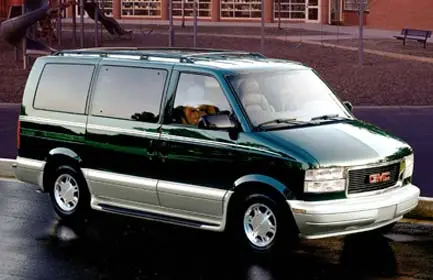
The GMC Safari is a minivan that General Motors built and sold from 1985 to 2005 alongside the Chevrolet Astro. It was the first minivan from GM and, unlike the Chrysler minivans it was meant to answer, it used a rear-wheel-drive chassis with light truck running gear.
GMC Safari at a glance
| Class | minivan, passenger and cargo |
|---|---|
| Production | 1985-2005 |
| Twin model | Chevrolet Astro |
| Layout | rear-wheel drive, all-wheel drive from 1990 |
| Built at | Baltimore Assembly, Maryland |
| Total Astro and Safari production | about 3.2 million |
| Seating | two to eight passengers |
| Engines | 2.5 L four with 98 hp to a 4.3 L V6 with 200 hp |
| Towing capacity | up to 5,500 lb |
| Wheelbase codes | M-body rear-wheel drive, L-body all-wheel drive |
| Manual gearbox | BorgWarner T-5 until 1989 |
| Final year | 2005 |
Based on one source, the English Wikipedia article on the Chevrolet Astro, which covers the Safari as its GMC twin. No free photograph of a Safari was found.
History of the GMC Safari
A truck-based minivan
The Safari and the Chevrolet Astro were introduced for the 1985 model year as GM’s first minivan. While they were marketed as a response to the first Chrysler minivans, GM chose a rear-wheel-drive layout and sized the vans close to the short-wheelbase Chevrolet G10 van. To keep costs down GM adapted light-truck powertrain components, with engines and transmissions from the Chevrolet S-10, which allowed a towing capacity of up to 5,500 lb. GMC took the Safari name from Pontiac, which had used it for its station wagons, and between 1985 and 1989 both GMC and Pontiac Safaris were sold through the same dealership network. Advertising promised a vehicle that would make buyers realise life is too big for a minivan.
First generation (1985-1994)
The van could be configured for between two and eight passengers. Engines ranged from a 98 hp 2.5-litre four to a 200 hp 4.3-litre V6, the four being offered only in short rear-wheel-drive cargo vans and in passenger vans for 1985 before being dropped after 1990. The 4.3 used a four-barrel carburettor in 1985, throttle-body injection from 1986 and central port injection from 1992. The rear-wheel-drive M-body and all-wheel-drive L-body vans had a bolt-on subframe, front suspension shared largely with the GM B-body station wagons and a leaf-spring rear axle. Digital dashboards were offered at first and dropped after 1995, and the BorgWarner T-5 manual was available until 1989, after which 700R4 and 4L60 automatics were used until 1993.
All-wheel drive and updates
For 1990 GM added an all-wheel-drive system, the first in a US-built minivan, designed by FF Developments; it used a BorgWarner 4472 transfer case and returned 17 mpg on the highway against 20 to 21 for rear-wheel-drive vans. That year also brought an analogue dashboard and Hydroboost braking, and in mid-1990 an extended body sharing the same wheelbase. In 1992 a Dutch door rear opening became available, with two bi-parting doors and a flip-up window, and the 4L60E four-speed automatic became the only transmission for 1993. For 1994 the vans gained centre high-mounted stop lamps.
Second generation (1995-2005)
For 1995 the front was facelifted with a longer nose resembling the new full-size Express vans, higher trims gained horizontally mounted rectangular headlights and the short body was dropped. A redesigned dash with a passenger-side airbag arrived in 1996. For 2003 both vans received chassis upgrades, four-wheel disc brakes and six-lug 16-inch wheels from the half-ton pickups. Production in 1998 was 32,736 units, after which sales declined and the second shift was eliminated. The Safari was not replaced directly: GMC moved its family transport to the Savana and later to crossovers.
Design and features
- Rear-wheel drive: a truck-style layout rather than the front-drive of rival minivans.
- Light truck parts: engines and transmissions from the S-10 pickup.
- All-wheel drive: the first US-built minivan to offer it, from 1990.
- High towing capacity: up to 5,500 lb.
- Dutch doors: a split rear opening with a flip-up window, from 1992.
GMC Safari versions
- Passenger Safari: two to eight seats in short or extended bodies.
- Cargo Safari: the commercial version with the 2.5-litre four or 4.3 V6.
- All-wheel-drive Safari (1990-2005): the L-body with a BorgWarner transfer case.
- Extended body (from mid-1990): longer rear overhang on the same wheelbase.
- Second-generation Safari (1995-2005): the facelifted version with a longer nose.
The Safari was replaced in GMC’s range by the GMC Savana and later by the GMC Acadia. Its pickup relatives include the GMC Sonoma. More cars are in the GMC collection.
Sources
- Chevrolet Astro, English Wikipedia: production, layout, engines, all-wheel drive, model-year changes