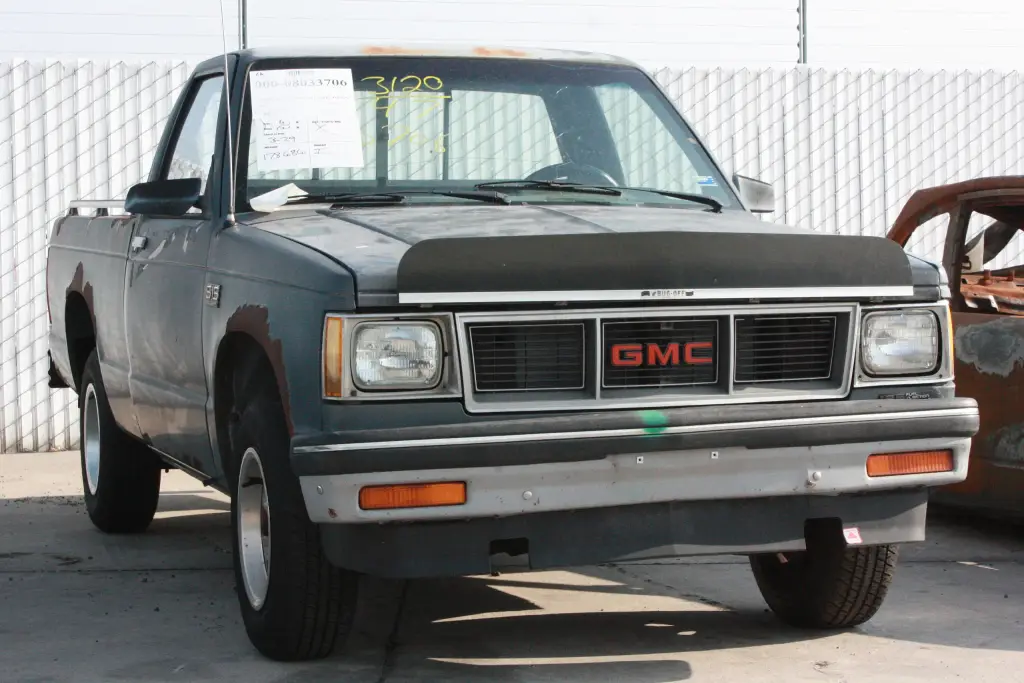
The GMC Sonoma is a compact pickup truck that GMC sold as its version of the Chevrolet S-10. Introduced for 1982 as the GMC S-15, it was renamed Sonoma in 1991 and stayed in production until the Canyon replaced it for 2004.
GMC Sonoma at a glance
| Class | compact pickup |
|---|---|
| Introduced | 1982 model year, as the GMC S-15 |
| Renamed Sonoma | 1991 |
| Chevrolet twin | Chevrolet S-10 |
| First-generation last year | 1993 |
| Engines | 1.9 L Isuzu four, 2.8 L V6, 2.0 L four, 2.2 L Isuzu diesel, 2.5 L Iron Duke, 4.3 L V6 |
| Extended cab | Club Coupe on GMC models from 1983 |
| Four-wheel drive | Insta-Trac from 1983 |
| Anti-lock brakes | from 1989 |
| Performance versions | Syclone (1991), Sonoma GT (1992) |
| Replaced by | GMC Canyon, 2004 |
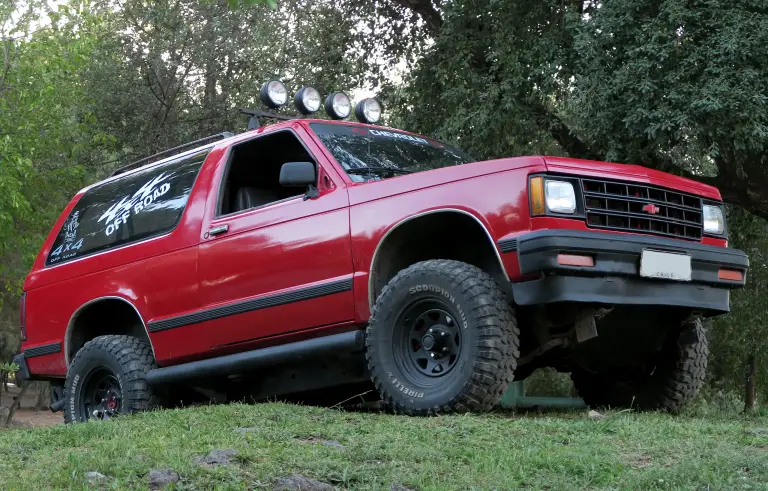
Based on one source, the English Wikipedia article on the Chevrolet S-10, which covers the Sonoma as its GMC twin. No free photograph of a Sonoma was found.
History of the GMC Sonoma
Why GM built a compact pickup
After the 1973 Arab oil embargo demand grew in North America for smaller, more affordable utility vehicles. GM’s first answer was the Chevrolet LUV, a rebadged Isuzu KB introduced in 1972 as the first compact truck from the Big Three, but the American chicken tax put a 25 percent charge on imported utility vehicles, so many LUVs had to be shipped disassembled to avoid it. GM replaced the LUV with a domestically built compact truck that would not be subject to the tax, using parts from other GM lines, mainly the G-body intermediates, with a track width similar to the H-body Vega and Monza.
The S-15 years (1982-1990)
The first S-series pickups arrived in 1981 as 1982 models. The base engine was an imported 1.9-litre Isuzu four shared with the LUV and Isuzu P’up, with a 2.8-litre V6 as an option, and the Chevrolet and GMC versions were identical apart from the grille, tailgate and badges. For 1983 GM added an extended cab, called Club Coupe on GMC models, Insta-Trac four-wheel drive and two new engines: a 2.0-litre four from the J-platform cars and an Isuzu 2.2-litre diesel. The S-10 Blazer and S-15 Jimmy SUVs arrived the same year. Heavy-duty and off-road suspensions and a hydraulic clutch came in 1984, the 2.5-litre Iron Duke replaced the 2.0 in 1985, and a 4.3-litre V6 joined the range for 1988, with anti-lock brakes the following year.
The Sonoma name and the performance trucks
The GMC S-15 became the GMC Sonoma in 1991, and the Sierra trim packages were dropped to avoid confusion with the new full-size GMC Sierra. The turbocharged Syclone appeared the same year, followed by the Typhoon SUV in 1992 and the Sonoma GT, a lower-priced performance package on the two-wheel-drive regular-cab short-bed Sonoma with a naturally aspirated Vortec 4.3 V6 of 195 hp and 260 lb-ft. Only 806 Sonoma GTs were built.
The end of the S-series
In North America the S-series was replaced in 2004 by the Chevrolet Colorado, GMC Canyon and Isuzu i-Series. Production of the S-series continued in Brazil until 2012, where it was replaced by the Chevrolet Colorado but kept the S-10 name.
Design and features
- Domestic compact: built in North America to avoid the chicken tax on imported trucks.
- Shared with Chevrolet: identical to the S-10 apart from grille, tailgate and badges.
- Club Coupe: GMC’s name for the extended cab introduced in 1983.
- 4.3 V6: the small-block-derived engine that became the performance choice.
- Sonoma GT: a 195 hp sport package with the Syclone look but without the turbo.
GMC Sonoma versions
- S-15 (1982-1990): the original GMC-badged compact pickup.
- Sonoma (1991-1993): the renamed first-generation truck.
- Syclone (1991): the turbocharged all-wheel-drive performance pickup.
- Sonoma GT (1992): a 195 hp two-wheel-drive sport package, 806 built.
- Second-generation Sonoma: the later version sold until the Canyon arrived for 2004.
The Sonoma’s SUV sibling was the GMC Jimmy, and its performance version was the Syclone. It was replaced by the GMC Canyon. More pickups are in the GMC collection.
Sources
- Chevrolet S-10, English Wikipedia: origins, engines, S-15 and Sonoma naming, Sonoma GT