The GMC Astro, also known as the Chevrolet Titan, was a heavy-duty Class 8 cabover truck manufactured by the GMC Truck and Coach Division of General Motors from the 1969 to 1987 model years. It replaced the F/D-series Crackerbox cabover and was the largest cabover truck General Motors ever produced.
GMC Astro at a glance
| Class | Class 8 heavy-duty cabover |
|---|---|
| Production | 1969-1987 model years |
| Also sold as | Chevrolet Titan, 1970-1980 |
| Predecessor | GMC F/D-series Crackerbox cabover |
| Assembled | Pontiac Central Assembly, Pontiac, Michigan |
| Cab length | 54 in bumper to back of cab |
| Axles | single or tandem rear axle |
| Base engine, 1969 | Detroit Diesel 6-71N |
| Engine options | Detroit 8V71, 12V71; Cummins N-series, KT450; Caterpillar 3406 |
| Aerodynamic option | Dragfoiler roof spoiler, from 1975 |
| Special series | SS package, standard from 1979 |
| End of production | 1987, after the Volvo-GM joint venture |
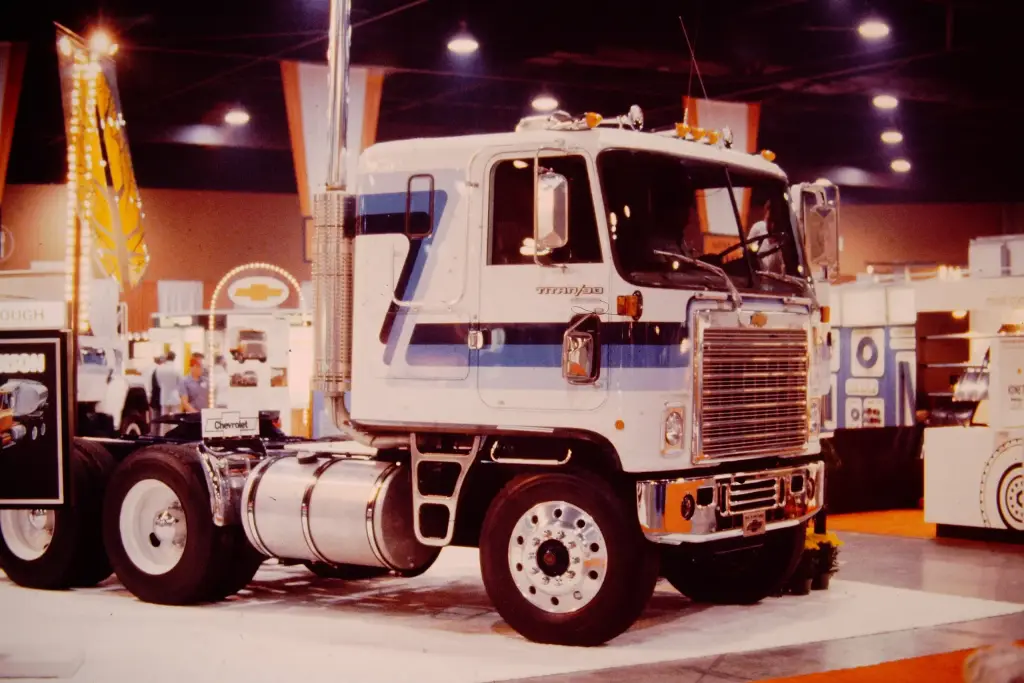
Based on one source, the English Wikipedia article on the GMC Astro. The photograph shows a Chevrolet Titan, the same truck sold under the Chevrolet name.
History of the GMC Astro
From the Crackerbox
GMC entered Class 8 cabovers in 1959 with a boxy truck that became known as the Crackerbox, built with an all-aluminium fully tilting cab in a 48-inch bumper-to-back-of-cab length. It was offered with a 702 cu in GMC V12 petrol engine or with Detroit Diesel 6-71, 6V71, 8V71 and 12V71 engines, on single or tandem axles and with a sleeper cab. In the late 1960s American manufacturers began updating their cabovers, and design work started on an all-new replacement that would also be sold by Chevrolet.
Astro and Titan
For 1969 the Crackerbox was replaced by the GMC Astro, and Chevrolet unveiled its Titan for 1970. The cab was lengthened by nearly six inches to a 54-inch bumper-to-back-of-cab length, and two sleeper cab configurations were available. The Astro and Titan were sold with single or tandem rear axles and introduced a wraparound dashboard, with the speedometer and tachometer directly in the driver’s line of sight and the secondary gauges placed to the side according to how often they were used.
Design changes
In contrast to the boxy Crackerbox, the Astro had rounded body corners and wraparound windscreen glass. GMC introduced the Dragfoiler roof spoiler as an option in 1975, and in 1979 the SS, or Special Series, package became standard: it brought a much larger radiator grille and improved exterior and interior trim aimed at owner-operators. In 1983 the Aero Astro package arrived for better fuel economy, adding the Dragfoiler, body extension panels between cab and trailer, an air dam below an extended bumper and an optimised grille.
Engines and the end
When it was introduced in 1969 the Astro was marketed exclusively with diesel engines: the Detroit Diesel 6-71N as standard, with the 8V71 and Cummins N-series as options. The Detroit 12V71 became available in 1972 and stayed until 1978, and in 1977 the Cummins KT450 and Caterpillar 3406 joined the list. The 6-71 was replaced by the 6V92 in 1979. After 1980 Chevrolet left the heavy-truck market, so the Astro was sold only as a GMC. In 1986 Volvo took an 85 percent stake in a heavy-truck joint venture with GM, and the Astro was discontinued after 1987 without a direct replacement.
Design and features
- Wraparound dashboard: the main instruments sat directly in the driver’s line of sight.
- Aluminium tilting cab: a legacy of the Crackerbox carried into the new design.
- Dragfoiler spoiler: an early aerodynamic aid, offered from 1975.
- Aero Astro package: body extensions, air dam and optimised grille for fuel economy, from 1983.
- Diesel only: no petrol engine was offered in the Astro from the start.
GMC Astro versions
- Astro (1969-1987): the GMC-badged cabover.
- Chevrolet Titan (1970-1980): the same truck sold through Chevrolet dealers.
- SS package (1979): larger grille and upgraded trim for owner-operators.
- Aero Astro (1983): aerodynamic package with roof spoiler, side extensions and air dam.
- Sleeper cabs: two sleeper configurations were offered alongside the day cab.
The Astro was sold alongside the conventional GMC Brigadier and GMC General. More trucks are in the GMC collection.
Sources
- GMC Astro, English Wikipedia: production, design, engines, end of production