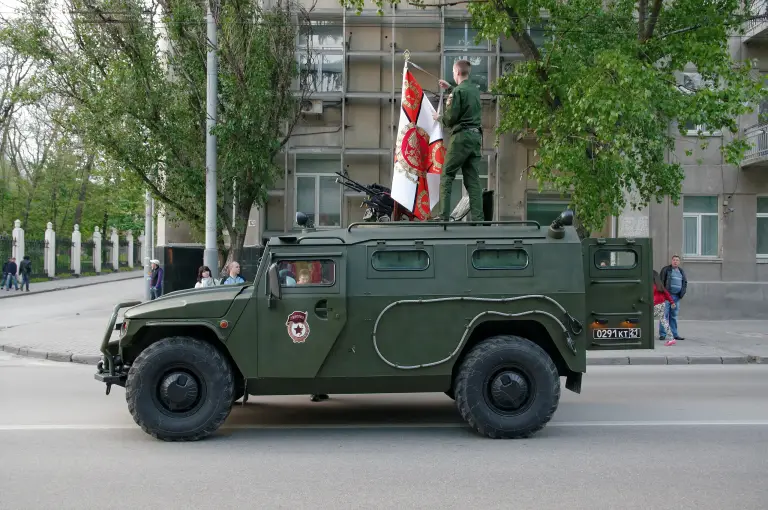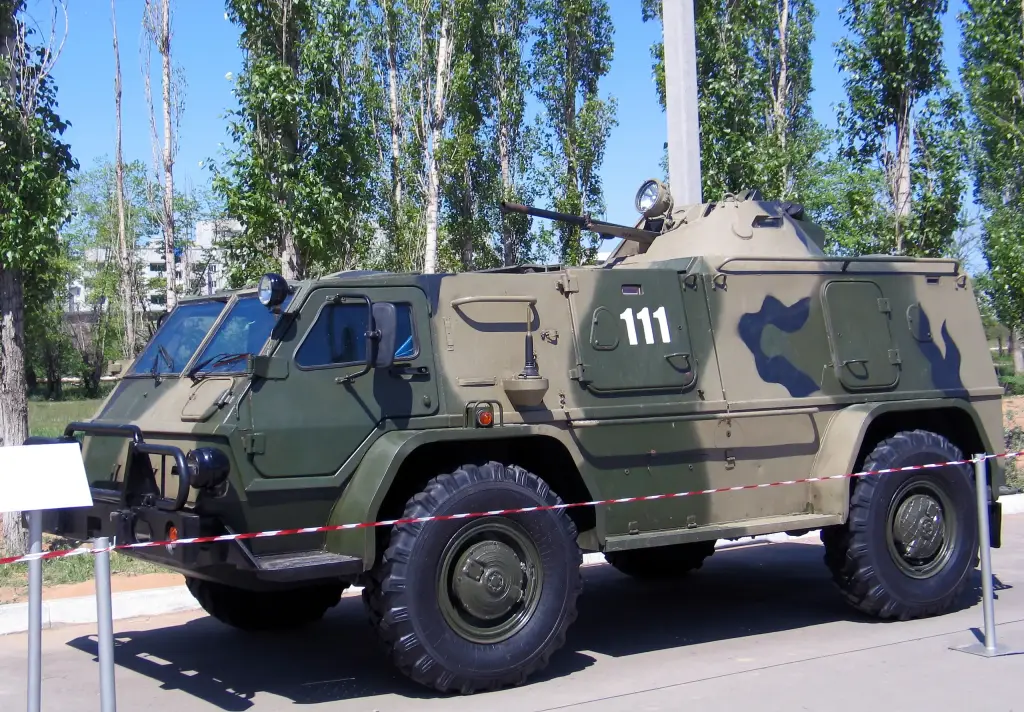
The GAZ-3937 Vodnik is a Russian 4×4 armoured vehicle with a modular body, designed in the design bureau of the Gorky Automobile Plant (GAZ) and built at the Arzamas Machine-Building Plant. It carries people or cargo in difficult terrain and protects the crew from small arms. This page gives the key figures, the history, the two versions (GAZ-3937 and GAZ-39371) and answers to common questions.
GAZ-3937 Vodnik at a glance
| Type | 4×4 armoured multipurpose vehicle with a modular body |
|---|---|
| Manufacturer | designed at GAZ, built at the Arzamas Machine-Building Plant |
| Military production | for the Russian Ministry of Defence since 2005 |
| Engine | GAZ-5621 six-cylinder turbodiesel, 3,200 cc, licensed from Steyr-Daimler-Puch |
| Power | 175 hp |
| Top speed | 120 km/h on the road (112 km/h in another passage of English Wikipedia); 4–5 km/h afloat |
| Range | 700–1,000 km |
| Gross weight | 6,600–7,500 kg |
| Payload | 1,500–2,500 kg |
| Seats | up to 10–11 (Russian Wikipedia); 6 in the specification of English Wikipedia |
| Length | 5,100 mm (Russian Wikipedia) or 5,800 mm (English Wikipedia) |
| Width | 2,600 mm |
| Height | 2,300 mm (Russian Wikipedia) or 2,630 mm (English Wikipedia) |
| Wheelbase and track | 3,000 mm and 2,200 mm |
| Ground clearance | 475 mm |
The two Wikipedia articles disagree on length, height and the number of seats, so the table shows both values. The top speed of 112 km/h in the English description does not match the 120 km/h in its own specification table.
History of the Vodnik
The Vodnik was designed to an order of the Soviet Ministry of Defence under the research theme “Vodnik”. Russian Wikipedia says that the other vehicle built under this theme, the floating NAMI-0281 of 1988, had a completely different layout with the engine at the rear. Neither it nor the GAZ-3937 met every requirement of the competition: a gross weight of up to 4,000 kg and transport by Mi-8 helicopter. English Wikipedia dates the start of the NAMI-0281 design to 1985 and calls the Vodnik a “heavy modification” of the civil GAZ-2330 Tigr.
The vehicle was nevertheless produced: Russian Wikipedia says it has been made for the Russian Ministry of Defence since 2005, and English Wikipedia says it was adopted by the Russian Armed Forces. Uruguay received 48 GAZ-39371 vehicles in 2006. Russian Wikipedia also lists 54 vehicles with the Russian Ministry of Interior (4 GAZ-39344 and 50 GAZ-39371-011).
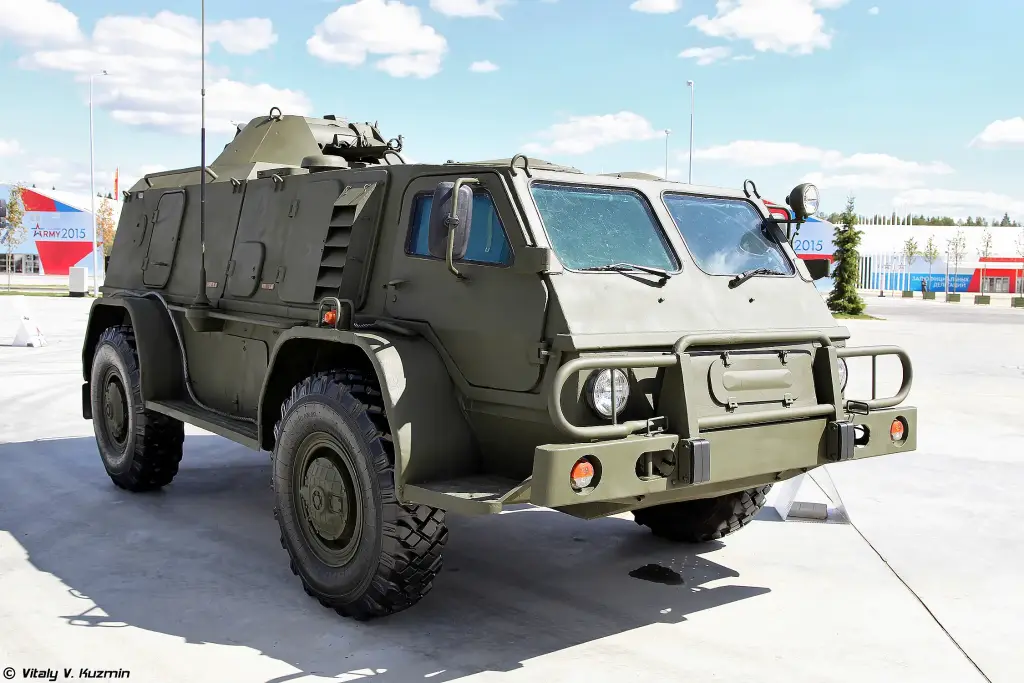
Design and features
- Modular body: the welded hull has two removable modules. The front module holds the engine and the driver’s compartment, separated by a sealed bulkhead; the rear multipurpose module can be exchanged in the field with a quick-release connection.
- Roles: one chassis can carry people, cargo and equipment to remote areas, living units and other utility modules, or serve as a fuel tanker or a carrier for tanks and containers.
- Running gear: disengageable front-wheel drive, independent torsion bar suspension, central tyre pressure control and power steering.
- Comfort: a powerful heating system and air conditioning.
- Water: English Wikipedia describes the Vodnik as amphibious, driving itself on its wheels when afloat. The Russian article does not mention swimming.
- Armament: English Wikipedia says it may carry a BPU-1 turret with a 14.5 mm KPV and a 7.62 mm PKT machine gun, or a BPPU turret with a 30 mm 2A72 cannon.
Vodnik versions
- GAZ-3937: the driver and a passenger sit one behind the other on the left of the vehicle, with the engine to their right.
- GAZ-39371: the nose is pushed forward over the wheel arches and the cab seats three, with a second passenger to the right of the driver.
- GAZ-39344 and GAZ-39371-011: variants named in the list of Ministry of Interior vehicles in Russian Wikipedia.
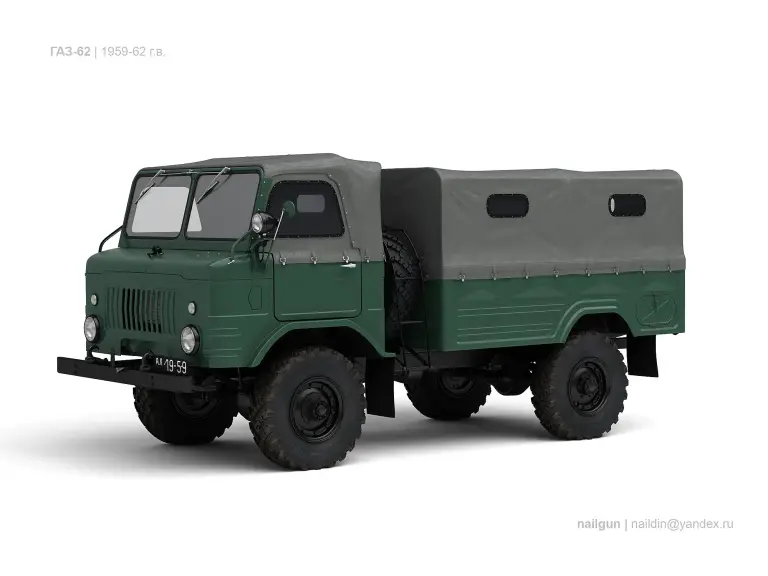
The Vodnik is related to the GAZ-2330 Tigr. More Russian trucks and off-roaders are in our GAZ collection, for example the GAZ 66.
GAZ-3937 Vodnik questions and answers
What does Vodnik mean?
English Wikipedia explains that “vodnik” is Russian for a person employed in water transport, and the word is also used for things related to water.
Who builds the GAZ-3937?
It was designed at GAZ and is built at the Arzamas Machine-Building Plant.
What engine does the Vodnik have?
The GAZ-5621, a 3.2-litre six-cylinder turbodiesel of 175 hp, based on a Steyr-Daimler-Puch engine built under licence.
Is the Vodnik amphibious?
English Wikipedia says yes: a sealed hull lets it float and it moves at 4–5 km/h on its wheels. The Russian article does not state it.
What is the difference between the GAZ-3937 and the GAZ-39371?
The cab layout. In the GAZ-3937 the engine sits to the right of the driver; in the GAZ-39371 the nose is longer and the cab seats three people.
Who uses the Vodnik?
The Russian armed forces and interior ministry, and Uruguay with 48 GAZ-39371. English Wikipedia also lists Syria.
Video: GAZ 3937 Vodnik (4×4)
Video by yolkhere on YouTube.
Sources
- ГАЗ-3937, Russian Wikipedia: design, history, specifications, operators
- Vodnik (Russian military vehicle), English Wikipedia: description, versions, armament, operators