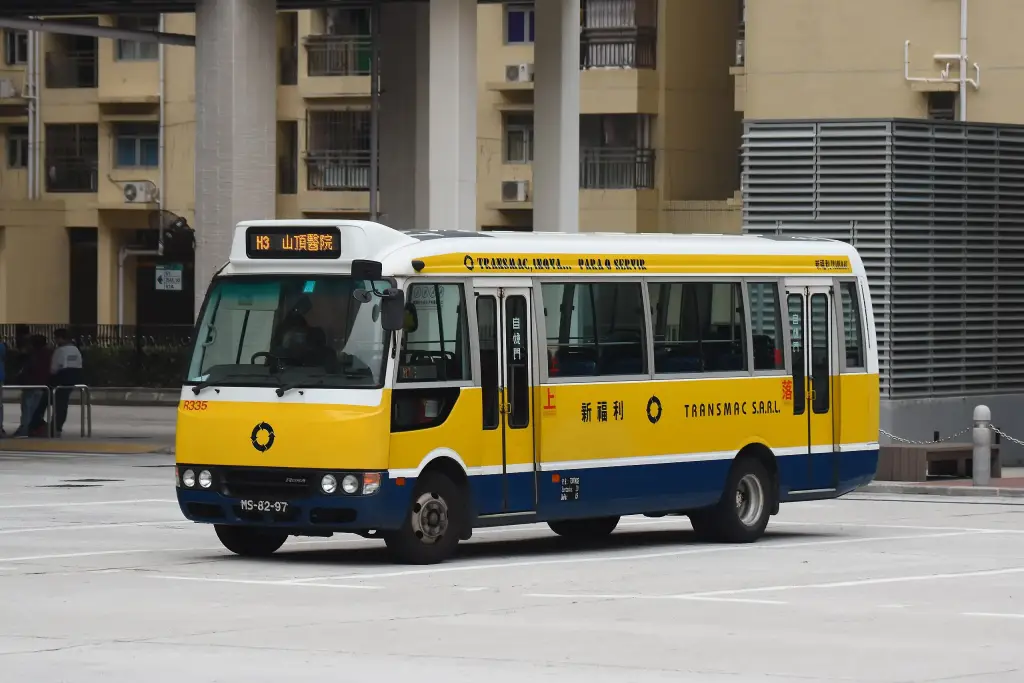
The Mitsubishi Fuso Rosa is a Japanese minibus based on the Mitsubishi Fuso Canter. It was launched in 1960 and is now in its fifth generation, known as the BE7. In Japan, Asia-Pacific, the Middle East, Africa, Jamaica and South America its main rivals are the Isuzu Journey, Nissan Civilian, Mazda Parkway and Toyota Coaster.
Fuso Rosa at a glance
| Maker | Mitsubishi Fuso Truck and Bus Corporation |
|---|---|
| Class | minibus |
| Launched | 1960 |
| Current generation | fifth, coded BE7 |
| Based on | Mitsubishi Fuso Canter |
| First generation | 1960–1973, chassis code B10, later B20 |
| Second generation | 1973–1986, BC2, BE2, BH2, BK2 |
| Third generation | June 1986–1997, BE4 |
| Body lengths (BE4) | 6,200 mm short, 6,950 mm long |
| Seating (BE4) | 26–29 |
| Tyres (BE4) | 205/85R16 |
| Rivals | Isuzu Journey, Nissan Civilian, Mazda Parkway, Toyota Coaster |
This page is based on English Wikipedia only, so the figures could not be cross-checked against a second source.
History of the Fuso Rosa
First generation (1960–1973)
Mitsubishi launched the Rosa in 1960; the factory code was B10 and the bus was developed from the chassis of the Mitsubishi Jupiter T10 truck. Its body was similar to that of the Mercedes-Benz O 319 minibus and it measured about 5.4 metres. A year later the B20 extended the line to lengths between 6.25 and 7 metres. In 1966 the Rosa became a Mitsubishi Fuso product, replacing the Fuso MB720 minibus.
Second generation (1973–1986)
The second generation of 1973 looked much like the first, but the front was substantially revised and many parts were shared with Mitsubishi trucks. It began with the BC2 short-wheelbase petrol version, the BE2 short-wheelbase diesel and the BH2 long-wheelbase diesel; in 1981 the BK2 added a long version 2.3 metres wide.
Third generation, BE4 (1986–1997)
The BE4 arrived in June 1986 as a full model change over the BE3 “Pretty Rosa”, with a cab-forward profile, a panoramic one-piece windscreen, a lower beltline and rectangular twin headlamps on upper trims; from January 1990 the twin rectangular lamps were standard across the range. Bodies came in short (6,200 mm) and long (6,950 mm) form with 26 to 29 seats. A Royal tourist trim arrived in September 1987 with reclining headrest seats, curtains, full-length overhead racks with lighting and air ducts, roof air conditioning, ceiling fans, a refrigerator and an optional television pod. The corporate Fuso emblem reached the grille in May 1988.
The 1990 update widened the grille and headlamp spacing, revised the interior, added an automatic transmission, introduced four-wheel drive on the long body and gave upper trims independent front suspension. In 1992 the Royal gained rear air suspension. The BE4 used 4D3-series four-cylinder diesels with gear-driven timing, a five-speed manual as standard and, later, a four-speed automatic, on 205/85R16 commercial tyres. Production ended in 1997 with the move to the BE6 fourth generation.
Dimensions and equipment
A long-body BE4 of about 1989 measured 6,950 mm long, 1,990 mm wide and 2,670 mm high on a 3,995 mm wheelbase, weighed about 3,200–3,300 kg and had a gross vehicle weight of up to 6,600 kg. Pre-update buses used leaf springs all round; after 1990 upper trims had independent front suspension, and hydraulic brakes with an exhaust brake were standard.
Design and features
- Canter foundations: the minibus uses the mechanicals of Mitsubishi’s light truck.
- Tourist trims: the Royal of 1987 brought reclining seats, curtains, roof air conditioning and a refrigerator.
- School versions: vinyl bench seats, a folding passenger door and bright paint for kindergarten and school work.
- Four-wheel drive: offered on the long body from the 1990 update.
- Air suspension: rear air springs on Royal models from 1992.
Fuso Rosa versions
- School/Kindergarten: vinyl bench seats, heater only, folding passenger door.
- Standard Shuttle: cloth or vinyl seats, optional overhead racks.
- Deluxe: reclining seats, overhead racks, optional curtains and roof air conditioning.
- Royal (1987): tourist microcoach with reclining headrest seats, curtains and a refrigerator.
- BC2, BE2, BH2, BK2: petrol and diesel second-generation models in short and long bodies.
The Rosa shares its mechanicals with the Fuso Canter, and the larger Fuso Fighter and Fuso Super Great complete the range. More vehicles are in the Fuso collection.
Video: Telford’s bus and Coach TV 6849 (Mitsubishi Fuso Rosa)
Video on YouTube.
Sources
- Mitsubishi Fuso Rosa, English Wikipedia: generations, trims, dimensions