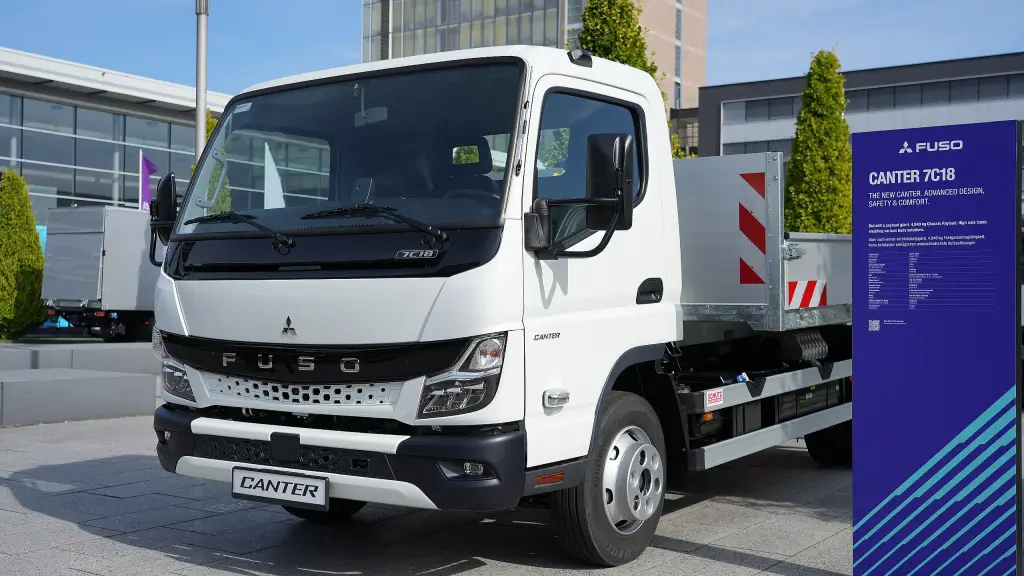
The Mitsubishi Fuso Canter is a line of light commercial trucks built by Mitsubishi Fuso Truck and Bus Corporation, now part of Daimler Truck. Production began in 1963 and the truck is now in its eighth generation. The name comes from the English word for the gait of a horse, a hint at the “thoroughbred” character Mitsubishi claimed for its trucks.
Fuso Canter at a glance
| Maker | Mitsubishi Fuso Truck and Bus Corporation (Daimler Truck) |
|---|---|
| Production | since 1963, eighth generation |
| Class | light-duty commercial truck |
| Payload at launch | 2 tonnes |
| Current range | 3.5–8.5 tonnes gross weight, narrow and wide cabs |
| Factories | Japan, Chennai (India), Tramagal (Portugal) |
| CKD assembly | Egypt, Jakarta, the Philippines, Malaysia, Turkey, Russia |
| Markets | more than 150 countries |
| Main export market | Indonesia, where it was called Colt Diesel until 2022 |
| Japanese rivals | Isuzu Elf, Toyota Dyna, Nissan Atlas |
| Electric version | eCanter |
| Hybrid version | EcoHybrid |
This page is based on English Wikipedia only, so the figures could not be cross-checked against a second source.
History of the Fuso Canter
First and second generations (1963–1973)
The first Canter, the T720, replaced the T710 and was built from 1963. It had two round single headlights, replaced by twin round lamps at the 1964 facelift, and carried two tonnes. Buyers could choose a 90 PS (66 kW) KE42 petrol engine or a 68 PS (50 kW) 4DQ11A diesel. The second generation arrived in 1968 with a 55 kW (74 hp) 4DR1 diesel and petrol options of 90 PS and, in long-wheelbase T93/97 form, 95 PS from a 2.3-litre KE47. The T92 was a long-wheelbase model with dual rear wheels, and in July 1970 a 2.7-litre 4DR5 diesel of 59 kW (79 hp) joined the range.
Third and fourth generations
The T200 series of the 1970s paired diesel T200/T210 models with the 80 PS 4DR5 and petrol T205/215 models with the 100 PS KE47; the older 95 PS KE42 was still listed. In January 1975 the petrol engines gave way to the 1,995 cc 4G52 (100 PS) and the 2,384 cc 4G53 (110 PS), and a three-tonne version appeared. From the fourth generation Japan also got wide-cab 2- and 3-tonne models; power steering became optional on the wide trucks in February 1980, and a narrow 1.5-tonne and a wide 3.5-tonne model followed at the end of that year. In November 1982 came the 4D30 indirect-injection diesel of 90 PS and the 4D31, naturally aspirated or turbocharged, of 115 PS. A 1.5-tonne Walk Through Van completed the range in December 1983.
Later generations and the export range
The Canter label has since grown into a family of products. From the fifth generation the Japanese Fighter Mignon was exported as the Canter 75, Canter HD or Canter FH; the seventh generation offered a twin rear axle, and since 2018 the Nissan NV350 has been sold in the Near East as the Canter Van. In 2010 the Tramagal plant in Portugal introduced Iveco F1C engines from Fiat Powertrain and ZF gearboxes, and the eighth generation built around these “World Engines” is aimed at markets with strict emission limits, with EcoHybrid and all-electric eCanter versions. Developing markets get a simplified General Export Model with Mitsubishi engines.
Names that change with the market
Model names follow local habits rather than one system. In Japan a Canter 15 carries 1.5 tonnes, while the same truck in Europe is a Canter 35 because of its 3.5-tonne gross weight. Indonesian names use chassis codes such as FE71 and FE83, while in North America the number gives the gross weight in hecto-pounds, so an FE130 is a 13,000 lb truck. Since the seventh generation Fuso has also used a Daimler-style naming system in Europe, Australia and New Zealand.
Design and features
- One basic design, many bodies: the Canter chassis is used for vans, tippers, box trucks and minibuses such as the Rosa.
- Local production: the Tramagal factory in Portugal supplies Western Europe with a local sourcing rate of 50 per cent.
- Modern powertrains: Iveco F1C diesels and ZF gearboxes from 2010, plus EcoHybrid and electric eCanter versions.
- Export reach: sold in more than 150 countries, with Indonesia the largest export market.
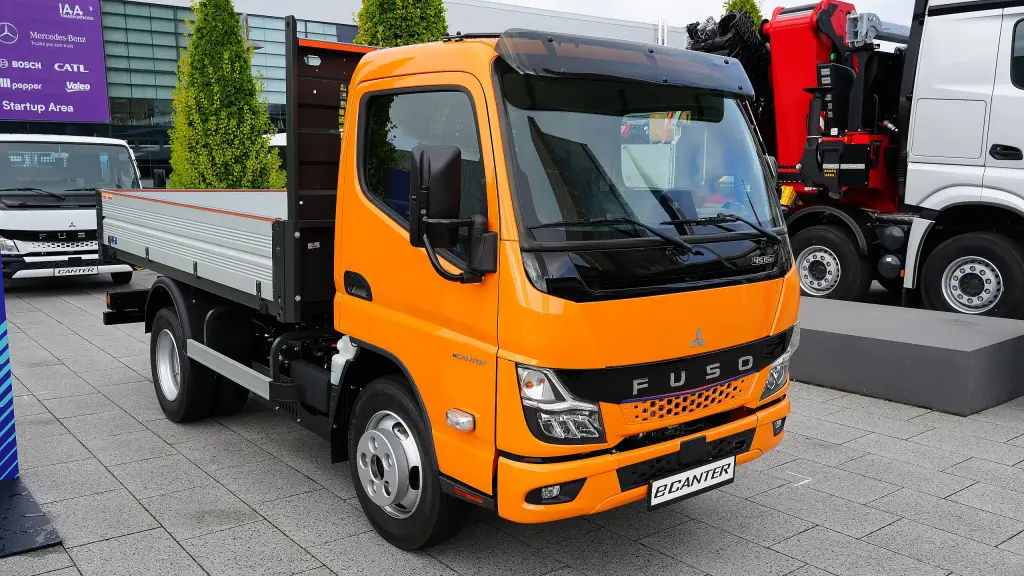
Fuso Canter versions
- Canter (Japan): narrow and wide cabs; the Canter Guts is a 1.5-tonne model built to Japanese compact-vehicle rules.
- Canter 35 (Europe): 3.5-tonne gross weight, named after the weight class rather than the payload.
- FE series (North America): model numbers give gross weight in hecto-pounds, as in the FE130.
- Canter FH and Canter 75: export names for versions of the Japanese Fighter Mignon.
- Canter Van: the Nissan NV350, exported to the Near East under the Canter name since 2018.
- eCanter and EcoHybrid: electric and hybrid versions of the eighth generation.
The Canter also forms the basis of the Fuso Rosa minibus, and the larger Fuso Fighter sits above it in the range. More commercial vehicles are in the Fuso collection.
Sources
- Mitsubishi Fuso Canter, English Wikipedia: history, engines, production and naming