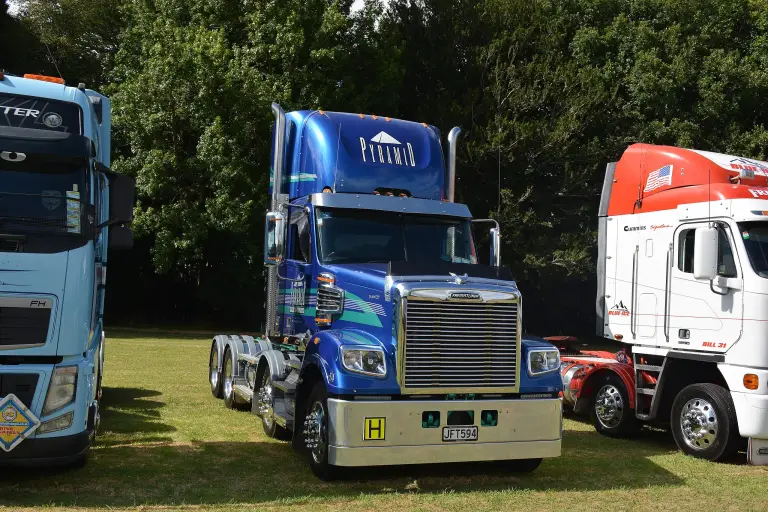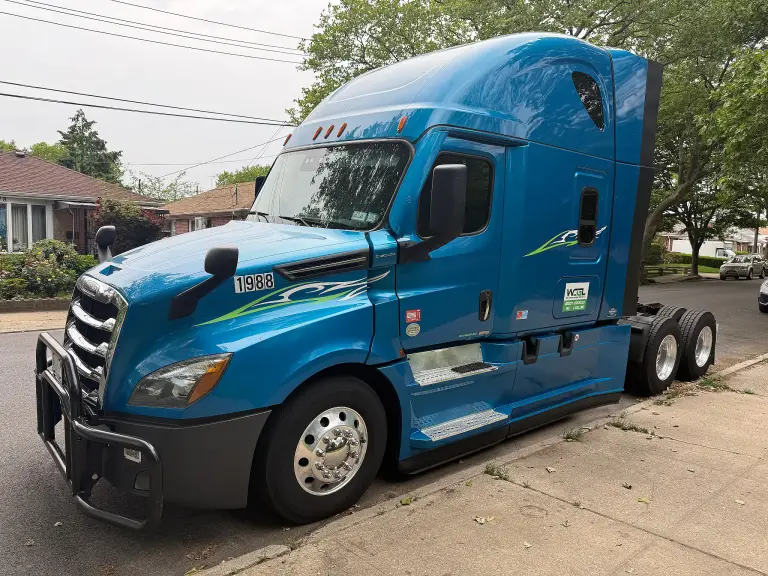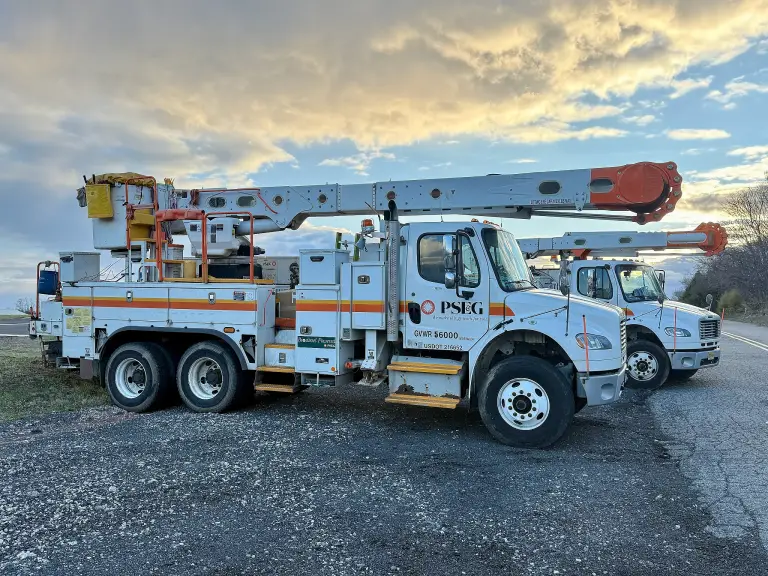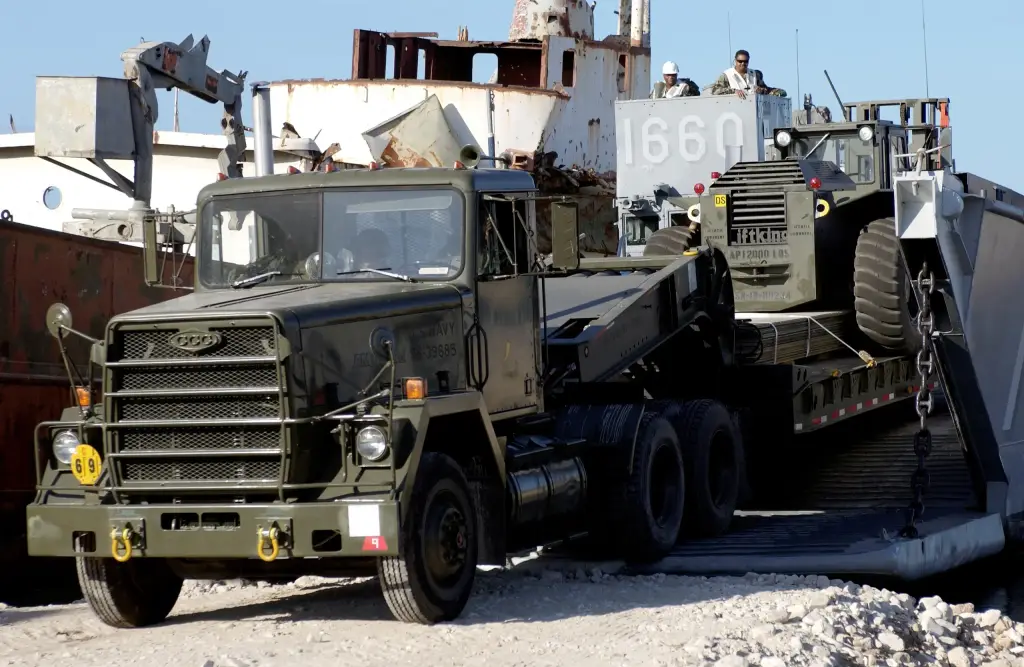
The M915 is a tractor unit used for line-haul missions by the United States Army. It is a commercial-type conventional 6×4 rear-wheel-drive 14-ton semi-tractor designed for use on improved roads, and the 1990 M915A2 upgrade was a completely new truck designed by Freightliner Trucks.
Freightliner M915 at a glance
| Type | 14-ton 6×4 line-haul semi-tractor |
|---|---|
| User | United States Army |
| Layout | conventional cab, rear-wheel drive, no driven front axle |
| Original M915 / A1 | Crane Carrier Company design, built by AM General, 1978–1982 |
| M915 engine | Cummins NTC 400, 855 cu in (14.0 L), 400 hp |
| M915 torque | 1,150 lbf·ft at 1500 rpm |
| M915A2 | 1990, Freightliner design with a new engine, transmission, hood and cab |
| M915A2 engine | Detroit Diesel Series 60, 775 cu in (12.7 L), 400 hp |
| M915A2 torque | 1,400 lbf·ft at 1200 rpm |
| Later upgrades | older trucks rebuilt to A4; A3 upgraded to armoured A5 from 2009 |
based on one source; the M915 series was designed by Crane Carrier and AM General before the 1990 Freightliner M915A2
History of the Freightliner M915
A commercial tractor, not a tactical truck
The M915 is the namesake and basis of a tactical truck series, although it is not tactical itself. It is a commercial-type conventional 6×4 rear-wheel-drive 14-ton semi-tractor designed for improved roads, where a powered front axle and other tactical equipment are not needed; leaving them out made the truck lighter and simpler. It shares its engine, transmission, cab and some other components with the rest of the series. The more specialised trucks in that family are the M916 6×6 all-wheel-drive 14-ton Light Equipment Transporter tractor with rear winch, the M917 8×6 20-ton dump truck, the M918 6×6 22.5-ton bituminous distributor, the M919 8×6 22.5-ton concrete mixer and the M920 8×6 20-ton Medium Equipment Transporter tractor, all used by engineer combat support and construction units.
Crane Carrier and AM General
The M915 and the follow-on M915A1 were a Crane Carrier Company design based on that company’s Centaur commercial tractor, built under contract by AM General between 1978 and 1982. They were powered by a Cummins NTC 400, an 855 cubic inch (14.0 litre) turbocharged and intercooled inline six producing 400 hp at 2100 rpm and 1,150 lbf·ft of torque at 1500 rpm, with a water-to-air aftercooler.
The Freightliner M915A2
The 1990 M915A2 upgrade was a completely different truck: a Freightliner Trucks design with a different engine and transmission and a new hood and cab. Its engine was a Detroit Diesel Series 60 DDEC II of 775 cubic inches (12.7 litres), also a turbocharged, intercooled four-stroke inline six, rated at 400 hp at 2100 rpm but with 1,400 lbf·ft of torque at 1200 rpm. Older models were later brought up to M915A4 standard with a new cab and frame that reused the original truck’s components, and from 2009 M915A3s were upgraded to the armoured M915A5 standard.
Design and features
- Line-haul specialist: a 14-ton 6×4 tractor for improved roads, without a driven front axle.
- Freightliner A2: the 1990 upgrade brought a new hood, cab, engine and transmission.
- Big torque: the Series 60 delivered 1,400 lbf·ft, well above the Cummins it replaced.
- Long rebuild life: A4 and A5 programmes kept old trucks in service.
Freightliner M915 versions
- M915 / M915A1 (1978–1982): Crane Carrier Centaur design built by AM General.
- M915A2 (1990): Freightliner design with the Detroit Diesel Series 60.
- M915A3: later production version, upgraded to armoured A5 standard from 2009.
- M915A4: older trucks rebuilt with a new cab and frame.
- M915A5: armoured upgrade of the A3.
Freightliner’s civilian heavy trucks of the same era are described in the Century Class and Cascadia articles. More vehicles are in the Freightliner collection.
Sources
- M915 (truck), English Wikipedia: role, history, engines, variants