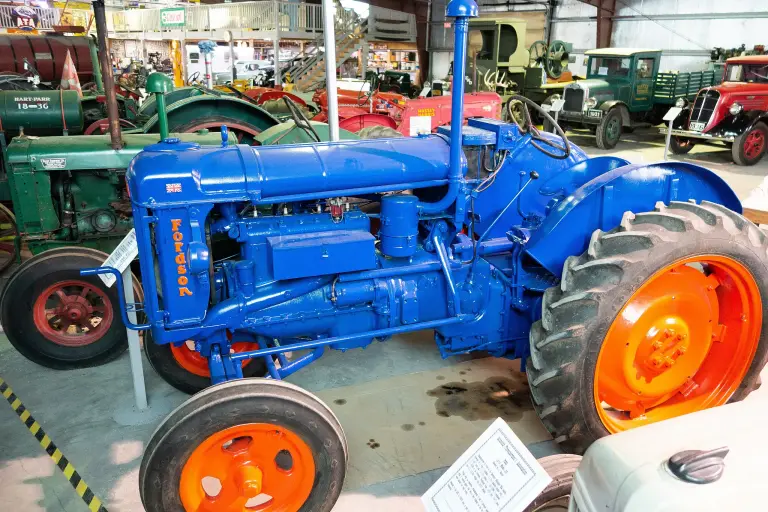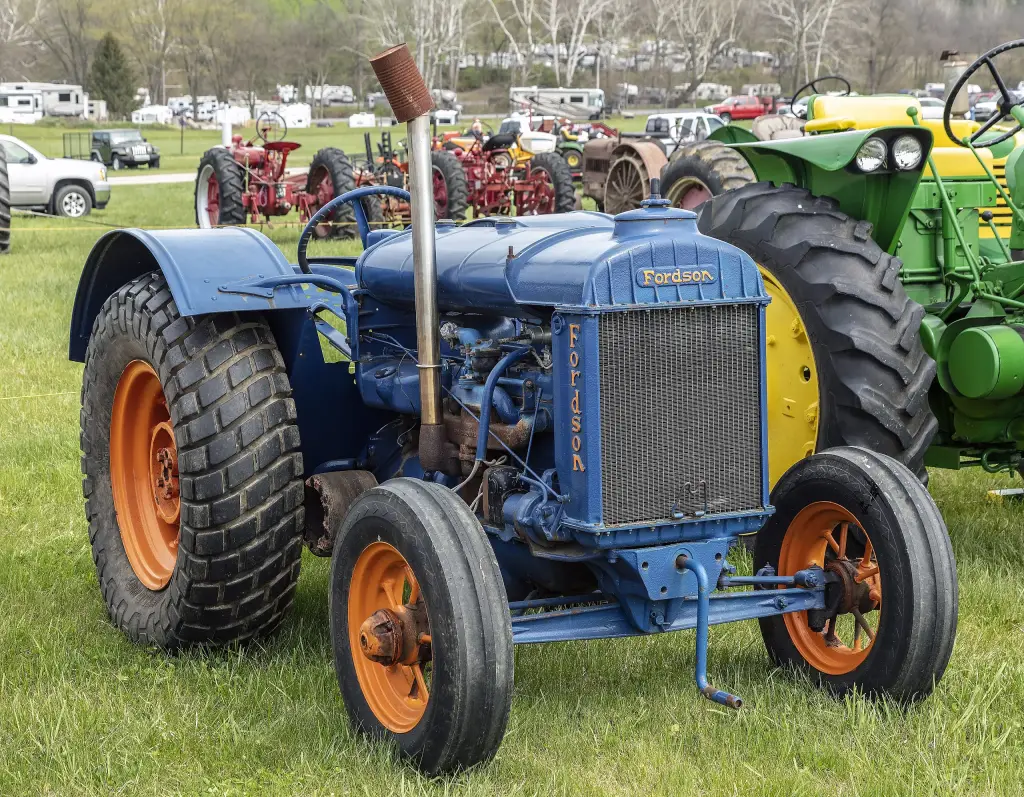
The Fordson was the tractor equivalent of the Model T: small, simple, mass-produced and cheap enough for an ordinary farmer. Introduced in 1917 as the Henry Ford & Son tractor, it became the Model F and then the Model N, and stayed in production in Britain until the 1940s.
Fordson Model F and N at a glance
| Maker | Henry Ford & Son; Ford Motor Company; Ford Motor Company Ltd |
|---|---|
| Production | 1917–1928 in the USA; 1919–1933 in Cork; 1933–1945 at Dagenham |
| First sale price | US$750 on 8 October 1917 |
| Engine | 20 hp inline four, petrol or kerosene |
| Transmission | three-speed spur gear, worm-drive rear axle |
| Frame | unit construction designed by Eugene Farkas |
| Model F | designation used from 1919 |
| Model N | from 1927, 27 hp |
| Model N equipment | rear fenders, higher-voltage ignition, optional pneumatic tyres |
| Power take-off | optional on the Model N from 1935 |
| Wartime output | over 136,000 Model N tractors at Dagenham |
| Total Model F output | 552,799 tractors, 1917–1928 |
Fordson models are covered in sections of one English Wikipedia article on the Fordson brand; no separate article exists for the Model F or Model N. This page is based on that single source.
History of the Fordson Model F and N
Henry Ford had been building experimental tractors since 1907, and the first dedicated Henry Ford & Son prototypes were completed in 1916. With the First World War raging, the British Ministry of Munitions selected the Fordson in 1917 for both import and British production, because so much shipping was being lost that carrying tractors across the Atlantic seemed wasteful. Ford chose Cork in Ireland for the factory, partly to bring work to southern Ireland, but production there did not begin until 1919, after the war had ended. In the meantime thousands of tractors were shipped from the United States.
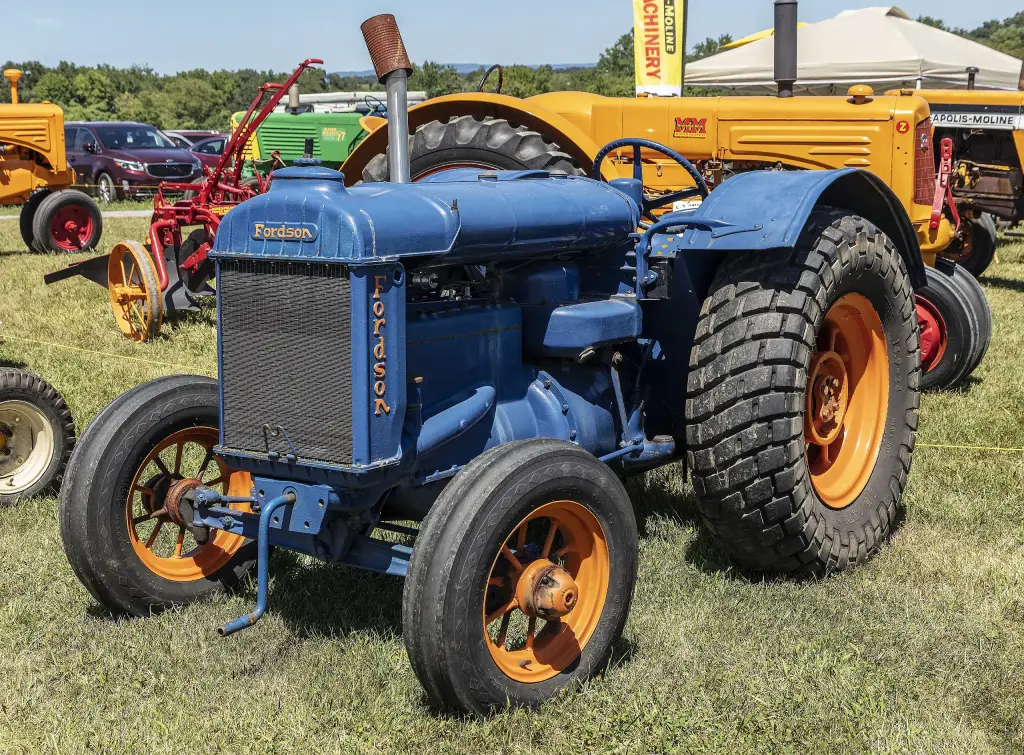
The tractor was deliberately simple. A 20 hp inline four-cylinder engine, closely related to the Model T unit, could run on petrol or kerosene; it started on petrol from a small auxiliary tank and was switched over once warm. A Holley carburettor and a water-bath air cleaner fed it, cooling was by thermosiphon, and the three-speed gearbox gave about 2¼ to 6¼ mph. Ford engineer Eugene Farkas made the engine block, oil pan, transmission and rear axle into stressed members of the frame, removing the need for a heavy separate chassis. Early tractors had no brakes at all: the driver stopped by depressing the clutch.
The name Fordson was trademarked in early 1918, and the Model F designation appeared in 1919. The Fordson went on sale on 8 October 1917 at US$750, against a manufacturing cost of $567.14. It was the first tractor to combine small size, light weight, mass production, a low price, a national dealer network and a trusted brand, and it gave Ford more than 70 per cent of the early American tractor market. Annual production reached 36,781 in 1921 and 99,101 in 1926; the 500,000th tractor was built in 1925, and 552,799 Fordsons were made between 1917 and 1928.
The Model N
The Model N replaced the Model F in 1927 and was an improved version of the same design. Production started in Cork and moved to Dagenham in 1933. The N had a 27 hp engine, standard rear mudguards, a higher-voltage ignition system and optional pneumatic tyres, and from 1935 a power take-off could be ordered. During the Second World War the Dagenham plant built over 136,000 Model N tractors, making it probably the most important tractor in Britain at the time. Fordsons were also exported in large numbers to the Soviet Union, over 25,000 between 1921 and 1927, and Soviet clones were built at Leningrad from 1924 and Stalingrad from 1930.
Design and features
- Unit frame: the engine, gearbox and rear axle formed the chassis, saving weight and cost.
- Multifuel engine: the 20 hp four ran on petrol or kerosene, with a small starting tank.
- Simple transmission: three forward speeds, a worm-drive rear axle and no brakes on early cars.
- Mass production: assembled on Model T-style lines from about 4,000 parts.
- Model N improvements: 27 hp, mudguards, better ignition and an optional power take-off.
Fordson Model F and N versions
- Henry Ford & Son tractor (1917–1918): the first production version, before the Fordson name was applied.
- Fordson Model F (1919–1927): the improved production model with the Fordson name.
- Fordson Model N (1927–1945): 27 hp development built in Cork and then Dagenham.
- Soviet Fordson-Putilovets: a clone built at Leningrad from 1924.
- Stalingrad-built tractors: production from 1930.
The Model N was developed into the Fordson E27N Major after the war. The later Fordson Major replaced it in 1952. More Fordsons are in the Fordson collection.
Video: VTS 01 1 Fordson standard N
Video on YouTube.
Sources
- Fordson, English Wikipedia: origins, Model F, Model N, production figures