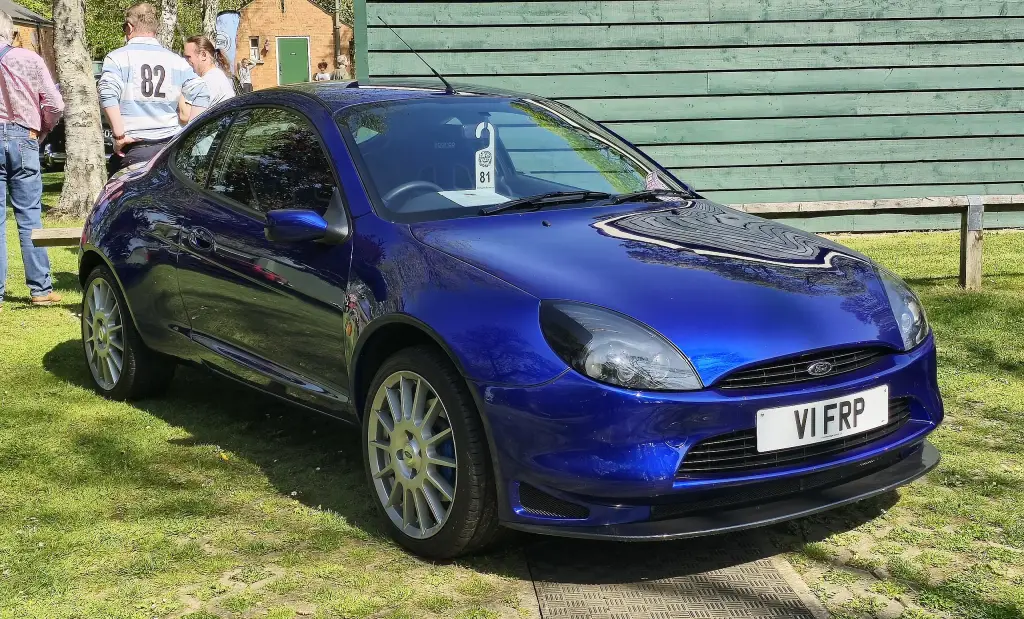
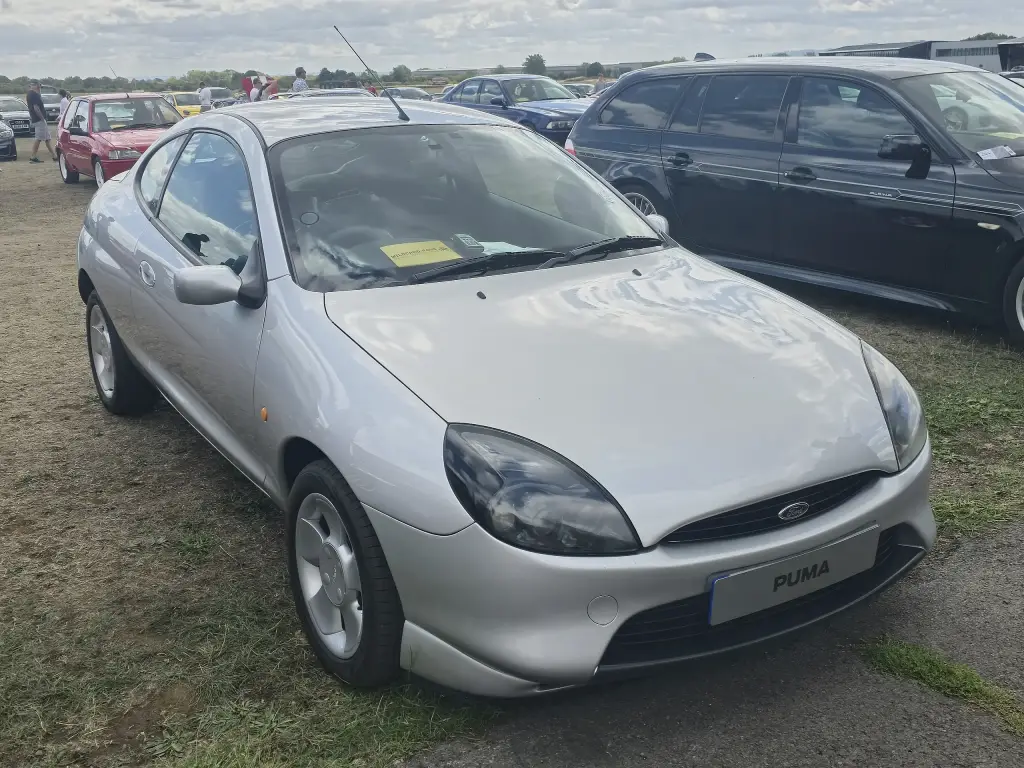
The Ford Puma was a small three-door coupe produced by Ford of Europe from June 1997 to 2001. Based on the Mk IV Fiesta and built at Ford’s Niehl plant in Cologne, it was a four-seat 2+2 and part of Ford’s New Edge family of cars.
Ford Puma at a glance
| Maker | Ford of Europe, Niehl plant, Cologne |
|---|---|
| Production | June 1997 – 2001 |
| Body | three-door coupe, four seats |
| Base | Ford Fiesta Mk IV |
| Concept | Lynx, Geneva Motor Show 1996 |
| Launch | Geneva Motor Show 1997 |
| Engines | 1.4, 1.6 and 1.7 VCT Sigma Zetec-SE units |
| Special engine | 1.7 VCT used only in the Puma |
| Ford Racing Puma | Tickford-tuned 1.7 with 17-inch wheels and four disc brakes |
| Wheels | 15-inch alloys as standard |
| Brakes | front discs, rear drums |
| Design tools | Paintbox CAD system |
This page is based on English Wikipedia only.
History of the Ford Puma
Jacques Nasser, Claude Lobo and a Fiesta coupe
The Puma programme began in 1993, when Ford’s then chief executive and president Jacques Nasser and its small and medium vehicle design director Claude Lobo discussed the idea of a 2+2 coupe based on the Fiesta chassis. All development was done in the Paintbox CAD system, which let designers render two- and three-dimensional models. The first version of the design was shown as the Lynx concept car at the Geneva Motor Show in 1996, and the production car was launched at the same show a year later.
What made it different
The Puma was a front-engined, front-wheel-drive three-door coupe with four seats, 15-inch alloy wheels as standard and front disc with rear drum brakes. It used the Mk IV Fiesta as its base but with new engines co-developed with Yamaha, a new body, stiffer suspension, a wider track and a close-ratio gearbox. Four engines were offered: a 1.4-litre from 1997 to 2000, a 1.6-litre from 2000 to 2001, the 1.7-litre VCT used only in the Puma and the Tickford-tuned 1.7 VCT of the Ford Racing Puma. All were 16-valve Sigma engines sold as Zetec-SE, and the 1.7s used Nikasil cylinder plating, which required a specific 5W30 semi-synthetic oil to reduce wear. The Ford Racing Puma came with 17-inch alloys and disc brakes front and rear.
A short, fondly remembered life
The Puma followed the design cues of Ford’s other cars of the time and belonged to the New Edge generation that included the Ka and the Focus. Production ended in 2001, and the model is remembered as one of Ford’s better-handling small cars of the period.
Design and features
- Fiesta base: Mk IV mechanicals with a new body and wider track.
- Yamaha engines: Sigma Zetec-SE units co-developed with Yamaha.
- Unique 1.7 VCT: an engine used in no other Ford model.
- Ford Racing Puma: a Tickford version with 17-inch wheels and four disc brakes.
Ford Puma versions
- Puma 1.4 (1997–2000): the entry engine.
- Puma 1.6 (2000–2001): the later mid-range engine.
- Puma 1.7 VCT: the engine unique to this model.
- Ford Racing Puma: Tickford-tuned 1.7 with 17-inch wheels and four disc brakes.
The Puma was built on the Fiesta platform and shared the New Edge look of the Ka. More Ford vehicles are in the Ford collection.
Sources
- Ford Puma (coupe), English Wikipedia: programme, design, engines, running gear