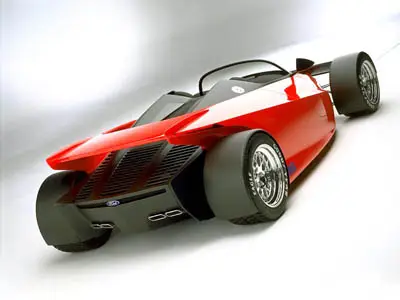
The Ford Indigo was a concept car built for the 1996 auto show season to showcase Ford’s Indy car technology. Designed by Ford’s design and technical director Claude Lobo, it took six months from the original computer designs to the finished show car, and only two examples were built.
Ford Indigo at a glance
| Maker | Ford Motor Company |
|---|---|
| Shown | 1996 auto show circuit |
| Designer | Claude Lobo |
| Built | two cars, only one of them functional |
| Chassis | carbon-fibre monocoque with Reynard Motorsport |
| Engine | 6.0 L V12 48-valve DOHC, 435 hp at 6,100 rpm |
| Torque | 405 lb ft at 5,250 rpm |
| Gearbox | six-speed transaxle, manual clutch, wheel-mounted buttons |
| Wheels | 17 x 11.5 in front, 18 x 12.5 in rear |
| Performance (estimated) | 0–60 mph in 4 seconds, 180 mph |
| Owners | Ford keeps the running car; the other was auctioned to Jack Roush |
This page is based on English Wikipedia only.
History of the Ford Indigo
Indy technology on the road
The Indigo was developed to show Ford’s Indy car technologies, including new materials and construction methods as well as powertrain and aerodynamic improvements. Its monocoque chassis was developed with Reynard Motorsport as a single-piece tub of carbon-fibre composite with the suspension attached directly to it. That suspension was a direct copy of Reynard’s Indy car designs and materials, needing only small changes to allow two seats.
The V12
The working Indigo had a 6.0-litre V12 with 48 valves and double overhead camshafts, using the pistons, rings, rods and valve train of Ford’s Duratec V6 from the Taurus and Mercury Sable; it had no relation to the V12 of the GT90 concept, despite the same displacement. It produced 435 hp at 6,100 rpm and 405 lb ft at 5,250 rpm, and the same engine later powered many Aston Martins while Ford owned the company. It was bolted directly to the chassis and carried some suspension loads, as in most Indy cars. The six-speed transaxle came from Reynard with a manual clutch and push-button gear shifting on the steering wheel, and Ford claimed the engine was efficient enough for 28 mpg on the highway. Cosworth built five of these engines for Ford, which still keeps them.
Design details and afterlife
The carbon-fibre and fibreglass body had scissor doors, high-intensity discharge lamps in the mirrors, deep leather bucket seats, a premium stereo, air conditioning and a four-point racing harness, with an LCD screen behind the steering wheel for the instruments. The wedge shape had a shark nose with an attached front spoiler housing LED indicators and a rear spoiler integrated into the bodywork with a neon tail light inside it, and the car did without full wings, using small covers over exposed wide tyres. Fikse three-piece wheels, Taurus-derived power steering and Brembo brakes completed the package. The static show car kept a visor for the occupants that the running car did without; that show car was auctioned to Jack Roush. The Indigo also appeared in the racing games Need for Speed II, Ford Racing 2 and 3 and Project Gotham Racing 3.
Design and features
- Reynard monocoque: a single carbon-fibre tub with Indy car suspension.
- 6.0 V12: 435 hp, built by Cosworth, using Duratec V6 internals.
- Indy controls: push-button gear changes on the steering wheel.
- Show car details: scissor doors, LCD instruments and neon tail lights.
Ford Indigo versions
- Running prototype: the functional car, still owned by Ford.
- Static show car: built with a visor, later auctioned to Jack Roush.
- Game appearances: Need for Speed II, Ford Racing 2 and 3, Project Gotham Racing 3.
The Indigo was a pure concept, unlike Ford’s production sports cars such as the GT, and its design language fed into later show cars like the Iosis. More Ford vehicles are in the Ford collection.
Sources
- Ford Indigo, English Wikipedia: design, chassis, engine, details