The Ferrari SP, also known as the Ferrari Dino SP, was a series of Italian sports prototype racing cars produced during the early 1960s. All featured a rear mid-engine layout, a first for a Ferrari sports car.
Ferrari SP at a glance
| Built | early 1960s |
|---|---|
| Chassis produced | six, in various engine configurations |
| Layout | rear mid-engine, a first for a Ferrari sports car |
| Engines | Dino V6 in SOHC 60° and DOHC 65° forms |
| Later engine | SOHC 90° V8 designed by Carlo Chiti |
| Lubrication | dry sump on all engines |
| Gearbox | five-speed manual |
| Chassis | tubular steel, tipo 561 |
| Suspension and brakes | all-round independent suspension, disc brakes |
| Major wins | Targa Florio 1961 and 1962 |
| Title | 1962 European Hill Climb Championship |
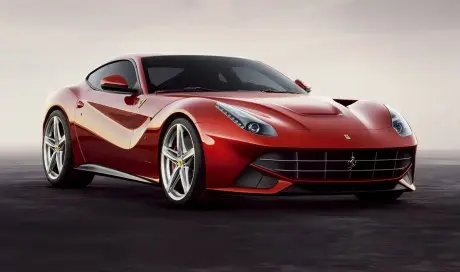
based on one source (English Wikipedia); no free photographs of this model were found, so the previous cover is kept. The video attached to the old record shows a 430 Scuderia and is not used.
History of the Ferrari SP
The SP series first used Vittorio Jano’s Dino V6 engines in both single-overhead-cam 60° and double-overhead-cam 65° forms. Later Ferrari introduced a new single-overhead-cam 90° V8 designed by Carlo Chiti. All used dry-sump lubrication and a five-speed manual transmission. In total only six chassis were produced with various engine configurations, and many were modified or converted into a different specification. The tubular steel chassis, tipo 561, had all-round independent suspension and disc brakes, and all cars shared the same wheelbase and open body style with some variations.
The 246 SP
At a special press conference in 1961 Ferrari unveiled its first mid-engined sports car, the 246 SP. Although the front-engined 250 Testa Rossa had won much in the late 1950s, the emergence of rear-engined rivals in Grand Prix and sports car racing showed that Ferrari needed a new design. Enzo Ferrari publicly denied in January 1959 that a rear-engined car was in the works, yet that same year privately tasked Carlo Chiti with developing both a rear-engined Formula One car and a rear-engined sports car for the 1961 season. Chiti decided Jano’s existing 2.4-litre 65° Dino V6 was suitable for both because of its light weight and compact size, and development ran through 1960 and early 1961.
Racing record
The 246 SP was introduced to the public at the press conference of 13 February 1961 and proved itself at that year’s Targa Florio, which Wolfgang von Trips and Olivier Gendebien won outright, scoring a point for Ferrari in the 1961 World Sportscar Championship. For the 1962 championship, in the sports car class for cars under 3,000 cc, the 246 SP won two of three rounds, including the 1962 Targa Florio, and took the 1962 Coupe des Sports title. The model also contributed to the 1962 European Hill Climb Championship. Only two 246 SPs were produced, chassis 0790 and 0796, and both were later converted into other types, 0790 becoming a 196 SP.
Legacy
The mid-engine experience was soon carried into the V12-powered Ferrari P series of sports prototypes, which arrived in 1963, and by 1965 Ferrari had introduced its first mid-engined Dino sports prototype, the 166 P, with a V6. The Chiti V8 did not carry over to any successor, making the SP a short but influential chapter.
Design and features
- First mid-engined Ferrari sports car: a layout that became standard for Ferrari prototypes.
- Dino V6 power: Jano’s light, compact 60° and 65° engines, later a Chiti V8.
- Six chassis only: most were later converted to other specifications.
- Targa Florio winner: outright victory in 1961 and again in 1962.
- Step to the P series: its layout led directly to the V12 prototypes of 1963.
Ferrari SP versions
- 246 SP (1961): the first mid-engined Ferrari sports car, two built.
- 196 SP: a 246 SP converted to a different engine.
- Later SP variants: six chassis in all, many converted between specifications.
The SP series used engines from the Dino line and led to the P-series prototypes such as the Ferrari 330 P. More racing cars are in the Ferrari collection.
Sources
- Ferrari SP, English Wikipedia: engines, chassis, 246 SP, racing record