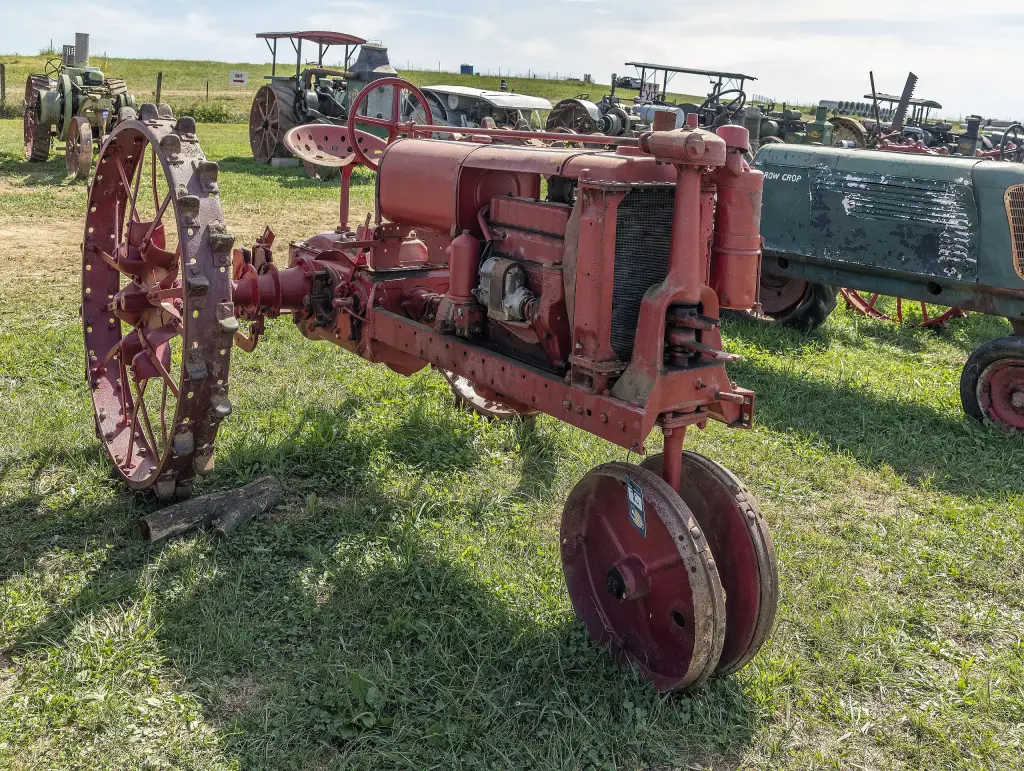
The Farmall F-12 was a small two-plow row-crop tractor produced by International Harvester from 1932 to 1938. A smaller, modernised version of the earlier Farmall Regular, it was the model that established bright red as the Farmall colour. About 123,000 were built before the F-14 took over.
Farmall F-12 at a glance
| Maker | International Harvester, USA |
|---|---|
| Production | 1932–1938 |
| Predecessor | Farmall Regular |
| Prototype | F-10 |
| Engine | 113 cu in four-cylinder, 14 hp in the W-12 |
| Transmission | sliding gear, three gears |
| Plow rating | two plows |
| Wheels | steel standard, rubber tyres optional |
| Paint | grey until 1936, then bright red |
| Price | about $600 at launch, rising to about $700 |
| Built | about 123,000 |
| Successor | Farmall F-14 |
Based on one source, the English Wikipedia article on the Farmall F-12, which also covers the F-14.
History of the Farmall F-12
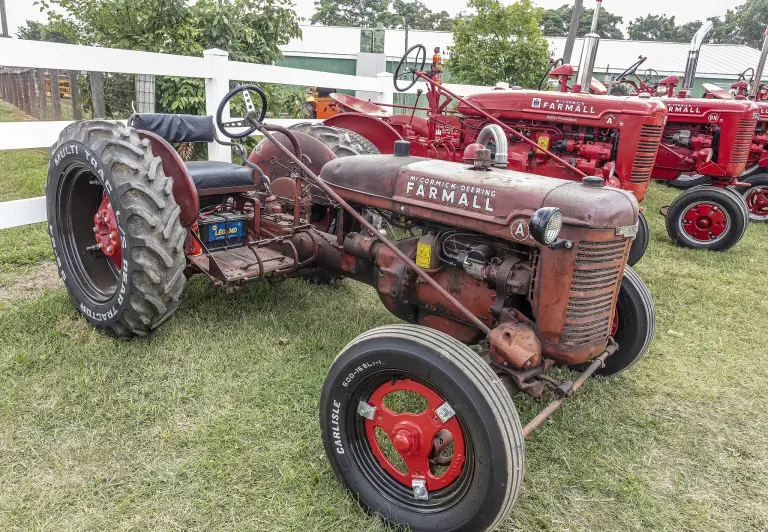
The Farmall F-12 was introduced in 1932 as a smaller, modernised version of the Farmall Regular, developed from a prototype designated the F-10. To reduce mechanical complexity and improve transmission efficiency, the Regular’s portal-axle rear wheels were replaced by a straight axle with larger wheels, which also gave a broader range of track adjustment for different row widths. The F-12 was rated for two plows, and production ran to 1938 with about 123,000 built.
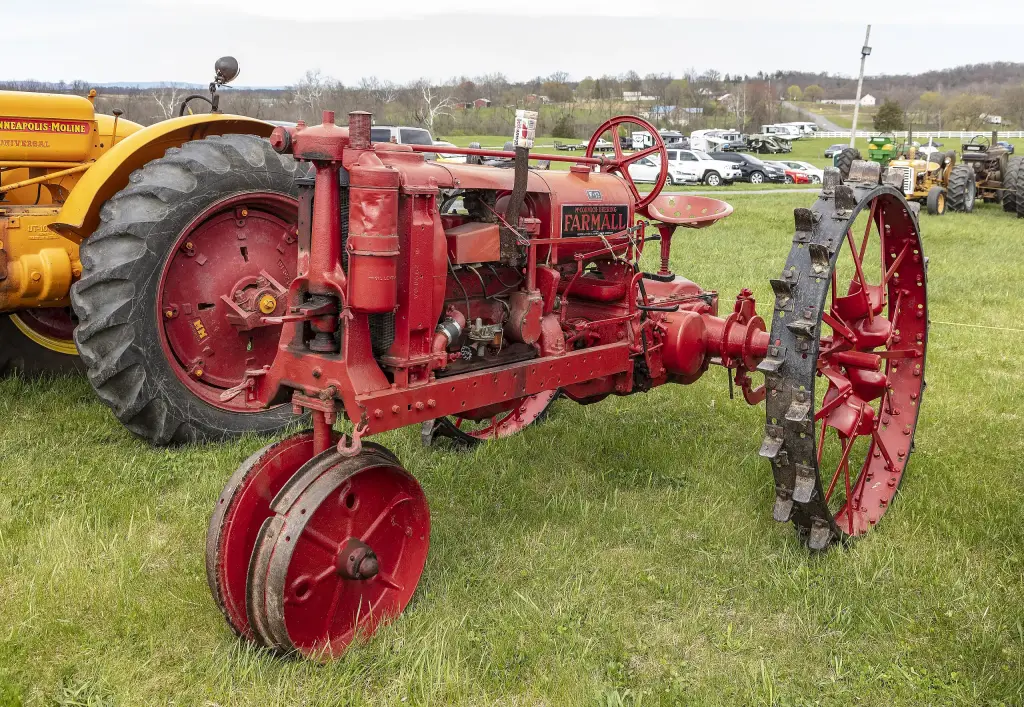
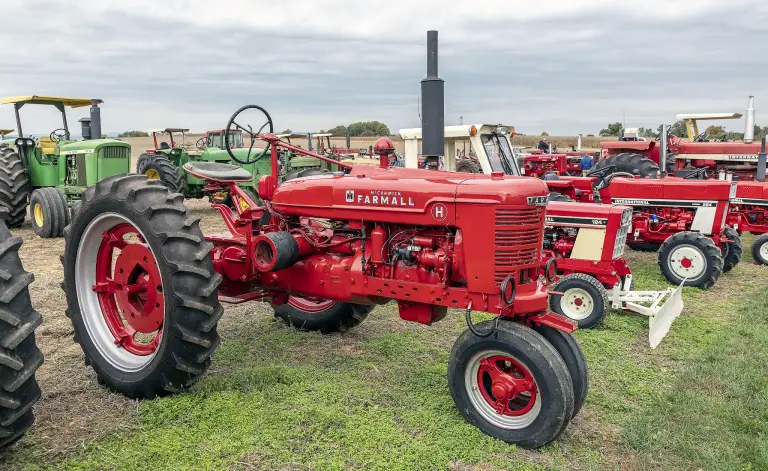
The tractor was available in gasoline or distillate form, and a wide front axle could be ordered. F-12s left the factory on steel wheels, with rubber tyres optional. Early examples were painted grey like the Regular, but from 1936 the F-12 was painted bright red to increase visibility, and red quickly became a trademark of the Farmall line. It cost about $600 when introduced and about $700 later. Early W-12 versions used a 14-horsepower, 113-cubic-inch engine, later replaced by a similar engine built in-house by International Harvester; the sliding-gear transmission had three gears.
Several variants were built alongside the F-12. The McCormick W-12 was a version with a wide front axle, and the F-12-G4 was assembled at International Harvester’s plant in Neuss, Germany. The I-12 was an industrial tractor and the O-12 an orchard model with fairings and underside exhaust routing, while the Fairway 12 was intended for golf courses and mowing; all except the Fairway had rubber tyres. In 1938 the F-14 replaced the F-12 with a 16-horsepower engine of the same displacement turning at higher rpm, which allowed a two-plow rating, and a hydraulic lift became a popular option. The F-14 was built in 1938 and 1939, about 32,000 in all, and cost between $800 and $850; it was itself replaced by the Farmall A and B in 1939.
Design and features
- Straight rear axle: simpler than the Regular’s portal axle and easier to adjust.
- Two-plow rating: enough power for a small row-crop farm.
- Bright red paint: adopted in 1936 and soon a Farmall trademark.
- Steel or rubber: steel wheels standard, pneumatic tyres optional.
- Wide front axle: available as an option.
Farmall F-12 versions
- Farmall F-12 (1932–1938): the standard two-plow tractor.
- McCormick W-12: wide-front version.
- F-12-G4: built at International Harvester’s Neuss plant in Germany.
- I-12: industrial version.
- O-12: orchard version with fairings and underside exhaust.
- Fairway 12: golf-course and mowing version, on steel wheels.
- Farmall F-14 (1938–1939): 16 hp successor, about 32,000 built.
The F-12 was followed by the Farmall F-20 in the larger class and by the Farmall A in the small line. More Farmall tractors are in the Farmall collection.
Video: Blueberry lane Farmall F-12
Video on YouTube.
Sources
- Farmall F-12, English Wikipedia: development, engines, paint, variants, F-14