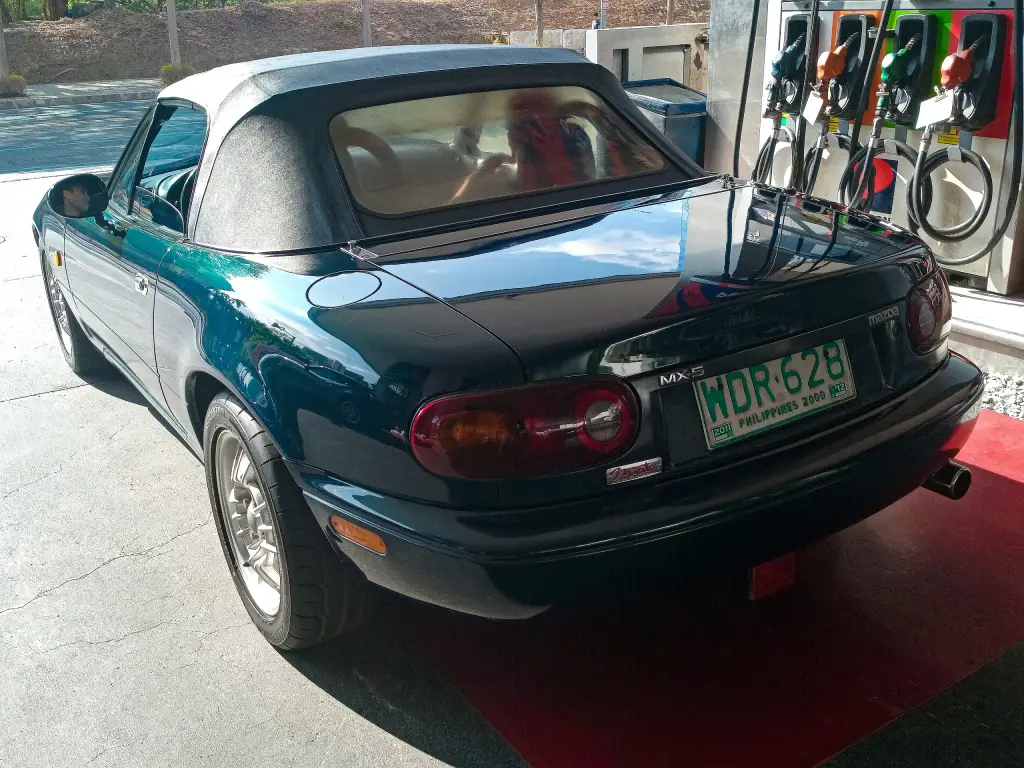
The Eunos Roadster was the Japanese-market version of the first-generation Mazda MX-5, sold from 1989 to 1997. In Japan the car carried no Mazda badge at all: Mazda was setting up separate sales channels for its more expensive models, and the little roadster became the first model of the new Eunos division.
Eunos Roadster at a glance
| Also known as | Mazda MX-5, Mazda MX-5 Miata (North America) |
|---|---|
| Production | 1989–1997 |
| Body | two-seat roadster |
| Engine 1989–1993 | 1.6 L B6ZE four, 115 bhp |
| Engine 1994–1997 | 1.8 L BP-ZE four, 129 bhp |
| Gearbox | five-speed manual; four-speed automatic optional |
| Weight | 980 kg without options |
| Length / width / height | 3,970 / 1,675 / 1,235 mm |
| Drag coefficient | 0.38 |
| Suspension | double wishbones all round |
| 0–60 mph | 8.6 s (manufacturer figure, 1990) |
| Top speed | 188 km/h; 180 km/h in Japan |
The Eunos Roadster is the Japanese-market name for the first-generation Mazda MX-5.
History of the Eunos Roadster
A new channel, a new name
Mazda unveiled the MX-5 at the Chicago Auto Show on 10 February 1989 with a price of about US$14,000. Deliveries began in May 1989 in the United States and Canada as a 1990 model, on 1 September 1989 in Japan and in 1990 in Europe. In Japan the car was not badged as a Mazda, because the company was launching separate marques for its deluxe models, much as Nissan had done with Infiniti and Toyota with Lexus. The MX-5 therefore became the Eunos Roadster, and it was soon joined by the MX-3, sold in Japan as the Eunos Presso. Its exterior dimensions and engine size also kept it within Japanese compact-car regulations.
Light weight and a simple recipe
The NA had a steel unibody with an aluminium bonnet and weighed 980 kg without options. Its 1.6-litre B6ZE engine, built specifically for the car, produced 115 bhp at 6,500 rpm and used a vane-type air flow meter and a camshaft angle sensor instead of a distributor; cars with the optional automatic were tuned to 105 bhp to suit the gearbox. The five-speed manual came from the rear-wheel-drive 929/Luce, with a deliberately small, light shift. To keep the price and weight down the entry model had steel wheels and no power steering, power windows, stereo or air conditioning. Double wishbones, four-wheel disc brakes and 185/60HR14 tyres completed the chassis.
Updates and the end of Eunos
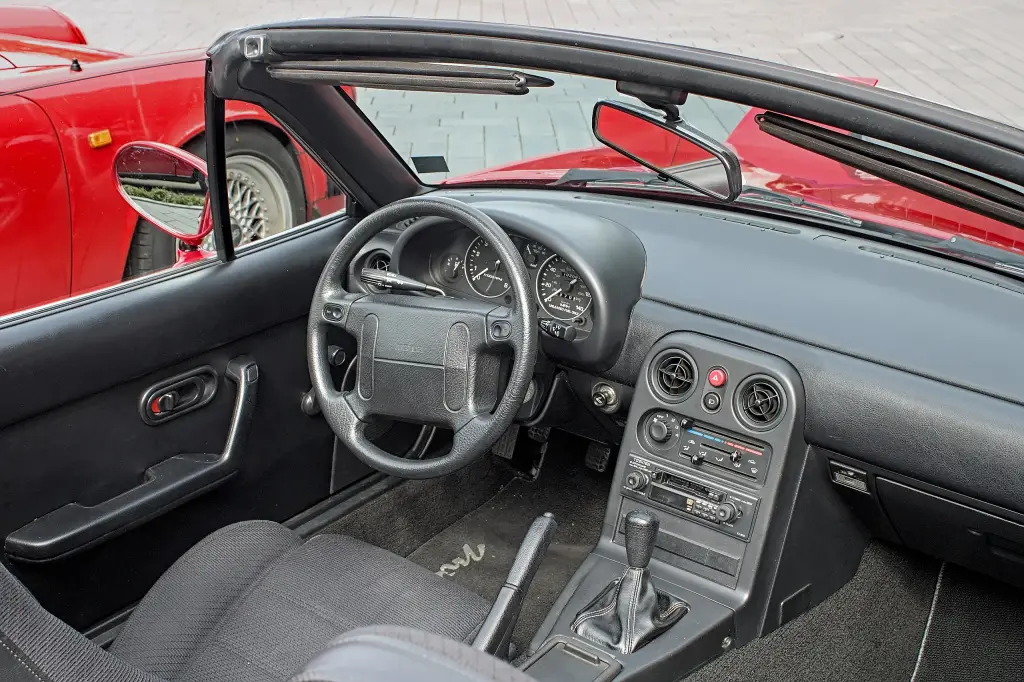
For 1994 the car received a 1,839 cc BP-ZE engine of 129 bhp, a redesigned dashboard with dual airbags, extra chassis bracing and a Torsen limited-slip differential in some markets, and a sporty R package with Bilstein dampers and stiffer springs. In 1993 Mazda built 1,500 Limited Edition cars, all in black, with red leather and BBS wheels. The Eunos channel itself did not last: it was closed at the end of March 1996 as Mazda cut back after the bubble economy burst, and the Roadster kept its name but moved to Mazda Anfini dealers. In its first year in Japan the car found 9,307 buyers, and 93,626 were sold worldwide in 1990 alone.
Design and features
- Light weight: 980 kg without options, with an aluminium bonnet over a steel body.
- Double-wishbone chassis: independent suspension at all four corners with anti-roll bars.
- Purpose-built engine: the 1.6-litre B6ZE with a lightened crankshaft and flywheel.
- Simple entry model: steel wheels and manual everything to keep the price low.
Eunos Roadster versions
- 1.6 (1989–1993): the original 115 bhp car.
- 1.8 (1994–1997): 129 bhp, later 133 bhp for 1996.
- Limited Edition (1993): 1,500 black cars with red leather and BBS wheels.
- R package (1994): Bilstein dampers, stiffer springs and a Torsen differential, without power steering or automatic.
The Roadster was the first model of the Eunos range and was soon joined by the Eunos 30X and the larger Eunos 500. More models are in the Eunos collection.
Sources
- Mazda MX-5 (NA), English Wikipedia: launch, engines, chassis, updates
- Mazda Roadster, Japanese Wikipedia: Eunos channel, Japanese launch, sales