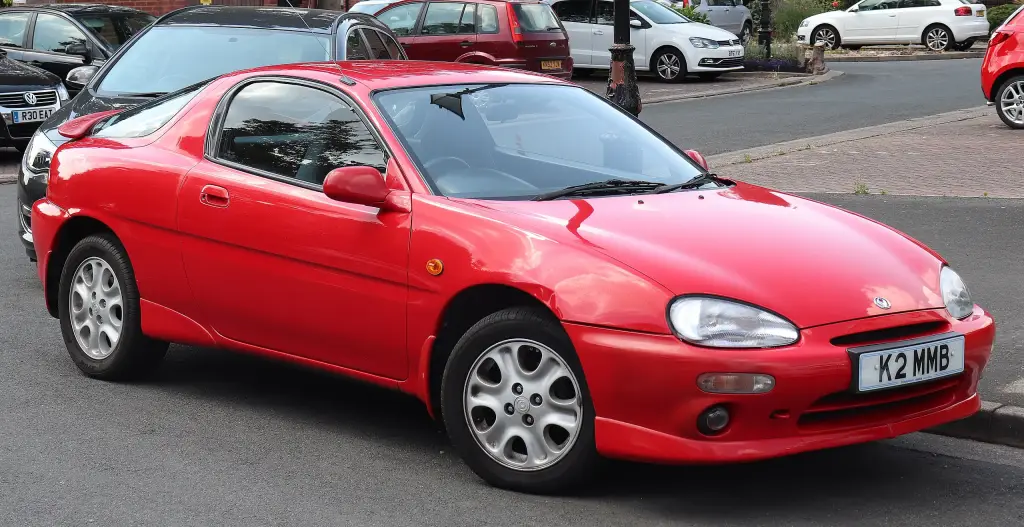
The Eunos 30X was the name Mazda used in Australia for the MX-3, a small front-wheel-drive 2+2 coupé introduced at the Geneva Motor Show in March 1991. In Japan the same car was sold as the Eunos Presso and the Autozam AZ-3, and its most distinctive feature was a 1.8-litre V6 in a class where four cylinders were the norm.
Eunos 30X at a glance
| Also sold as | Mazda MX-3, MX-3 Precidia (Canada), Eunos Presso, Autozam AZ-3, Mazda AZ-3 |
|---|---|
| Production | 1991–1998 |
| Body | 2+2 coupé, front-wheel drive |
| Platform | Mazda EC, related to the BG Familia/323 |
| Engines | 1.6 L four, 1.8 L V6, 1.5 L four (AZ-3 only) |
| V6 | K8-ZE, 7,000 rpm redline, 7,800 rpm cut-off |
| Rear suspension | Twin-Trapezoidal Link |
| 0–60 mph | 8.4 s (US-spec V6) |
| Top speed | 202 km/h in European trim |
| Lateral grip | 0.89 g |
| Australian name | Eunos 30X until late 1996, then Mazda-Eunos 30X |
The Eunos 30X is the Australian name for the Mazda MX-3; this article uses the English Wikipedia page on the MX-3 and writes only about the Eunos-badged car. Based on one source.
History of the Eunos 30X
A coupé for the Eunos years
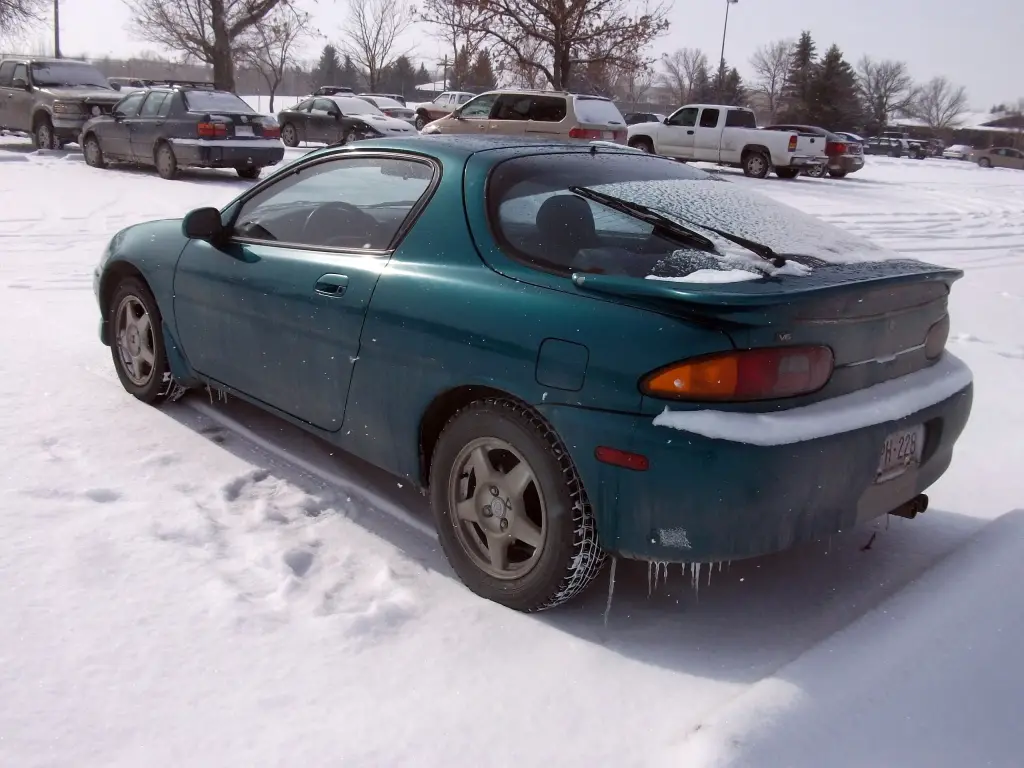
Mazda launched the car at Geneva in March 1991, and it went on sale in Japan, Europe, Australia and North America, reaching US dealers in September 1991 as a 1992 model. The platform, called EC, shared much with the BG platform under the contemporary Familia, 323 and Protegé. In Japan the car fitted neatly into Mazda’s multi-channel sales strategy: it was the Eunos Presso, a companion to the Eunos Roadster, while the youth-oriented Autozam channel got the AZ-3 with a smaller 1.5-litre twin-cam four. Australia, where Eunos was also a separate brand, called it the Eunos 30X until late 1996, after which it became the Mazda-Eunos 30X.
Engines and chassis
The range opened with a single-cam 1.6-litre four and the 1.8-litre twin-cam V6. The small V6 was chosen to set the coupé apart and to give it a smooth, balanced engine; project manager Tadayuki Hayashi, a keen motorcyclist, liked a peaky power delivery. The V6 belonged to Mazda’s K-series and used a variable-length intake manifold that Mazda called the Variable Resonance Induction System. In January 1994 a twin-cam version of the 1.6, the B6D, replaced the single-cam unit and made the much dearer V6 less attractive; V6 sales in the United States ended after the 1994 model year, though they continued in Canada, Japan and other export markets.
Driving and the end of the line
The rear suspension used Mazda’s Twin-Trapezoidal Link layout, which gave some of the benefits of four-wheel steering at lower weight and cost. Road testers measured 0.89 g of lateral grip and a 0–60 mph time of 8.4 seconds for the US-spec V6, with a claimed 202 km/h top speed in European tune. Mazda called the car a four-seater, but the rear seats were sized for people of what the company called “AF 50” dimensions, making it a de facto 2+2. Only one generation was built: the MX-5 was far more popular, and as the effects of Japan’s asset bubble became visible Mazda cut models that were not selling, the MX-3 among them.
Design and features
- Small V6: a 1.8-litre K-series unit with variable intake resonance, rare in the compact class.
- Twin-Trapezoidal Link rear suspension: Mazda’s own layout for sharper handling without the weight of four-wheel steering.
- Kammback shape: a 2+2 coupé body with a practical hatch and a low nose.
- Strong grip: 0.89 g measured lateral acceleration, among the best in its class.
Eunos 30X versions
- RS (1992–1996): the four-cylinder model.
- GS (1992–1994, Canada to 1995): the V6 version.
- 25th anniversary edition (1993): about 2,000 cars for Canada and the USA with V6, leather trim, heated seats in Canada and 15-inch Enkei wheels, mostly in raspberry metallic.
- V6 SE (1993, Europe): 100 cars in white with leather and suede trim.
- V6 Equipe: a small European run in sparkle green or noble green.
The 30X shared its showroom with the Eunos Roadster, and the larger Eunos 500 sat above it in the range. More Eunos models are in the Eunos collection.
Sources
- Mazda MX-3, English Wikipedia: history, engines, performance, special editions