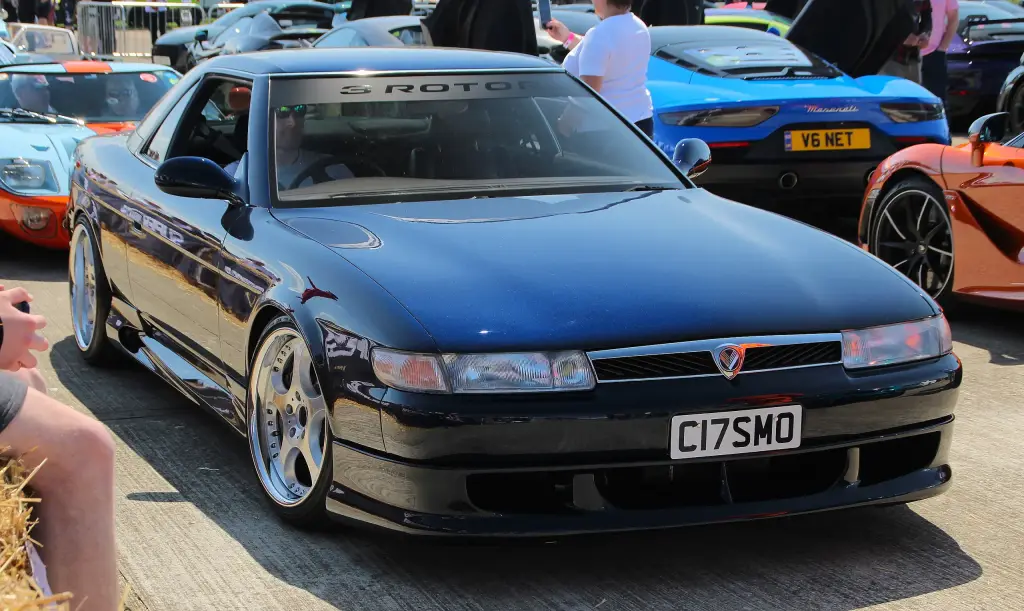
The Eunos Cosmo was Mazda’s top-line touring flagship, built from 1990 to 1995 and sold in Japan through the Eunos luxury channel. It was the only Mazda to use a three-rotor engine, it carried technology years ahead of its rivals, and it shared its name with the 1967 Cosmo that had launched Mazda’s rotary era.
Eunos Cosmo at a glance
| Production | February 1990 – September 1995 |
|---|---|
| Body | 2+2 coupé |
| Platform | Mazda JC |
| Engines | 13B-RE 1,308 cc two-rotor twin-turbo; 20B-RE 1,962 cc three-rotor twin-turbo |
| 20B-RE output | 280 PS and 403 Nm |
| Gearbox | four-speed automatic only |
| Length | 4,815 mm |
| Width | 1,795 mm |
| Height | 1,305 mm |
| Wheelbase | 2,750 mm |
| Weight | 1,490–1,640 kg |
| Top speed | limited to 180 km/h; about 255 km/h unrestricted with the 20B |
| Built | 8,875 |
The article covers only the JC-generation Eunos Cosmo; the English Wikipedia page also describes the earlier Cosmo generations. Based on one source.
History of the Eunos Cosmo
The Eunos flagship
Production started in 1990 on the new JC platform, and the car was loosely based on the 1985 MX-03 concept. As the top-line touring model of the Eunos channel it was loaded with power amenities and luxury equipment, following the Japanese luxury-car formula of the period. Only an electronically controlled four-speed automatic was offered, but it could be switched into a manual shift mode, and the dashboard display changed from PRNDSL to PRND321 to match. Two trim packages were available: the Type-S with firmer suspension, cloth inserts in the leather interior and a full-length centre console, and the softer, fully leather-trimmed Type-E.
Two rotaries, both twin-turbo
The JC Cosmo offered the two-rotor 13B-RE and the three-rotor 20B-RE, both with twin sequential turbochargers. The 20B-RE displaced 1,962 cc, making it the largest rotary Mazda ever sold, and produced 280 PS and 403 Nm with Hitachi turbochargers. These engines were the first Japanese-built series-production twin sequential turbo systems offered on any car, arriving before the FD-generation RX-7 received its own twin-turbo 13B-REW in early 1992; the JC used an HT-10 and HT-12 pair where the RX-7 later used two HT-12s. With more than 380 Nm available from 1,800 rpm the Cosmo accelerated strongly, at the cost of heavy fuel consumption.
Technology ahead of its time
The Eunos Cosmo was the first production car with a built-in GPS navigation system, and the first in Japan to use the Palmnet serial data system between its control units. The optional Car Communication System was a colour CRT touch-screen that controlled the climate control, a mobile phone, navigation, NTSC television, radio and CD player. The instruments were LCD screens drawing analogue gauges whose needles appeared to float. The car was limited to 180 km/h to suit Japanese rules, though a 20B version could reach about 255 km/h if given a free run.
Sales and the end
The Cosmo was built from February 1990 until September 1995 and found 8,875 buyers. Sales split roughly 60/40 between the two-rotor and three-rotor versions, which makes the 20B the rarer car today. It remained a Japanese-market model: exports had been proposed through Eunos and later under the stillborn Amati brand in the United States, but never happened, and left-hand-drive examples reached other countries only through private importers.
Design and features
- Three-rotor engine: the only Mazda production car with a 20B rotary, and its largest-capacity rotary at 1,962 cc.
- First with satellite navigation: a factory GPS navigation system years before it became common.
- Car Communication System: a colour CRT touch-screen for climate, phone, navigation, TV and audio.
- Twin sequential turbos: the first Japanese series-production installation of the layout.
- Digital instruments: LCD-rendered analogue gauges with floating needles.
Eunos Cosmo versions
- 13B-RE (1990–1995): the two-rotor 1,308 cc twin-turbo version.
- 20B-RE (1990–1995): the three-rotor 1,962 cc flagship, 280 PS.
- Type-S: firmer suspension, sports trim and a full-length centre console.
- Type-E: softer suspension and full leather upholstery.
- Series II (1994–1995): the facelifted JCES and JC3S models.
The Cosmo was the largest car in the Eunos range, above the Eunos 500 and the Eunos Roadster. More models are in the Eunos collection.
Video: Eunos Cosmo Features Tour
Video on YouTube.
Sources
- Mazda Cosmo, English Wikipedia: JC generation: engines, technology, production, sales