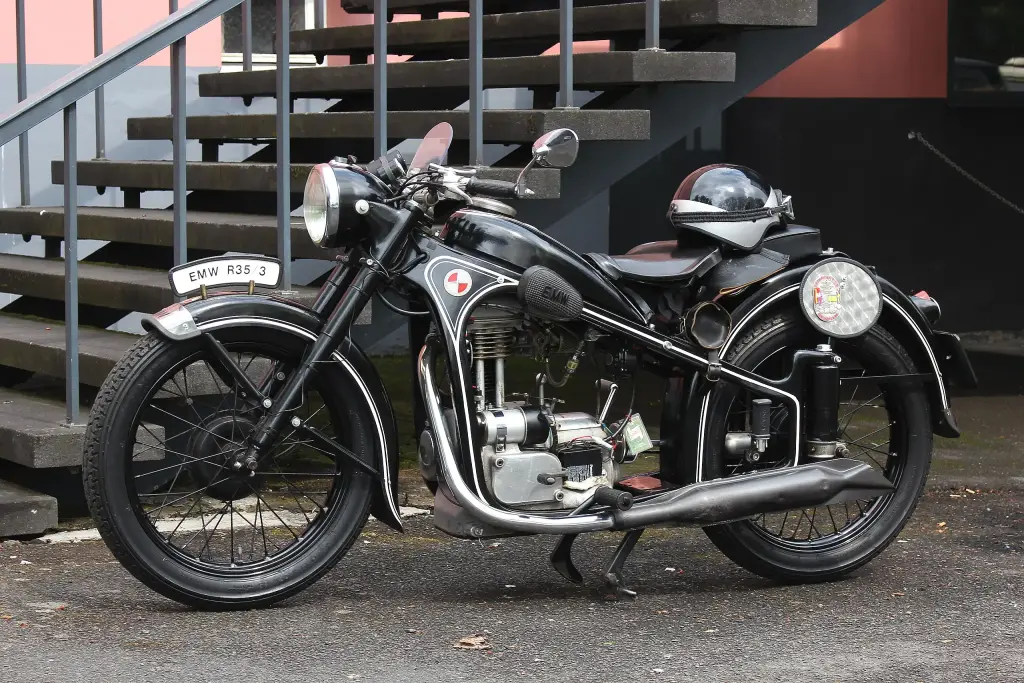
The EMW R 35 is the East German version of the BMW R 35, a 340 cc single-cylinder motorcycle designed in 1937 for police, authorities and the military. Production was moved to Eisenach during the war, and after 1945 the machine was assembled there from hidden parts and then built in large numbers, taking the EMW name and the R 35/3 designation from 1952 until production ended in 1955.
EMW R 35 at a glance
| Maker | BMW, Eisenach; from 1952 EMW |
|---|---|
| Production | 1937–1940 as BMW; postwar to 1955 |
| Type | single-cylinder four-stroke motorcycle |
| Engine | 340 cc, 14 PS |
| Frame | single loop; lengthened and strengthened on the R 35/3 |
| Rear suspension | rigid at first, damped on the R 35/3 |
| Front fork | telescopic without gaiters from mid-1951, hydraulic damping from late 1951 |
| Gear change | foot change with the improved gearbox from late 1951 |
| Built, postwar | about 90,000, of which around 27,000 exported |
| R 35/3 | about 50,000–66,000; 13,700 in the final year 1955 |
There is no English Wikipedia article on the EMW R 35; this page is based on one source.
History of the EMW R 35
The BMW R 35
BMW developed the R 35 in 1937: a single-cylinder four-stroke with 340 cm³ and 14 PS, robust and unusually reliable, and therefore suited to authorities, police and the military. When aircraft engine development was concentrated in Munich, the whole motorcycle line was moved to the BMW works at Eisenach in Thuringia. Production of the R 35 stopped in 1940 because the machine no longer met the requirements of the Wehrmacht.
Reparations
At the end of the war the Eisenach works was badly damaged, but the machines and spare parts had been stored in nearby potash mines, among them kits for about 1,000 R 35s, although without frames. Eisenach became part of the Soviet zone on 3 July 1945. Order no. 93 of November 1945 called for motorcycles to be built from the stored parts as reparations: the plan for 1945 was 70 machines, only 16 were finished, and 220 BMW R 35s were assembled and handed to the Soviets.
Awtowelo and the BMW badge
From 15 September 1946 the works belonged to the Soviet company Awtowelo. No reliable figures survive for 1946–1948; in 1949, 4,250 BMW R 35s were built at Eisenach. The machines, still carrying the BMW emblem, first went to authorities and to the FDJ motorsport group, from 1952 the Gesellschaft für Sport und Technik, and from 1949 private buyers could have them too. After the Düsseldorf court ruling of 17 November 1950 the maker’s plate was changed: it had read Bayrische Motoren Werke AG, without the city, since 1945, and from 1950 it named the state-owned Awtowelo works at Eisenach.
The R 35/3
From the middle of 1951 the machine was thoroughly updated: a telescopic fork without gaiters and a new sprung front mudguard, a thinner 22 mm handlebar with outside levers instead of the 25 mm bar with internal levers, and compression springs in place of tension springs under the rider’s saddle. By the end of the year the fork had hydraulic damping and the gearbox was modified with a contemporary foot change. In April 1952 the Awtowelo company was dissolved and the works passed to East Germany: BMW became EMW, with a white-and-red emblem, and the factory joined the IFA combine. By then 17,000 vehicles, most of them motorcycles, had left the works.
EMW R 35/3
With the change of name in 1952 came the R 35/3. The frame was lengthened, its sheet thickness raised from 2 to 3 mm, and a damped straight-line rear suspension added, which also required a new cardan housing. The engine now breathed through the air filter instead of a tube between the pushrod covers into the block, and the saddles differed: the Awtowelo BMW R 35 had two springs on the outside of the leather saddle, the EMW R 35/3 a single central spring on a rubber one. Fenders differed as well. In 1955, its last year, 13,700 R 35/3s were built; the EMW name ended with the 340/2, the 327/3 and this motorcycle, and no more four-strokes were made at Eisenach, the works turning to the two-stroke IFA F 9 and Wartburg.
Design and features
- Proven single: a 340 cc overhead-valve engine of 14 PS, chosen for reliability with authorities and the military.
- Reparation machine: the first postwar examples were assembled from parts hidden in potash mines during the war.
- Modernised front end: telescopic fork, hydraulic damping and a sprung mudguard from 1951.
- R 35/3 chassis: longer and stronger frame with a damped rear suspension and a revised cardan housing.
EMW R 35 versions
- BMW R 35 (1937–1940): the prewar original, built in Munich and then Eisenach.
- Postwar BMW R 35 (1945–1952): assembled and then built at Eisenach under Awtowelo, still with the BMW emblem.
- Improved 1951 specification: telescopic fork, foot gear change and hydraulic damping.
- EMW R 35/3 (1952–1955): longer frame, damped rear suspension, new air filter and saddle.
The Eisenach works also built the EMW 321, EMW 327 and EMW 340 cars. More vehicles are in the EMW collection.
Video: EMW R 35/3 Start mit Fehlzündungen
Video on YouTube.
Sources
- EMW R 35, German Wikipedia: origins, reparations, 1951 changes, R 35/3, production totals