The EMW 340 is the first new car developed at the Eisenach works after the Second World War. Launched in 1949 as the BMW 340, it used the wheelbase and engine of the prewar BMW 326 under completely new front and rear bodywork, and from 1952 it was sold under the EMW name until production ended in 1955.
EMW 340 at a glance
| Maker | BMW, Eisenach; from 1952 EMW |
|---|---|
| Production | 1949–1955, as the 340-2 from 1951 |
| Class | four-door six-cylinder saloon |
| Engine | 1971 cc straight-six, 54 PS (40 kW) |
| Gearbox | four-speed manual with rod linkage |
| Wheelbase | 287 cm (113 in), as on the BMW 326 |
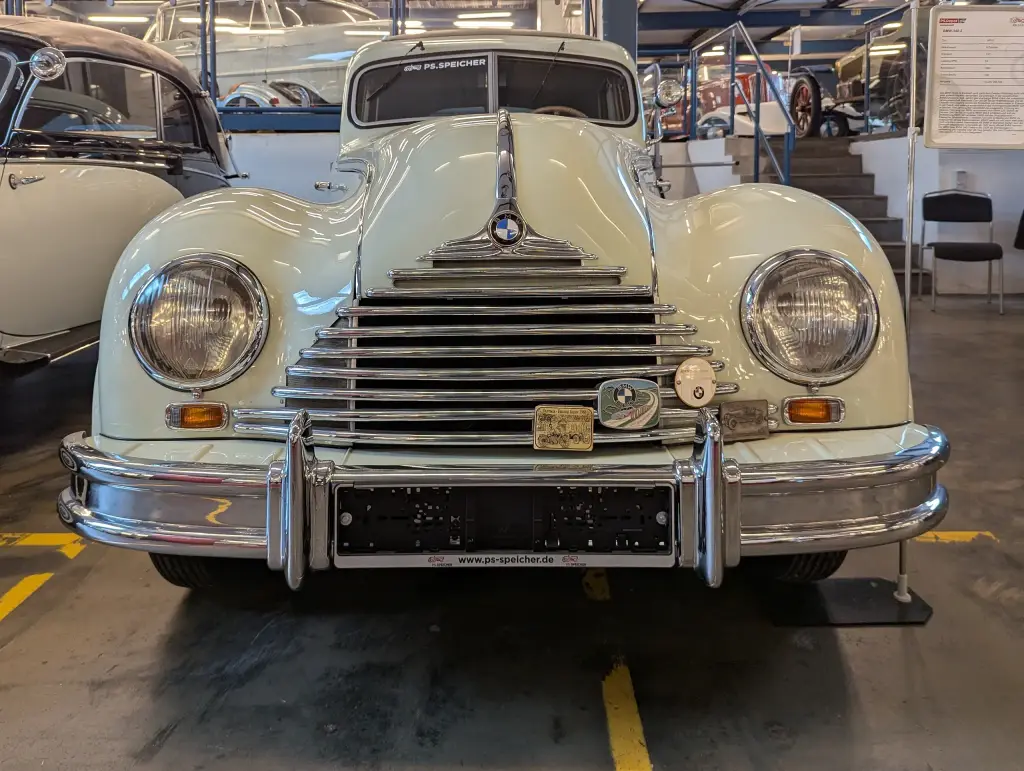
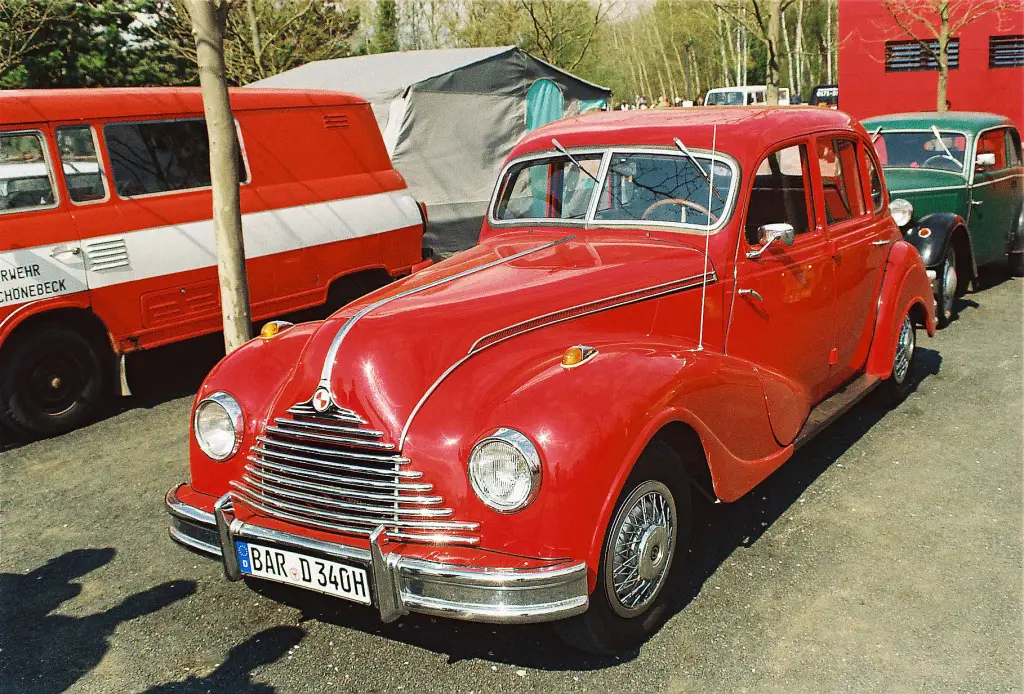
| Front | squared bonnet, headlights in the wings, horizontal-slat grille |
| Rear | external boot lid; spare wheel under a wooden false floor |
| Body styles | saloon, estate, ambulance, delivery van, Kübelwagen |
| Interesting detail | mechanical self-cleaning oil filter driven by the clutch pedal |
| Also | radiator blind adjustable from the driver’s seat |
History of the EMW 340
The plant after 1945
Eisenach passed to the Soviet occupation zone in July 1945, and the BMW works there was threatened with dismantling as reparations. Workers returning from the war began assembling prewar 326s, and Albert Seidler’s demonstration of a 321 to Marshal Zhukov won an order for five cars. In November 1945 the plant received an order for 3,000 cars and motorcycles, and in September 1946 it was folded into the Soviet Awtowelo company. Munich’s attempts to recover the factory were rebuffed.
A new body on an old base
By late 1948 the 340 was ready for production. It kept the 287 cm wheelbase and the central body section of the 326, but the bonnet was squared off, the headlights were integrated into the front wings, and the familiar BMW kidney grille gave way to a semi-triangular grille of horizontal metal slats, in the manner of the Peugeot 203 launched at about the same time. The bonnet now opened in one piece towards the front instead of along the centre line.
New boot and interior
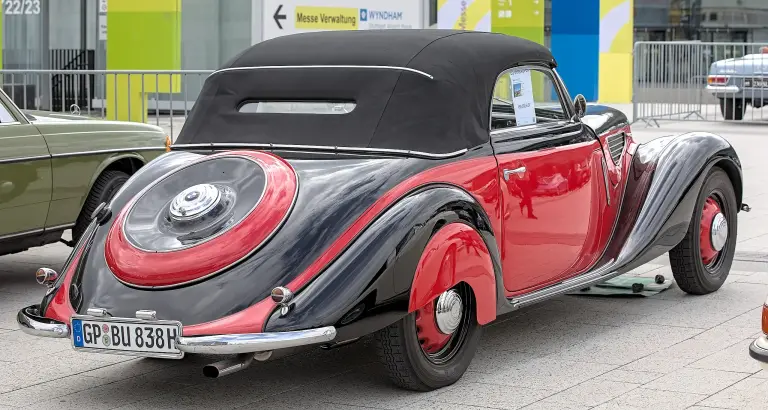
The rear was reworked in the American manner: the boot gained an external lid, so luggage no longer had to be passed over the folded rear seat, and the spare wheel moved from the tail panel to a flat well under a wooden false floor, together with a jack and an air pump. The tool kit included an inner tube and a special key for bleeding the brakes. Early cars followed the 326 interior; later ones replaced the individual front seats with a bench and deleted the rear central armrest.
Engineering details
The 1971 cc six produced 54 PS (40 kW). The four-speed gearbox of the 326 was retained, but its damage-prone cable linkage was replaced by rods. Above the clutch pedal sat a mechanical self-cleaning oil filter, its scraper advanced by a ratchet with every press of the pedal. The radiator was protected by a blind that the driver could raise or lower from the seat, so the engine warmed up faster in central European winters; a temperature gauge on the facia told him when to open it again. Several cars were sent on a 10,000 km endurance run before series production began.
From BMW to EMW
Suppliers left in West Germany and the uneven quality of parts troubled production, and western buyers took their complaints to BMW in Munich. The Düsseldorf court ruling of 17 November 1950 led to the BMW badges being replaced by EMW ones from 1 July 1952, the blue-and-white propeller becoming a red-and-white emblem. A 340-8 with a new front and a 60 PS engine was shown at the Leipzig fair in 1952 but never built, and the BMW 342 and 343 of 1951 stayed prototypes. The works went on to build the IFA F 9 and then the Wartburg 311, and the EMW name ended in 1955 with the 340/2, 327/3 and R 35/3.
Design and features
- New front end: squared bonnet, headlights built into the wings and a horizontal-slat grille instead of the BMW kidney.
- Usable boot: a proper external lid and the spare wheel out of the way under a false floor.
- Cold-weather kit: a radiator blind worked from the driving seat, a feature also found on some Russian cars.
- Self-cleaning oil filter: a scraper ratcheted forward by the clutch pedal on every gear change.
EMW 340 versions
- 340 (1949–1951): the original saloon with individual front seats.
- 340-2 (from 1951): the developed saloon with a bench front seat.
- 340-7 estate: a kombi added in 1952.
- Commercial and service bodies: delivery vans, ambulances and Kübelwagen in small numbers.
- 340-8: shown at Leipzig in 1952 with a 60 PS engine, never produced.
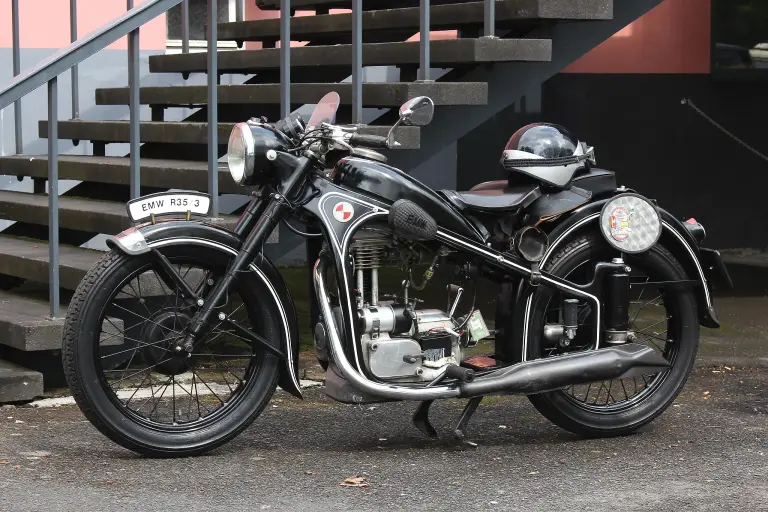
The 340 was developed from the prewar EMW 321 and 326 family and shared its six with the EMW 327 coupé. The same works built the EMW R 35 motorcycle. More cars are in the EMW collection.
Video: Mit einem EMW / BMW 340-2 durch das Schleizer Oberland
Video on YouTube.
Sources
- BMW 340, English Wikipedia: development, bodywork, engine, plant history
- EMW 340, German Wikipedia: production years, 340-2, variants, badge change