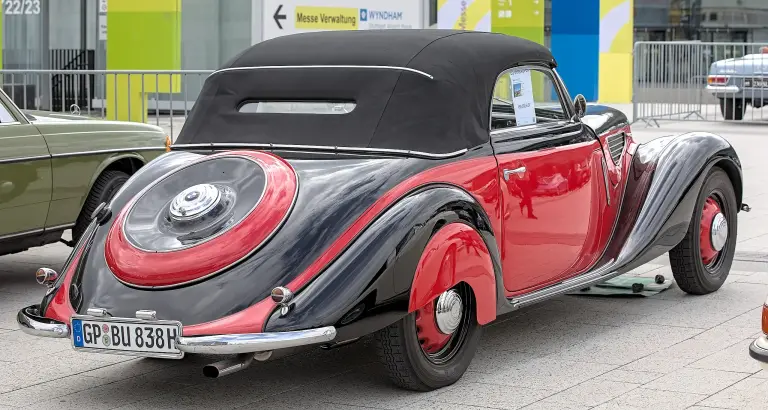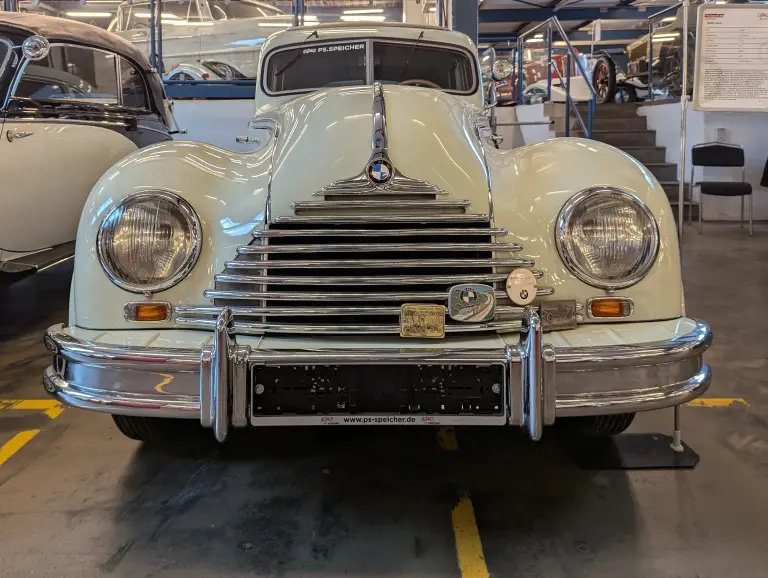
The EMW 321 is the Eisenach-built BMW 321 under its later East German name. The car appeared in January 1939 as the successor to the BMW 320 and was produced until 1941; after the war the same design was assembled again at Eisenach until 1950, and from 1952 it carried the EMW badge.
EMW 321 at a glance
| Maker | BMW, Eisenach works; from 1952 EMW (Eisenacher Motorenwerk) |
|---|---|
| Production | 1939–1941 and 1945–1950 |
| Class | compact six-cylinder saloon and cabriolet |
| Engine | 1971 cc M78 straight-six, 45 PS (33 kW) |
| Top speed | 115 km/h (71 mph) |
| Gearbox | four-speed manual, as on the BMW 326 |
| Chassis | shortened BMW 326 frame; front suspension from the 326 |
| Bodies | two-door saloon, two-door cabriolet, chassis only |
| Doors | rear-hinged |
| Price, 1939 | 4,800 RM saloon, 5,650 RM cabriolet |
| Built | 3,697 in 1939–1941 (English Wikipedia gives 3,814), about 8,996 after the war |
The two Wikipedias give different prewar totals (3,697 and 3,814); both are shown above.
History of the EMW 321
A revised 320
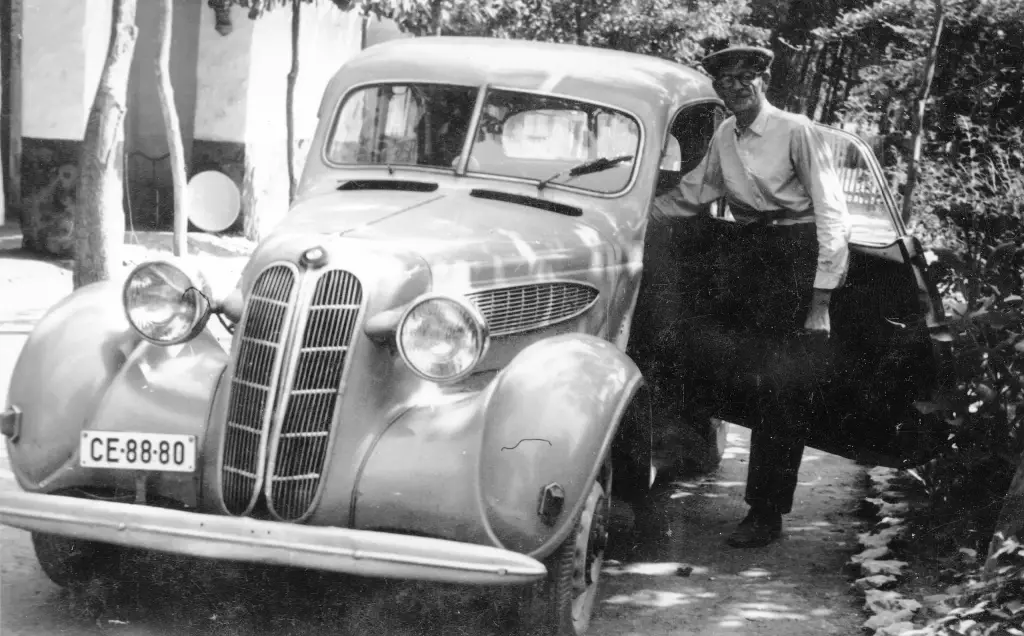
The 321 was introduced at the start of 1939 as the successor to the BMW 320. It used a shortened version of the BMW 326 chassis, and its front suspension came from the 326 as well: upper control arms with a low-mounted transverse leaf spring, in place of the 320 arrangement with a high spring and lower arms. The bodies were 110 mm wider than those of the 320, and the doors were now hinged at the rear, which made getting in and out easier. A Golde sliding roof was available for the saloon at extra cost.
Engine and bodies
The 1971 cc M78 straight-six came from the BMW 326, with a single carburettor and a claimed 45 PS (33 kW), enough for 115 km/h. The four-speed manual gearbox was also the 326 unit. Buyers could choose a two-door saloon at 4,800 RM, a two-door cabriolet at 5,650 RM, or a bare chassis for a coachbuilder’s body. The saloon with the sliding roof cost 5,100 RM.
War and postwar production
In 1941, two years after the launch, car production at Eisenach was stopped in favour of war work. After 1945 the plant lay in the Soviet occupation zone. The tooling had been hidden in nearby mines, and the workers who returned from the war began assembling prewar designs again. Albert Seidler, who had run motorcycle production at Eisenach, had a new 321 with red seats assembled and shown to Marshal Zhukov; the Russians then agreed to spare the plant if six cars could be built in a week, and in October 1945 order no. 93 sent finished cars to the Soviet Union instead of the factory itself.
The EMW years
From 1946 the works belonged to the Soviet-controlled Awtowelo company. Early production went to the Soviet Union and to government use, and civilian sales and exports began in 1948; a further 8,996 cars are thought to have been built between 1945 and 1950. One was advertised in Switzerland in 1949 at CHF 10,300. After the Düsseldorf court ruling of 1950 and the reorganisation of 1952 the works took the name EMW and the blue-and-white BMW badge gave way to the red-and-white Thuringian one.
Design and features
- 326 front end: the 321 took the more modern front suspension of the larger BMW 326, which gave it better road manners than the 320.
- Rear-hinged doors: a detail that was modern in its day and made entry easier for driver and passengers.
- Wider body: the coachwork was 110 mm wider than the 320’s, with more room inside.
- Proven six: the 1971 cc M78 engine and four-speed gearbox were already familiar from the 326.
EMW 321 versions
- Saloon (1939–1941): two-door, 4,800 RM, 5,100 RM with the Golde sliding roof.
- Cabriolet (1939–1941): two-door open car at 5,650 RM.
- Chassis only: offered for customers who wanted a coachbuilt body.
- Postwar BMW 321/2 (1945–1950): assembled at Eisenach under Awtowelo, mostly for the Soviet Union and the military administration.
- EMW 321 (from 1952): the same car with East German badges.
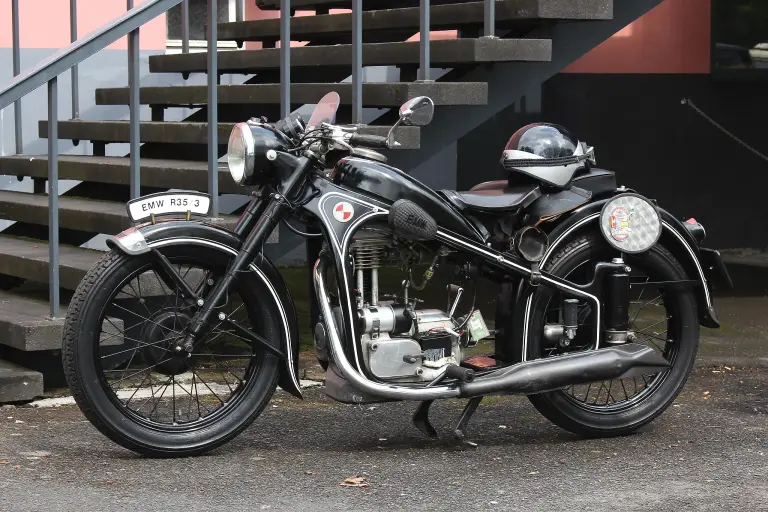
The 321 sat below the larger EMW 340 and shared its engine with the EMW 327 coupé. The works also built the EMW R 35 motorcycle. More cars are in the EMW collection.
Video: 1939 — 1941 BMW 321
Video on YouTube.
Sources
- BMW 321, English Wikipedia: launch, suspension, engine, postwar production
- BMW 320, German Wikipedia: body width, doors, prices, production