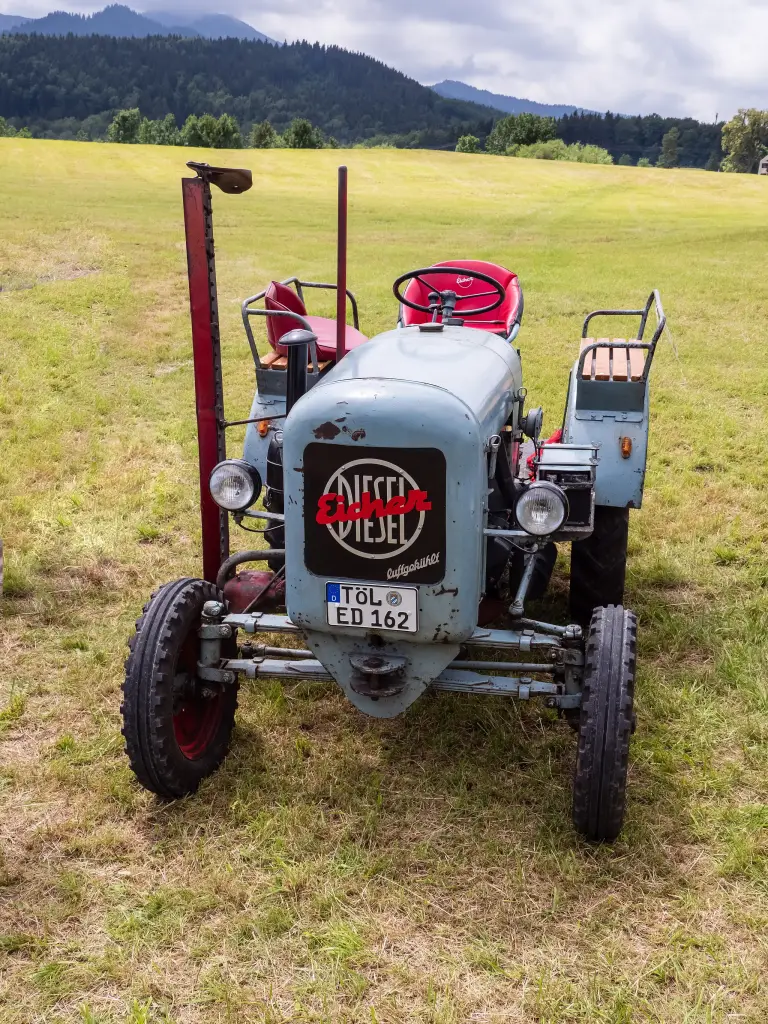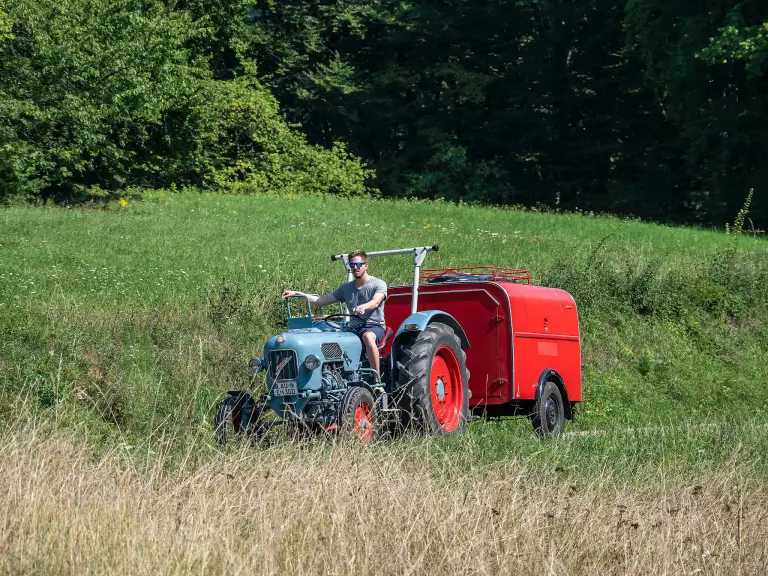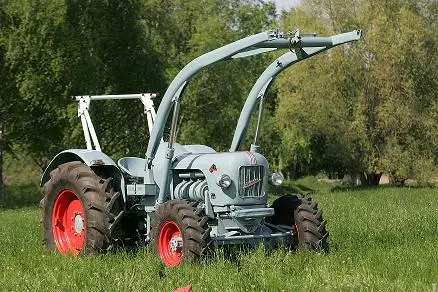
The Eicher Mammut was the heavyweight of the Bavarian maker’s Raubtier series. Its best-known form, the EM 600 Mammut II of 1962–1969, carried a four-cylinder air-cooled engine of up to 62 PS, and from 1963 it was offered with all-wheel drive as the EA 600.
Eicher Mammut at a glance
| Maker | Gebr. Eicher, Forstern and Landau, Bavaria |
|---|---|
| Series | Raubtierserie, the predator series |
| Mammut introduced | 1960, as the ED 310 |
| Mammut II | EM 600, 1962–1969 |
| All-wheel version | EA 600, 1963–1969 |
| Engine | EDK 4 four-cylinder air-cooled diesel, 3,927 cc |
| Power | 55 PS at first, 60 PS from 1964, 62 PS from 1967 |
| Gearbox | ZF A-216 II, eight forward and four reverse gears |
| Length | 3,520 mm, or 3,400 mm for the EA 600 |
| Wheelbase | 2,350 mm, or 2,200 mm for the EA 600 |
| Weight | 2,975 kg, or 2,980 kg for the EA 600 |
| Top speed | about 20 km/h, 28 km/h in the fast gear |
| Built | 600 rear-wheel drive and 643 all-wheel drive |
There is no separate Wikipedia page for the Mammut; the article uses the German page for the EM 600 Mammut II and the model history in the articles on the manufacturer.
History of the Eicher Mammut
Eicher added the Mammut to its predator-named range in 1960, together with the Leopard. The first tractor to carry the name was the ED 310, a large machine that went into series production in 1960 with the older three-cylinder ED engine of 45 PS. It was a stopgap in mechanical terms: Eicher had been working on a new engine generation since 1958, and in 1962 it presented the successor, the EM 600 Mammut II, with the newly developed four-cylinder EDK engine.
The Mammut II was built until 1969. Its engine, the EDK 4, was an air-cooled four-cylinder with 3,927 cc from a 100 mm bore and 125 mm stroke. It left the factory with 55 PS, was raised to 60 PS in 1964 and to 62 PS three years later. The engine was bolted to a ZF A-216 II gearbox with eight forward and four reverse gears. A live power take-off and a dual clutch with a built-in economy PTO at half speed were standard, as was a block hydraulic lift with draft control.
The design was long and low, with a low centre of gravity. Eicher emphasised its pulling power and its stability on side slopes, which made it suitable for work on hillsides and in forestry. The rear-wheel-drive version measured 3,520 mm in length, 1,900 mm in width and 1,700 mm in height on a 2,350 mm wheelbase, and weighed 2,975 kg. It reached about 20 km/h, or roughly 28 km/h in the fast gear.
From 1963 the Mammut II was also available with all-wheel drive as the EA 600. It used a new ZF front axle, the GLA 2550, driven by a propeller shaft from the gearbox through a friction clutch, so that the drive could be engaged and disengaged at any time, even under load. The all-wheel tractor was shorter, with a 3,400 mm length and a 2,200 mm wheelbase, and slightly heavier at 2,980 kg. Eicher built 600 Mammut IIs with rear-wheel drive and 643 with all-wheel drive.
The Mammut name was also used for the most ambitious technical experiment of the period. Eicher had been working on a stepless hydrostatic transmission since 1963, and in 1966 it put it on the market in the Mammut of the 3000 series, together with the follow-up types 3019 and 3020. The advertising effect was greater than the commercial one: fewer than 100 examples of all hydrostatic versions were sold in the following five years. The 3000 series was later joined by the six-cylinder Wotan, built from 1968 to 1976 as the Wotan I with 80 PS and the Wotan II with 95 PS.
In 1968 Eicher renewed its standard tractors with the help of the designer Ernest Igl. The basic technology stayed, but the appearance was redesigned, the predator names were kept, and a new front axle with independent suspension and a cast front axle bracket was introduced, together with a side gearshift for ergonomic reasons.
Design and features
- Long, low layout: a low centre of gravity for stability on slopes and in forestry.
- EDK 4 engine: air-cooled four-cylinder of 3,927 cc, developed from 55 to 62 PS.
- Eight-speed ZF gearbox: eight forward and four reverse gears, with a fast gear for about 28 km/h.
- Comfortable drive: live PTO and a dual clutch with an economy PTO at half speed as standard.
- Optional all-wheel drive: the EA 600 could engage its front axle under load.
Eicher Mammut versions
- ED 310 Mammut (1960): the first Mammut, with the older three-cylinder ED engine of 45 PS.
- EM 600 Mammut II (1962–1969): the four-cylinder EDK 4 model, 600 built.
- EA 600 (1963–1969): the all-wheel Mammut II with the ZF GLA 2550 front axle, 643 built.
- Hydrostatic Mammut (1966): the 3000-series tractor with stepless drive, followed by the 3019 and 3020.
- Wotan (1968–1976): the six-cylinder member of the 3000 series, 80 or 95 PS.
The Mammut was the largest member of the Eicher EM series, which followed the earlier ED tractors. More machines are in the Eicher collection.
Video: Eicher Mammut
Video on YouTube.
Sources
- Eicher EM 600, German Wikipedia: Mammut II history, engine, gearbox, dimensions, production figures
- Eicher, German Wikipedia: Mammut in 1960, hydrostatic 3000 series, 1968 renewal, Wotan
- Eicher tractor, English Wikipedia: company history
- Eicher EM 100, German Wikipedia: the Raubtier series and its engine generation