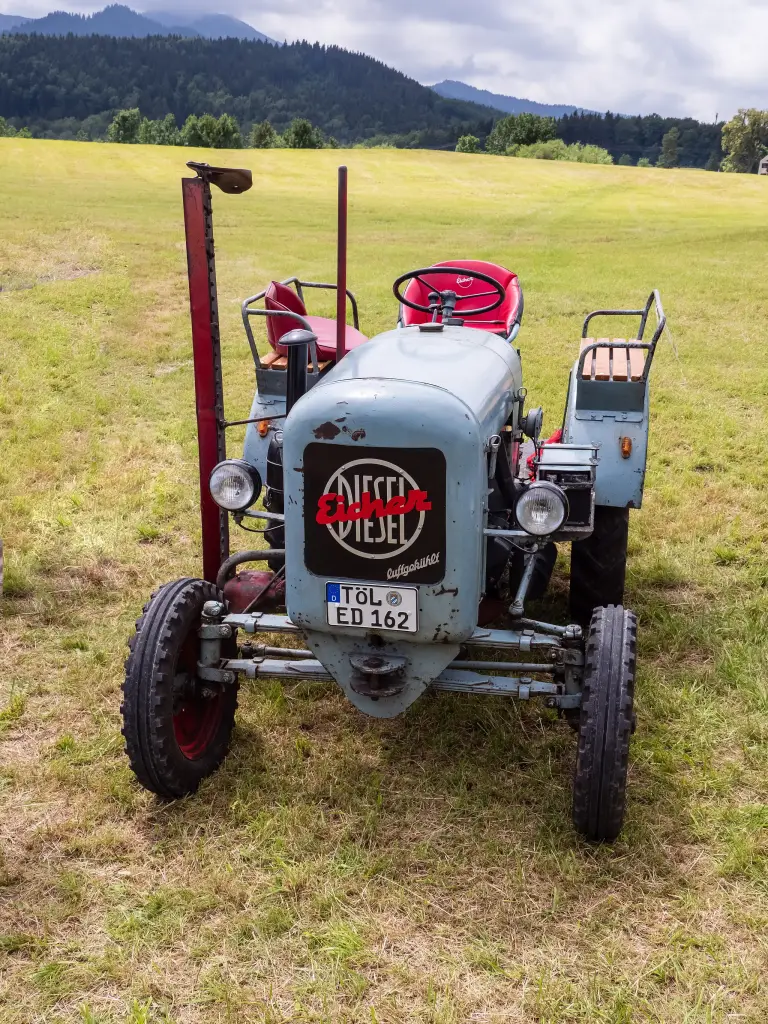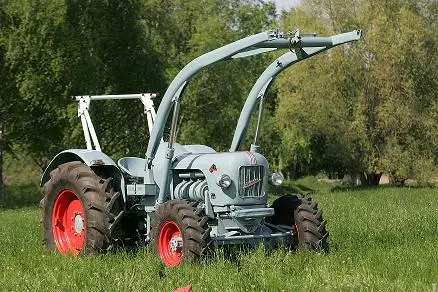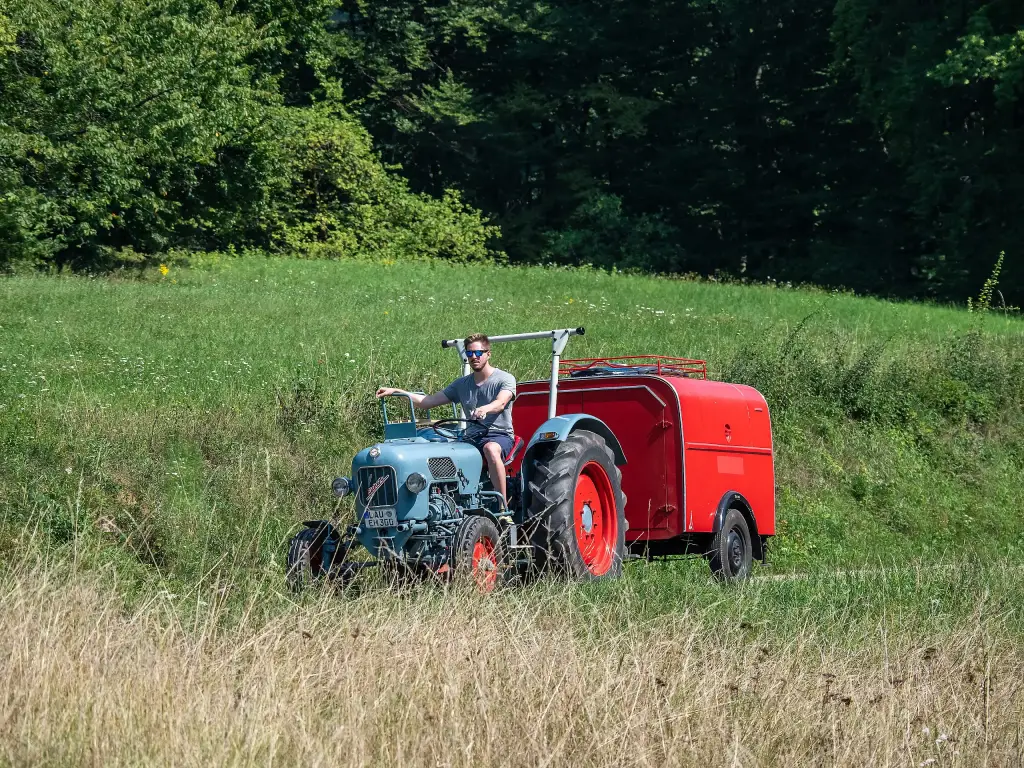
Eicher gave its tractors the names of big cats from 1959, and the EM numbers identified the members of that Raubtier series. The EM 100 Leopard was its smallest model, the EM 600 Mammut II its largest, and both used the short-stroke air-cooled EDK diesel engines that replaced the earlier ED units.
Eicher EM series at a glance
| Maker | Gebr. Eicher, Forstern, Bavaria |
|---|---|
| Series | Raubtierserie, the predator series |
| First predator models | Panther, Tiger and Königstiger, 1959 |
| Added in 1960 | Leopard (EM 100), Mammut (EM 600), Puma |
| Production | 1960–1969 |
| Smallest model | EM 100 Leopard, 16 PS |
| Largest model | EM 600 Mammut II, 55–62 PS |
| Engines | EDK air-cooled four-stroke diesels, 981 cc to 3,927 cc |
| Gearbox | ZF, six forward and two reverse gears in the EM 100 |
| Top speed | about 20 km/h |
| EM 100 built | 5,371 |
| EM 600 built | 600 rear-wheel drive and 643 all-wheel drive |
The article is based on the German Wikipedia pages for the EM 100 and EM 600 plus the model history in the articles on the manufacturer.
History of the Eicher EM series
In 1959 Eicher replaced most of its range with a new family named after predators. It started with the Panther, Tiger and Königstiger, and in 1960 came the Leopard and the Mammut; the Puma followed in the same year. A 1962 revision moved the headlamps on to the bonnet, the most visible change to the series. Within it Eicher used a system of EM numbers, and the two ends of that range were the small EM 100 Leopard and the heavy EM 600 Mammut II.
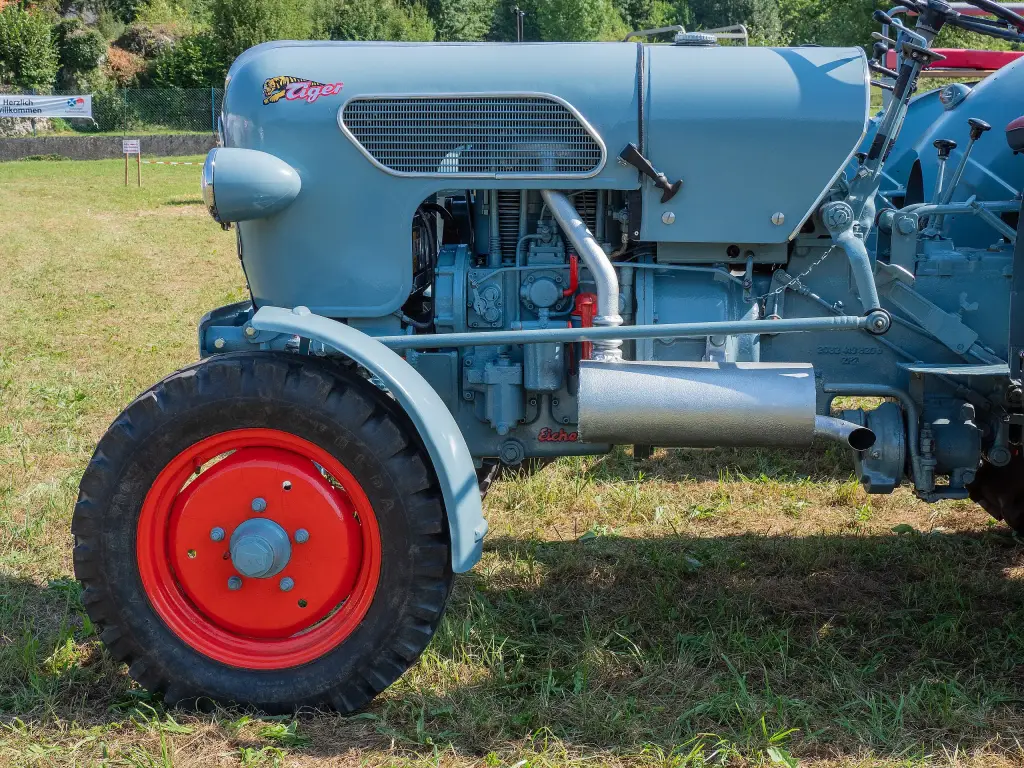
The EM 100, usually called the Leopard, was built from 1960 to 1966 and was at the time the smallest model of the Raubtier series. It arrived when demand for single-cylinder tractors was already falling, as farms increasingly preferred multi-cylinder engines, and when production ended in 1966 it received no direct successor. Even so, 5,371 units were built.
Its engine was the air-cooled single-cylinder EDK 1 of the second Eicher generation, with 981 cc from a 100 mm bore and 125 mm stroke, producing 16 PS at 2,000 rpm. Compared with the older ED engines it was shorter in stroke and therefore freer-revving. The EDK 1 was part of a modular engine system and was also built as two- to six-cylinder units for the larger models of the series. Power went through a single-plate double clutch to a ZF A4 gearbox with group shifting, six forward and two reverse gears, giving a top speed of 20 km/h. Braking was by mechanically operated drum brakes.
The EM 100 was built in block construction and had an unusual single-wheel steering without a track rod, which did not establish itself on the market. The front axle was a pendulum axle with stacked leaf springs. A power take-off was standard, while a hydraulic lift, mower and front loader cost extra. The tractor measured 2,546 mm long, 1,524 mm wide and 1,424 mm high, on a 1,649 mm wheelbase, and weighed 1,064 kg.
At the other end of the range, the EM 600 Mammut II was built from 1962 to 1969 and was also available with all-wheel drive as the EA 600 from 1963. Its four-cylinder EDK 4 engine of 3,927 cc started at 55 PS, rose to 60 PS in 1964 and to 62 PS three years later. It was combined with a ZF A-216 II gearbox with eight forward and four reverse gears. The all-wheel versions followed on from the all-wheel machines of the 1950s: in 1963 Eicher added the EA 600 and the EA 400, the all-wheel Königstiger, based on the EM 300.
The series was replaced from 1968, when Eicher renewed its standard tractors with the help of the designer Ernest Igl, keeping the predator names but fitting a new front axle with independent suspension, a cast front axle bracket and a side gearshift. The EM generation thus spans the decade in which Eicher moved from the post-war ED engines to its own short-stroke EDK family.
Design and features
- EDK engines: short-stroke air-cooled diesels built as one to six cylinders from the same modular system.
- Predator names: Panther, Tiger, Königstiger, Leopard, Mammut and Puma identified the models.
- ZF gearboxes: group-shift transmission with six forward and two reverse gears in the EM 100.
- Unusual steering: the EM 100 used single-wheel steering without a track rod and a pendulum front axle.
- All-wheel versions: the EA 400 and EA 600 added four-wheel drive to the series in 1963.
Eicher EM series versions
- EM 100 Leopard (1960–1966): 16 PS single-cylinder, the smallest of the series, 5,371 built.
- EM 600 Mammut II (1962–1969): four-cylinder EDK 4 of 55 to 62 PS.
- EA 600 (1963–1969): the all-wheel version of the Mammut II.
- EA 400 (1963): the all-wheel Königstiger, developed from the EM 300.
- Panther, Tiger and Königstiger: the models that opened the series in 1959.
The EM 600 was the Mammut II, and the series grew out of the earlier Eicher ED tractors. More machines are in the Eicher collection.
Video: Eicher EM 295 Panther
Video on YouTube.
Sources
- Eicher EM 100, German Wikipedia: engine, gearbox, steering, dimensions, production total
- Eicher EM 600, German Wikipedia: Mammut II, EA 600, engine and production figures
- Eicher, German Wikipedia: Raubtier series, 1962 revision, 1968 renewal
- Eicher tractor, English Wikipedia: company history