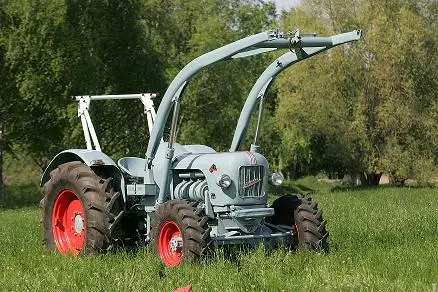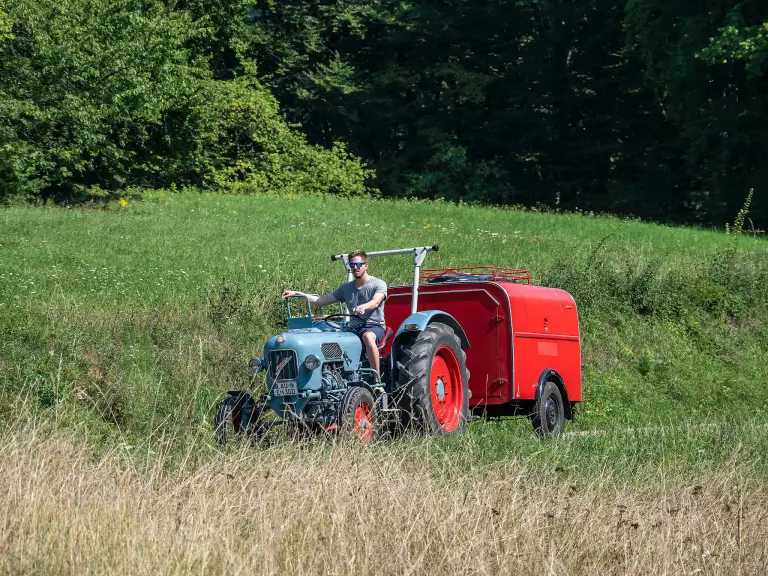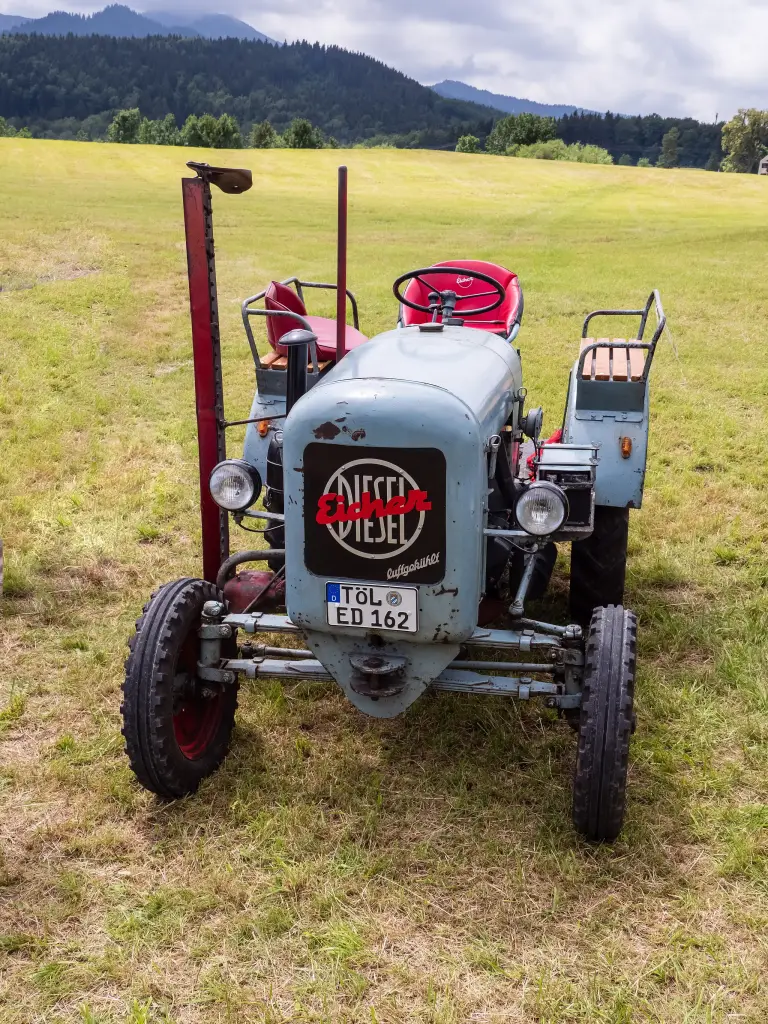
The Eicher ED series began in 1948 with the ED 16/I, the first tractor in the world with an air-cooled four-stroke diesel engine. Its name stood for Eicher Diesel, and over the following decade the Bavarian firm expanded the range from 16 hp single-cylinder machines to 60 hp three-cylinder tractors.
Eicher ED series at a glance
| Maker | Gebr. Eicher, Forstern, Upper Bavaria |
|---|---|
| Series name | ED, for Eicher Diesel |
| Production | 1948 to the early 1960s |
| First model | ED 16/I, 1948 |
| First engine | ED 1 single-cylinder, air-cooled, 12 kW (16 PS) |
| Cooling | air, with a separate radial fan for each cylinder |
| Related models | Eicher 30 (1949), 25/I (1950), L 28 (1953), L 60 (1954) |
| Own multi-cylinder engines | ED 2e, 22 kW (30 PS), 1955; ED 3d three-cylinder, 1957 |
| Top of the series | ED 50 with 37 kW (50 PS) and ED 60 with 44 kW (60 PS) |
| All-wheel drive | ED 22 Allrad and ED 30 Allrad with a Renk gearbox |
| Production milestone | the 20,000th Eicher was built in 1953 |
Eicher has no separate Wikipedia page for the ED series; this article uses the model history in the German and English articles on the manufacturer.
History of the Eicher ED series
After the Second World War Eicher resumed production of its pre-war tractors, and in 1948 the company presented its first post-war design, the ED 16/I. It was powered by Eicher’s own single-cylinder engine, the ED 1, rated at 12 kW (16 PS). The significance of the machine lay in its cooling: the ED 16/I was the first tractor in the world with an air-cooled diesel engine working on the four-stroke principle. Stihl showed a tractor with an air-cooled two-stroke diesel at the same time, but the four-stroke layout prevailed. Air-cooled engines with a separate radial fan for each cylinder became a recognisable feature of Eicher tractors for decades, and the letters ED, for Eicher Diesel, stayed in the model names.
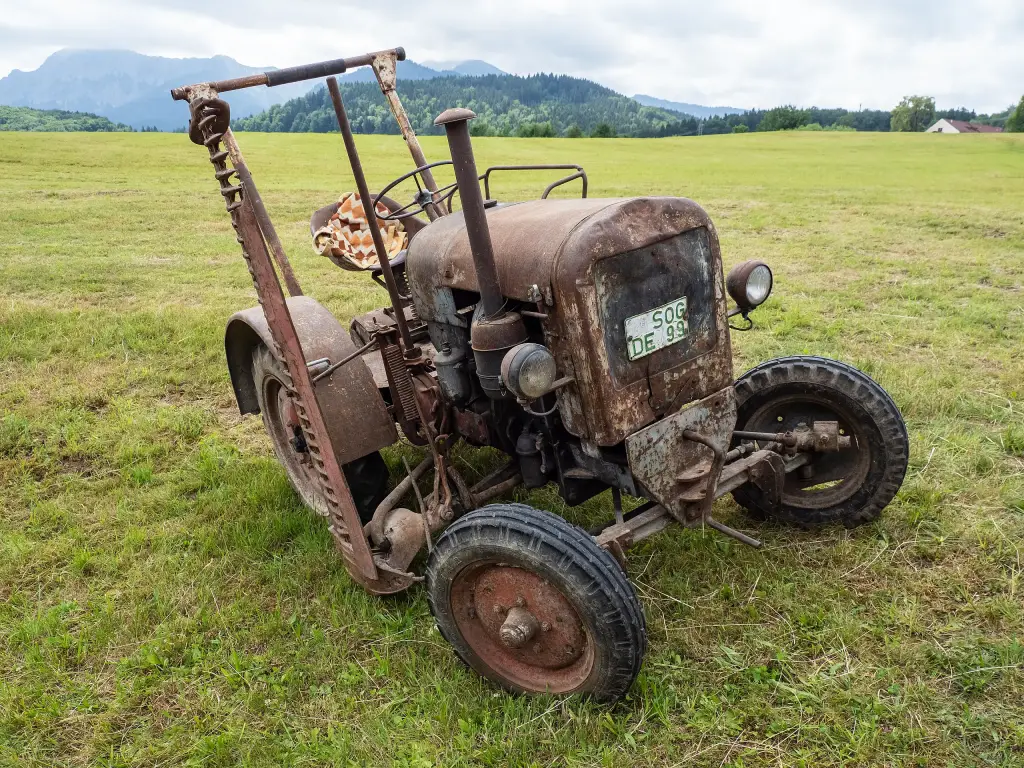
The programme then widened quickly. The Eicher 30 of 1949 used a Südbremse engine, the 25/I of 1950 a water-cooled Deutz unit, and the L 28 of 1953 an air-cooled Deutz engine. Production rose with the range: the 2,000th Eicher tractor was completed in 1950 and the 20,000th in 1953. On 1 July 1951 the brothers acquired the Fahrzeug- und Maschinenbau GmbH, known as Famag, in Dingolfing, which brought a foundry of their own. With it came a full line of implements — ploughs, harvesters, loaders, cultivators, harrows and rotary tillers — summed up in the slogan “For the farmer a safe pledge: tractor and implements from one hand”.
Eicher had begun with bought-in engines, but from the mid-1950s it designed its own multi-cylinder units. The ED 2e of 1955 was the company’s first own multi-cylinder engine: 22 kW (30 PS), combined with a ZF A 15 gearbox in the ED 30. In 1957 the ED 3d became Eicher’s first three-cylinder engine; with a ZF A 24 gearbox it powered the ED 50 at 37 kW (50 PS), and with a ZF A 26 the ED 60 at 44 kW (60 PS). The L 60 of 1954, with 44.2 kW (60 PS), had been the most powerful Eicher tractor up to that point. A technical change came with the short-stroke EDK engine of the second generation, which replaced the older, larger and slower-revving ED units in the Raubtier series from 1960.
All-wheel drive was another branch of the ED family. When Renk offered a gearbox that allowed a tractor with four equal wheels, Eicher built the ED 22 Allrad and the ED 30 Allrad. The drive was permanent and there was no longitudinal differential between the front and rear axles, which made the tractors very large in turning circle and restless on the road. Eicher therefore advertised them as special machines for steep slopes and forestry work. The all-wheel ED models of the 1950s and 1960s earned respect for their traction and off-road ability, although their high price kept sales small.
Alongside the standard tractors Eicher built small machines and tool carriers. The EKL 11/2 of 1956, with a Deutz F1 L 612 engine of 8 kW (11 PS), was the smallest tractor in the company’s history. The G 19 Kombi tool carrier of 1955 was based on the EKL 15/II with a Hurth G 85 gearbox, and in 1956 the range was extended by the G 13 Muli with a 10 kW (13 PS) Hatz engine. The EKL 15 also starred in the Eicher-Rad, a looping track shown at the DLG exhibition in Cologne in May 1951, in which the tractor drove upside down in a ring of rails.
Design and features
- Air-cooled four-stroke diesel: the ED 16/I of 1948 was the first tractor in the world with this layout.
- Radial fan per cylinder: the cooling arrangement that became an Eicher trademark.
- Own engines: from the ED 2e of 1955 to the three-cylinder ED 3d of 1957.
- All-wheel drive: the ED 22 Allrad and ED 30 Allrad with a Renk gearbox, intended for slopes and forestry.
- Implements from one hand: the Famag works in Dingolfing supplied ploughs, harvesters, loaders and tillers.
Eicher ED series versions
- ED 16/I (1948): the first post-war model, single-cylinder ED 1 engine, 12 kW (16 PS).
- Eicher 30 (1949): with a Südbremse engine.
- Eicher 25/I (1950): with a water-cooled Deutz engine.
- L 28 (1953) and L 60 (1954): with air-cooled Deutz engines, the L 60 rated at 44.2 kW (60 PS).
- ED 30 with ED 2e (1955): the first Eicher with an own multi-cylinder engine.
- ED 50 and ED 60 (1957): three-cylinder ED 3d engines of 37 kW (50 PS) and 44 kW (60 PS).
- ED 22 Allrad and ED 30 Allrad: permanent four-wheel drive for steep ground and forest work.
The ED series was followed by the EM Raubtier series, whose largest member was the Mammut. More Eicher tractors are in the Eicher collection.
Sources
- Eicher tractor, English Wikipedia: ED 16/I, ED 30, ED 25/I, ED 28, production history
- Eicher, German Wikipedia: ED engines, ED 2e and ED 3d, all-wheel models, small tractors
- Eicher EM 100, German Wikipedia: EDK short-stroke engine as the successor of the ED units
- Eicher EA 400, German Wikipedia: reputation of the all-wheel ED models