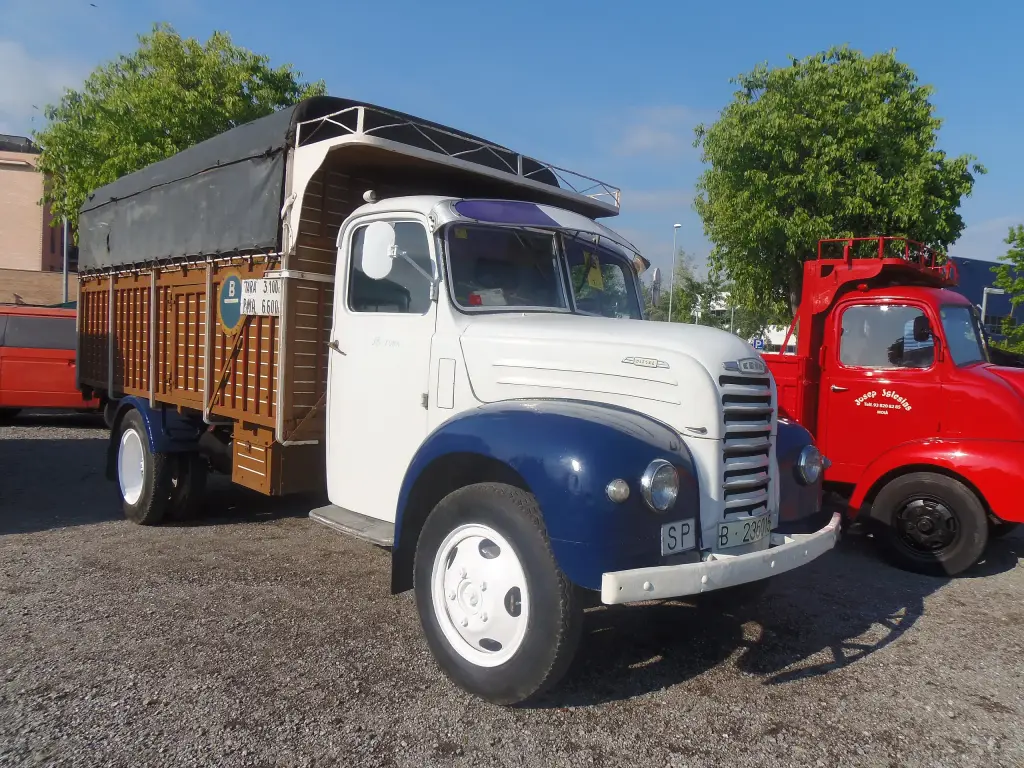
The Ebro B-45 was one of the first lorries sold under the Spanish Ebro name in the 1950s. Like everything Motor Ibérica built in those years, it was a near-identical adaptation of a British Ford, in this case the Thames Trader, and Spanish sources describe it as one of the most popular trucks of the early Ebro range.
Ebro B-45 at a glance
| Maker | Motor Ibérica, S.A., Barcelona |
|---|---|
| Brand | Ebro, registered in 1954 for tractors and lorries |
| Production | from 1955 |
| Based on | Ford Thames Trader, the ET4 4×2 and ET6 6×4 |
| Licence | built in Spain under agreement with Ford |
| Character | near-identical copy of the British original |
| Company background | Ford’s Spanish factories nationalised in 1954 |
| Ebro output | about 10,000 lorries a year by the early 1960s |
| Next generation | tilt-cab models derived from the Ford D-series |
The B-45 has no Wikipedia article of its own. This page is based on the sections about the early Ebro range in the Spanish article on Motor Ibérica and the English article on Ebro trucks, which do not give the lorry’s own specifications.
History of the Ebro B-45
From Ford Spain to Motor Ibérica
Ford opened its first agency in Spain in 1907 and in 1920 founded Ford Motor Company, S.A.E. in Cádiz, where it built Ford T cars and light trucks. In 1923 the company moved to a factory in Barcelona, and in 1929 it was reorganised as Ford Motor Ibérica. Output reached 7,800 vehicles in 1935, half of them lorries, but the Civil War stopped production and the factory was bombed. The post-war years of autarky made manufacturing in Spain extraordinarily difficult: imports were restricted, petrol was rationed, electricity was available only for a few hours a day and tyres were so scarce that new lorries could not be sold.
When SEAT and FASA-Renault went into production in 1953 with the backing of the Franco regime, Ford gave up on its old Spanish market. It sold its share in 1954, the company was nationalised as Motor Ibérica, S.A., and the Ebro brand was registered for tractors and lorries. The name was chosen from the river Ebro, the Iberian counterpart of the Thames after which the British trucks Ford supplied were named.
The B-45 and the Thames Trader
The first Ebro lorry range was based on the Ford Thames Trader, which Ford built in Britain as the ET4 4×2 and ET6 6×4. Motor Ibérica kept its link with Ford by assembling Fordson tractors and Thames Trader lorries, and in 1955 it launched its own range, beginning with the Ebro 38 tractor, built alongside the lorries to keep costs down. Initially both tractors and lorries were almost exact copies of the British originals.
Among these first lorries the B-45 became the best known; a 1961 photograph of an Ebro of the B series shows the family resemblance to the Thames Trader. The sources used here describe the early Ebro range as a whole and do not give the B-45’s own engine, payload or production figures, so this page does not repeat any.
After the B-45
Tractor production grew from 500 units in 1955 to 8,000 in 1964, and by the beginning of the 1960s Motor Ibérica was already building about 10,000 lorries a year. From the early 1960s the range moved on to a new series of lorries derived from the Ford D-series, with a tilting cab, and gradually covered a wide spread of configurations. In 1965 the ties with Ford were finally cut and Motor Ibérica signed a licence agreement with the American company Massey Ferguson, which also took a 36 per cent stake in the business. The B-45 belongs to the short first chapter of Ebro lorries, before the D-series cab and before the Nissan years.
Design and features
- Ford engineering: the lorry followed the Thames Trader, the British Ford cab-over lorry of the 1950s.
- Nationalised production: it was built by a Spanish company created when Ford left Spain in 1954.
- River name: Ebro was chosen to mirror the Thames, the river that named the British original.
- Best known of the first range: Spanish sources single out the B-45 as the most popular early Ebro truck.
Ebro B-45 versions
- B-45: the lorry described here, derived from the Ford Thames Trader.
- ET4 4×2 and ET6 6×4: the two Thames Trader models on which the first Ebro range was based.
- Ebro 38: the tractor launched in 1955 alongside the lorries, built on the same lines to cut costs.
- Ford D-series derived lorries: the tilt-cab generation that followed the B series from the early 1960s.
The B-45 was the lorry side of early Ebro production; the firm later built the Ebro Trade van and took over the Ebro Siata. More models are in the Ebro collection.
Video: Camión Ebro B-45
Video on YouTube.
Sources
- Ebro (Motor Ibérica), Spanish Wikipedia: early history, Thames Trader basis, the B-45
- Ebro trucks, English Wikipedia: Motor Ibérica, Thames Trader ET4 and ET6, later range