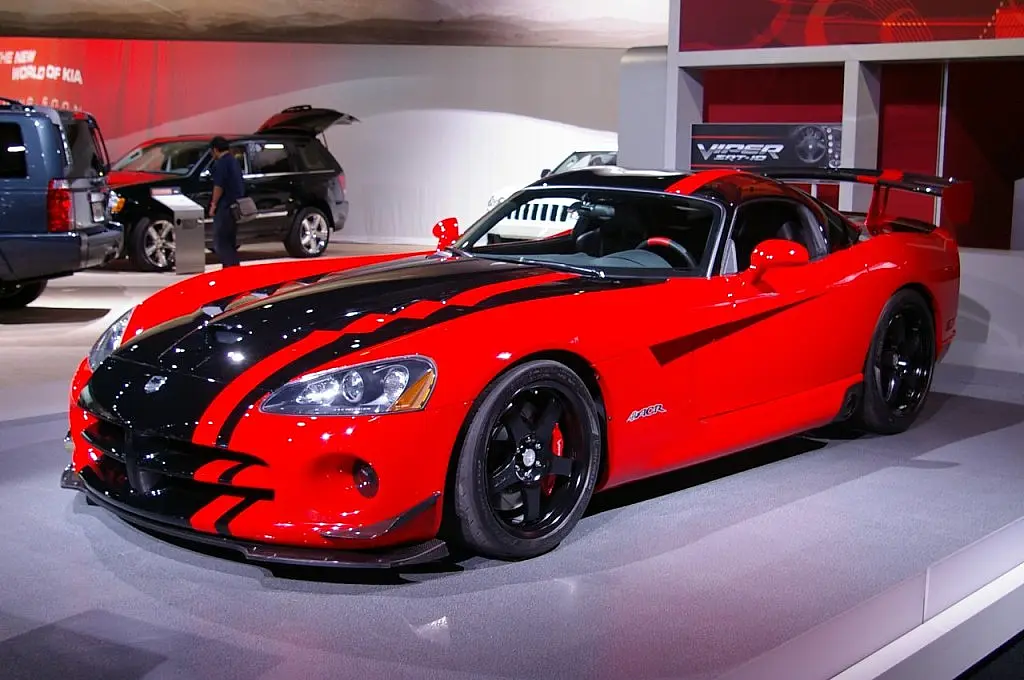
The Dodge Viper is an American sports car that Dodge built, with SRT taking over for 2013 and 2014. It was first shown in 1989 at the North American International Auto Show as an interpretive concept of a modern AC Cobra, and production of the two-seat car began in 1991 at the New Mack plant before moving to Conner Avenue in October 1995.
Dodge Viper at a glance
| Production | 1991-2017, five generations |
|---|---|
| Class | two-seat sports car |
| First shown | 1989 North American International Auto Show |
| First model | RT/10 Roadster, on sale January 1992 |
| Engine | 8.0 L V10, 400 hp and 465 lb-ft in the first generation |
| Layout | front engine, rear-wheel drive |
| Weight | about 3,280 lb in the first generation |
| 0-60 mph | 4.2 seconds in the first generation |
| Top speed | about 165 mph in the first generation |
| Built | about 32,000 cars over 26 years |
Based on one source: the English Wikipedia article on the Dodge Viper.
History of the Dodge Viper
The Viper was conceived in late 1988 at Chrysler’s Advanced Design Studios. The following February Chrysler president Bob Lutz suggested to Tom Gale that the company should build a modern Cobra, and a clay model was presented a few months later. Built in sheet metal by Metalcrafters, the car appeared as a concept in 1989, and public reaction was so enthusiastic that chief engineer Roy Sjoberg was told to develop it as a production vehicle. Chrysler chairman Lee Iacocca delayed approving the 70 million dollars needed, saying it was a lot to spend without assurance of financial return.
Sjoberg picked 85 engineers as Team Viper and development began in March 1989. The team asked Lamborghini, then a Chrysler subsidiary, to cast a prototype aluminium block in May, and the production body was finished in autumn 1989 with a chassis prototype running in December. A V8 powered the first test mule, called White Mule, but the V10 the production car was meant to use was ready in February 1990, and Iacocca gave official approval in May 1990. A year later Carroll Shelby drove a pre-production car as the pace vehicle at the Indianapolis 500, and in November 1991 the car was released to reviewers, with the first retail shipments in January 1992. The two-seater sold for 52,000 dollars and sparked immediate interest in Dodge among enthusiasts and the press.
The first generation, the SR I, debuted in 1991 with two pre-production cars as Indianapolis 500 pace cars after Dodge was forced to substitute the Viper for the Japanese-built Dodge Stealth because of complaints from the United Auto Workers. It went on sale in January 1992 as the RT/10 Roadster. Lamborghini helped design the V10, which was based on Chrysler’s LA V8, and chief power engineer Dick Winkles spent time in Italy overseeing its development.
The car was engineered as a performance machine and had no exterior door handles or key cylinders and no air conditioning, though air conditioning became an option for 1994 and 1995. The roof was canvas and the windows were vinyl with zippers, much like a Jeep Wrangler, but the Viper still had manually adjustable leather-trimmed bucket seats, an AM/FM cassette stereo and carpeting, and a lightweight fibreglass hard roof was shipped with each car. There were no airbags, to save weight. The engine weighed 323 kg and produced 400 hp at 4,600 rpm and 465 lb-ft at 3,600 rpm, and the car was rated at 12 mpg in the city and 20 on the highway. The body was a tubular steel frame with resin transfer moulded fibreglass panels, the curb weight was about 3,280 lb and there was no traction control or anti-lock braking. The SR I reached 60 mph in 4.2 seconds, 100 mph in 9.2 seconds and the quarter mile in 12.6 seconds, with a top speed of about 165 mph. Its large tyres let it corner at close to one lateral g, but the car was tricky at high speed, particularly for the unskilled.
The Viper gained a reputation early on as an intimidating car, with high power and torque and no driver aids. Later generations added electronic assists and safety features, making the car more accessible while also faster, and the model gradually moved upmarket into the supercar class. In 2014 the Viper was named number 10 on Cars.com’s American-Made Index, meaning 75 per cent or more of its parts were made in the United States. It was discontinued in 2017 after about 32,000 cars were built over 26 years, with a brief hiatus in 2007 and between 2011 and 2012.
Design and features
- V10 engine: a Lamborghini-assisted aluminium V10 based on Chrysler’s LA V8.
- No driver aids: no traction control, no anti-lock brakes and no airbags in the first generation.
- Raw detailing: canvas roof, zippered vinyl windows and no exterior door handles.
- Five generations: from the 1992 RT/10 to the 2017 cars, with about 32,000 built.
Dodge Viper versions
- RT/10 Roadster (1992-1995): the first-generation open car.
- Later generations: five in total between 1991 and 2017.
- SRT Viper (2013-2014): the version sold under the SRT brand.
The Viper’s engine later powered the Dodge Tomahawk concept, and the car sat above models such as the Dodge Stealth in the Dodge range. More Dodge models are in the Dodge collection.
Sources
- Dodge Viper, English Wikipedia: development, first generation, specifications, production