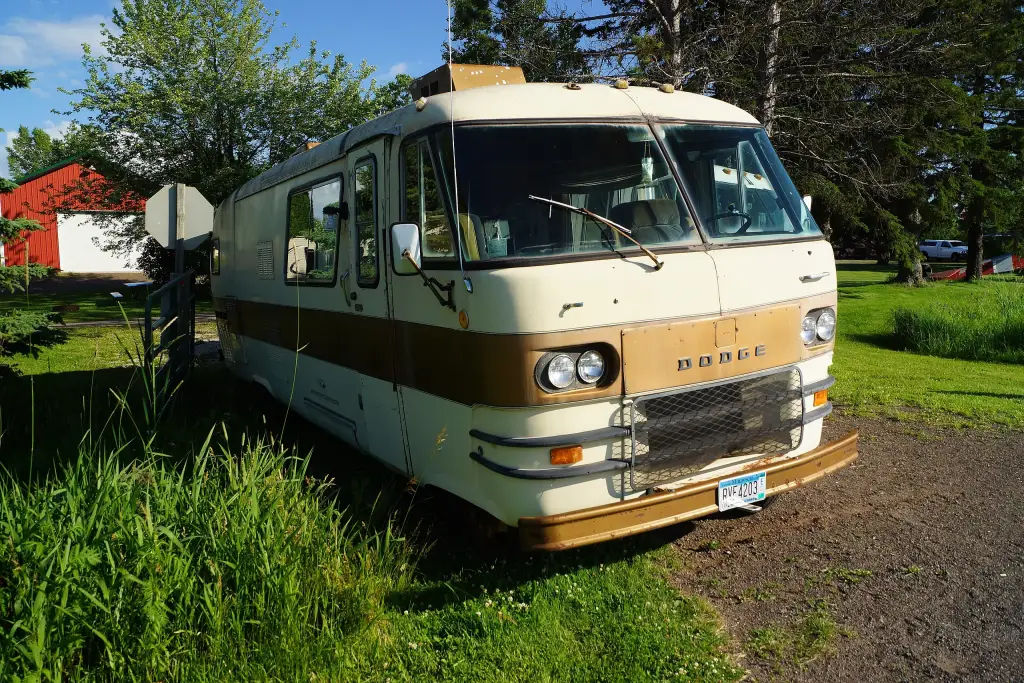
The Travco motorhome was an American aerodynamic Class A recreational vehicle built on a Dodge chassis from 1964 until the late 1980s. Its design began as a 1961 model called the Dodge Frank Motor Home, sold with the help of Chrysler, and many Travcos were sold with Dodge branding.
Travco at a glance
| Maker | Travco Corporation, on Dodge chassis |
|---|---|
| Production | 1964 to the late 1980s |
| Class | Class A motorhome |
| First year | 131 built, at about 9,000 dollars each |
| Sizes | 210 (21 ft), 220, 270, 290 and 320 (32 ft) |
| Best seller | the 27-foot 270 |
| Engines | Chrysler 318, later 413 and 440 |
| Gearbox | Torqueflite 727 automatic |
| Chassis | Dodge medium-duty, live rear axle and I-beam front axle |
| Tax case | won in 1971, motorhomes taxed at the lower private-car rate |
Based on one source: the English Wikipedia article on the Travco motorhome.
History of the Travco
The Travco design emerged as a 1961 model called the Dodge Frank Motor Home, marketed with the assistance of Chrysler. It was a refinement by Ray Frank of the original Frank Motor Home, a conventional box-type design on a Dodge chassis built in Brown City, Michigan from 1958 to 1962, and 131 were produced in the first year at an average price of 9,000 dollars. Ray Frank, founder of Frank Industries, also coined the term motorhome and later developed Xplorer Motorhomes; he was inducted into the RV/MH Hall of Fame as the father of the motorhome.
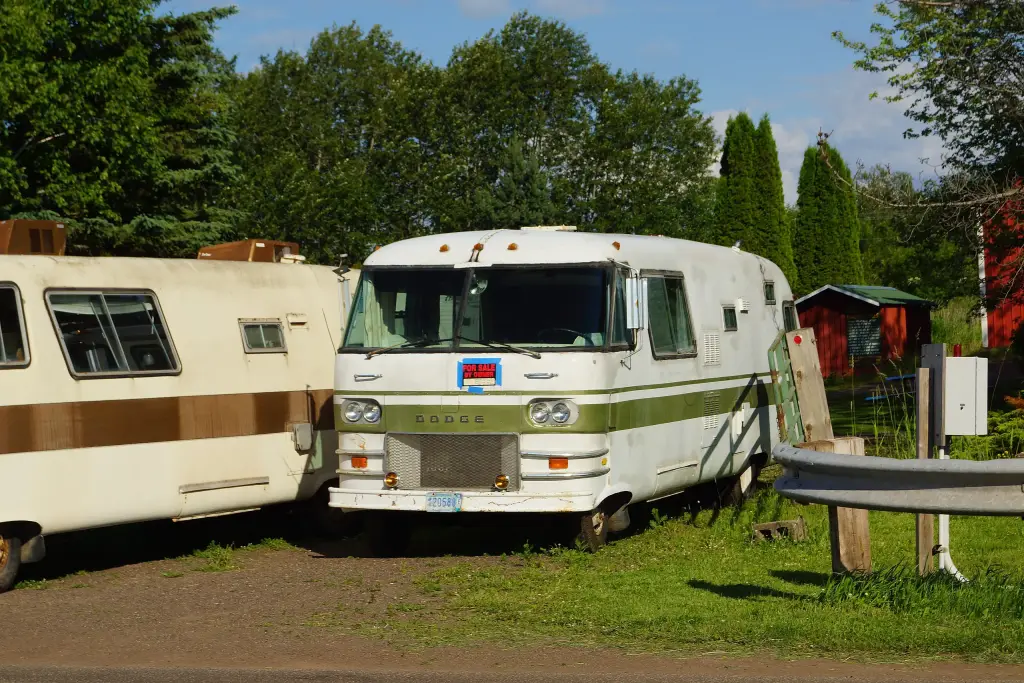
Travco enjoyed a large share of the young motorhome market. Its success contributed to the demise of more established makes such as the Corvair-powered UltraVan and opened the market to lower-cost makers such as Winnebago. Travco’s use of the Dodge M-series chassis established Dodge as the most popular motorhome chassis make for twenty years. The company offered a variety of lengths and floorplans, with the 27-foot model the most popular, and it challenged the tax law that treated motorhome chassis as trucks at a higher rate than private cars, winning its case in 1971 when the IRS accepted that motorhomes should be taxed at the lower rate.
In 1964 the Travco Corporation, a contraction of Travelers Company, took control, enlarged the windows and made other cosmetic changes. The mid-1960s Travco was offered in six colour combinations, and the styling changed very little from 1964 to 1980 apart from a choice of grilles. Five sizes were offered: the 21-foot 210, the 22-foot 220, the 27-foot 270, the 29-foot 290 and the 32-foot 320. The 270 was the best seller, and the most popular colour in the 1960s was white with a red band running lengthwise around the centre, while the 1970s favoured earth tones. Eventually the Atomic Age design lost its appeal despite a more modern grille in the mid-1970s.
As part of the loan guarantees to Chrysler during its late-1970s crisis, the company was told to leave the medium-duty truck market, including the Dodge motorhome chassis, and concentrate on light trucks. That ended production of the popular Dodge chassis with the 440 cu in big-block V8 and contributed to the demise of Travco, which was closely identified with Chrysler, along with management changes and the high fuel costs and interest rates of 1979. The body shells were used by the luxury motorhome maker Foretravel until about 1990. Travco also built van conversions called Family Wagons and Class C minihomes with aluminium sides and a fibreglass version called L’Esprit.
The original Dodge motorhome chassis used the Chrysler 318 Polysphere engine, refined for heavy-duty use. Gross vehicle weights could exceed six tons, yet the 318 with about 200 hp could keep up with traffic and reach slightly over 70 mph in most configurations. The 318 and later 413 and 440 engines were mated to the Torqueflite 727 automatic, which used a pushbutton selector until the 1964 model and an instrument-panel lever from 1965. All Dodge motorhome chassis engines were uprated truck versions with improved valves, stress-relieved castings and forged crankshafts, and the chassis used a live dual rear wheel axle and an I-beam front axle on semi-elliptic leaf springs. Interiors ranged from the luxury 27-foot Dodge Mahal of the early 1970s for two people to family floorplans sleeping up to ten, and the SightSeer was a cheaper box-style model aimed at the economy market.
Design and features
- Aerodynamic body: a fibreglass shape that stood out among boxy motorhomes.
- Dodge chassis: the medium-duty Dodge chassis that made Dodge the top motorhome chassis maker for 20 years.
- Five sizes: from the 21-foot 210 to the 32-foot 320, with the 270 the best seller.
- Tax victory: the 1971 case that won lower taxation for motorhomes across the industry.
Travco versions
- Travco 210 to 320: the five lengths offered from 1964.
- Dodge Mahal: the luxury 27-foot floorplan of the early 1970s.
- SightSeer: the cheaper conventional box-style motorhome.
- Family Wagon and L’Esprit: the van conversions and Class C minihomes.
Travco used Dodge chassis related to the Dodge D series and Dodge Ram trucks, and it shared the recreational market with the Dodge Ram Van conversions. More Dodge models are in the Dodge collection.
Sources
- Travco, English Wikipedia: history, models, chassis, interiors