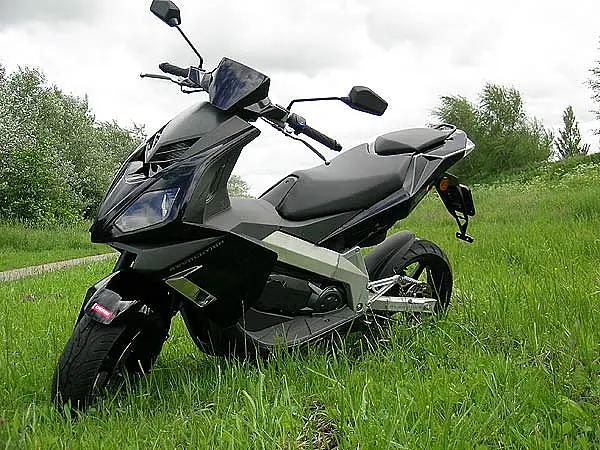
The Derbi GP1 was a sport scooter produced by the Spanish firm Derbi from 2005 to 2011. It was unusual among scooters for its motorcycle-type chassis: a twin-spar frame running alongside a centrally mounted engine, an aluminium swingarm and a radially mounted front brake caliper.
Derbi GP1 at a glance
| Maker | Derbi, Martorelles (Spain) |
|---|---|
| Production | 2005–2011 |
| Type | Sport scooter |
| Project cost | over €800,000, more than nine months of work |
| Project manager | Luca Loris, Derbi scooter division |
| Frame | aluminium twin-spar, engine in central position |
| Swingarm | inverted aluminium, partly forged and partly extruded, 35 mm |
| Front brake | radial caliper, vented disc |
| Wheels | 14 inch, Pirelli GTS tyres, 120/70 front and 140/60 rear |
| Engines | 50 cc two-stroke Piaggio; 125 and 250 cc from 2006 |
| Fuel tank | 11 litres |
| Premiere | Intermot Munich, 2004 (static display) |
| Press launch | Palma de Mallorca, February 2005 |
based on one source; the Italian Wikipedia article is the only detailed account of the GP1.
History of the Derbi GP1
The GP1 was the result of a project that took more than nine months and cost over 800,000 euros, led by Luca Loris, project manager of Derbi’s scooter division. Its chassis was closer to a motorcycle than to a scooter: a twin-spar frame running parallel to the engine, which was carried in a central position, an inverted swingarm in aluminium — partly forged and partly extruded — of 35 mm diameter, a central single shock absorber and a radially mounted front brake caliper. The brakes were vented discs and the wheels 14 inch, with Pirelli GTS tyres in 120/70 at the front and 140/60 at the rear.
The scooter was shown in static form at the Intermot fair in Munich in 2004, where it immediately won first prize for design in the scooter category from the Motorcycle Design Association. It was then presented to the press at Palma de Mallorca in February 2005, put into production at Derbi’s Martorelles plant and sold in Europe with a 50 cc two-stroke Piaggio engine.
The following year Derbi added 125 and 250 cc versions. These had a reinforced chassis with 40 mm inverted fork legs and a new central rear monoshock, and the braking system was changed too: the 250 received twin 245 mm front discs, while the 125 kept a single disc. A few months after the 125 and 250 were presented, a cheaper variant of the 50 joined the range, called Open. It was a simplified version of the standard 50, which was now renamed Racing. The Open was re-engineered for comfort with a conventional swinging engine and transmission unit instead of the central engine of the Racing, a single rear shock absorber, a traditional front caliper, a 13-inch rear wheel and a lower seat that could hold a jet helmet; the aluminium twin-spar frame and the 50 cc two-stroke engine were unchanged.
The GP1 went out of production in 2011, when Derbi closed its historic Martorelles factory.
Design and features
- Motorcycle-type chassis: twin-spar frame with the engine carried centrally.
- Forged aluminium swingarm: inverted, 35 mm, partly forged and partly extruded.
- Award-winning design: first prize in the scooter category from the Motorcycle Design Association at its 2004 debut.
- Two characters: the sporty Racing and the more comfortable, cheaper Open.
Derbi GP1 versions
- GP1 50 (2005): 50 cc two-stroke Piaggio engine, the original model.
- GP1 125 (2006): reinforced chassis, 40 mm inverted fork, single front disc.
- GP1 250 (2006): twin 245 mm front discs and the strongest chassis of the range.
- GP1 50 Open: simplified and cheaper, with a swinging engine unit, 13-inch rear wheel and lower seat.
- GP1 50 Racing: the original 50 renamed after the Open arrived.
The Derbi GPR was the firm’s geared 50 and 125 cc sports bike of the same years, and the Senda its supermotard. More scooters and motorcycles are in the Derbi collection.
Sources
- Derbi GP1, Italian Wikipedia: project, chassis, engines, versions, end of production