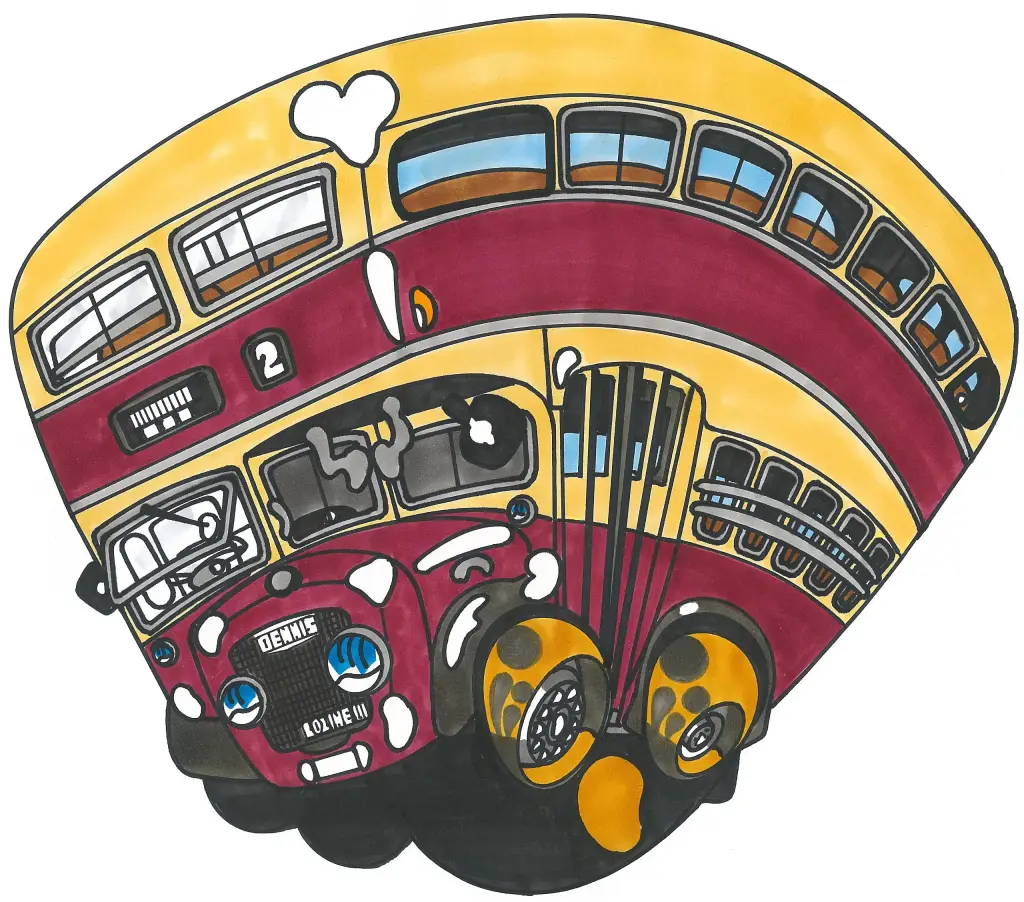
The Dennis Loline was a low-height double-decker bus built by Dennis of Guildford between 1958 and 1966. It was essentially a licence-built Bristol Lodekka, and it existed because Bristol’s own sales were restricted to the state-owned bus companies, leaving private and municipal fleets looking for an equivalent.
Dennis Loline at a glance
| Maker | Dennis Brothers, Guildford |
|---|---|
| Production | 1958–1966 |
| Type | low-height double-decker bus |
| Origin | licence-built Bristol Lodekka |
| Versions | Loline, Loline II, Loline III |
| Loline | rear entrance |
| Loline II | front entrance |
| Loline III | revised front grille, different clutch and constant-mesh gearbox |
| Largest operator | Aldershot & District Traction, 141 buses |
| Other customers | North Western Road Car Co. 50, Reading 26, Walsall 17 |
| Overseas | one bus with China Motor Bus, Hong Kong, 1963 |
Based on one source, the English Wikipedia article on the Loline.
History of the Dennis Loline
A Bristol for everyone else
In the 1950s Bristol Commercial Vehicles could sell its buses only to the state-owned operators grouped under the British Transport Commission. Municipal fleets, the British Electric Traction group and independent companies were shut out, and Dennis met that demand by building the Lodekka design under licence. The result was supplied mainly to municipal operators, to BET companies and to independents across the United Kingdom.
Three versions
The original Loline had a rear entrance. The Loline II moved the entrance to the front, following the fashion set by one-man operation. The later Loline III was recognisable by a revised front grille placed in front of the radiator, and it also had a different clutch and constant-mesh gearbox. Production had been scheduled to end in 1962, but the decision was quickly reversed and the model stayed on the price lists until 1966.
Low bridges and Hong Kong
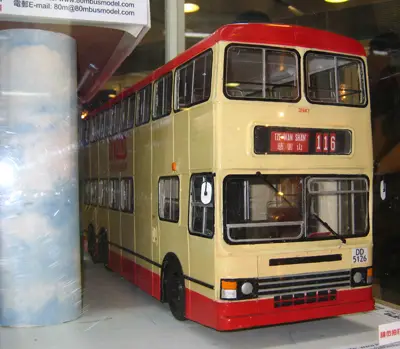
In 1961 Barton Transport commissioned vehicle No. 861, a Loline chassis with lowbridge bodywork, which became the lowest-roofed British double-decker ever built: it was designed to pass under an exceptionally low railway bridge at Sawley Junction, now Long Eaton station. Aldershot & District Traction was the largest operator with 141 buses, followed by North Western Road Car Co. with 50, Reading with 26 and Walsall with 17. Abroad, China Motor Bus in Hong Kong put a single Loline into service in 1963, and it became the first double-decker bus on Hong Kong Island.
Design and features
- Lodekka layout: the low-height body with a dropped rear axle that made the design attractive to operators with low bridges and tight depot roofs.
- Licence production: Dennis could offer a proven Bristol design to customers Bristol was not allowed to supply.
- Front-entrance option: the Loline II and III suited one-man operation and modern loading habits.
- Special lowbridge body: the 1961 Barton vehicle showed how far the chassis could be adapted.
Dennis Loline versions
- Loline (1958–1962): the original rear-entrance version.
- Loline II: front entrance for one-man operation.
- Loline III: revised grille ahead of the radiator, new clutch and constant-mesh gearbox.
- Barton No. 861 (1961): one-off lowbridge body, the lowest British double-decker roof.
The Loline was the last Dennis bus before a long gap in double-deck production, which ended with the Dennis Dominator of 1977. Other Dennis buses in the archive include the Dennis Dart. More are in the Dennis collection.
Video: Dennis Loline III bus ride, Aldershot & District 503
Video on YouTube.
Sources
- Dennis Loline, English Wikipedia: production years, versions, operators, Hong Kong